

Four-minute read
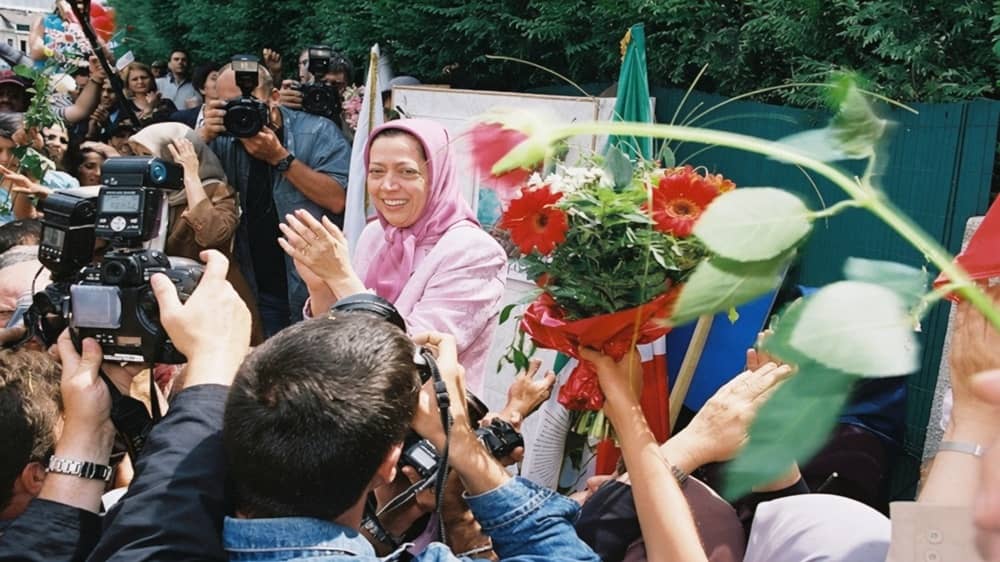
On July 3, 2003, Mrs. Maryam Rajavi stepped out of a French prison, effectively shattering a multinational effort to permanently paralyze the Iranian opposition. Her release did more than just end an unjust, two-week incarceration—it marked the collapse of an elaborate, politically motivated conspiracy designed to dismantle the movement she led as its president-elect. The message broadcast to the world that summer day was unmistakable: the Resistance was not finished. It was not even slowed down.
The June 17 Raid and the Price of Oil
To understand the gravity of that July victory, one must look back to the morning of June 17, when some 1,300 French police officers descended on the headquarters of the National Council of Resistance of Iran in Auvers-sur-Oise. They arrested Mrs. Rajavi along with roughly 160 members. Computers were seized. Bank accounts were frozen.
To uncover the true motive behind the raid, one must follow the money—specifically, to the boardrooms of Total, France’s oil colossus, which at the time was cementing multi-billion-dollar gas contracts with the Islamic Republic over the South Pars field. Tehran had a price for those contracts, and that price was the head of the organized Resistance. French authorities obliged.
What followed was a judicial spectacle dressed in the language of counter-terrorism but engineered in the backrooms of commerce and diplomacy. The charges never held. An investigative exposé later laid bare the political choreography behind the raid: The Élysée, the Quai d’Orsay, and Tehran’s intelligence apparatus had quietly coordinated to decapitate a dissident movement in exchange for petroleum access.
When French courts finally weighed the evidence on its merits, the case collapsed under its own fraudulence. Every single defendant was acquitted.
On This Day | July 3, 2003
On July 3, 2003, NCRI President-elect Mrs. Maryam Rajavi was released from prison after being arrested on June 17 during a raid on the NCRI's headquarters in Auvers-sur-Oise, France.Her release followed an international campaign that included hunger… pic.twitter.com/D2yK6JRj71
— SIMAY AZADI TV (@en_simayazadi) July 3, 2026
A Coordinated Global Siege
But France was not the only stage. In a coordinated campaign that stretched across Western capitals, the NCRI’s offices were raided, its accounts seized, its members surveilled and harassed. The movement’s armed wing, National Liberation Army (NLA) as well as its core member the People’s Mojahedin Organization (PMOI), was placed on terrorist blacklists in the United States, the European Union, and the United Kingdom. These designations later proved to have been driven not by evidence of terrorism, but by the diplomatic appetites of governments courting Tehran. The Resistance was disarmed, besieged, and conspired against by the very democracies whose values it claimed to champion.
And yet.
And yet the NCRI did not fracture. It did not negotiate its dignity. It did not beg. It litigated. It organized. It rebuilt—methodically, relentlessly, institution by institution, court by court, capital by capital.
The legal momentum began in London. The United Kingdom formally removed the PMOI from its proscribed list in 2008 following a landmark appellate court ruling. The European Union followed suit, with the European Court of Justice annulling the bloc’s terrorist designation multiple times before formally delisting the movement in 2009. Finally, the United States—which had originally blacklisted the group in 1997 as a diplomatic goodwill gesture to Tehran’s so-called reformists—formally reversed course and lifted its designation in 2012.
Each delisting was not a gift; it was a legal conquest won against the active resistance of foreign ministries that had persistently pursued appeasement of the regime, even at the cost of sacrificing its victims.
June 17: From Conspiracy to Victory Part 1
Twenty-three years ago, a joint political operation by Tehran and its Western appeasers sought to dismantle the Iranian Resistance.
Instead, it sparked one of the most extraordinary chapters in the Resistance's history.
Part I of our… pic.twitter.com/ArHqs8WZKr— SIMAY AZADI TV (@en_simayazadi) June 27, 2026
Unbowed Leadership and Nuclear Exposure
At the center of this improbable resurrection stands Mrs. Maryam Rajavi—a leader whose defining characteristic is a refusal to submit that borders on the geological. Arrested in 2003, she emerged unbowed on July 3. Smeared by a regime that has executed 120,000 of her movement’s members, she responded by building the largest organized Iranian opposition in exile, staging annual gatherings that draw tens of thousands and hundreds of political dignitaries. Most critically, she is the President-elect of a coalition whose principal member, the People’s Mojahedin Organization of Iran (PMOI/MEK), has rebuilt a clandestine domestic network inside Iran that the regime’s intelligence apparatus, for all its brutality, has been unable to uproot.
It was this network that, since 1991, brought to light what no Western intelligence agency had detected, making 135 distinct revelations that exposed Iran’s hidden nuclear activities—from the secret uranium enrichment facility at Natanz and heavy water reactor at Arak to dozens of other covert sites.
That single disclosure detonated the international nuclear crisis that has defined Middle Eastern geopolitics for a generation. Tehran’s nuclear weapons program—once its hidden trump card—became, thanks to the PMOI’s exposure, its single greatest international liability. The Resistance did not stop there. It exposed the regime’s ballistic missile procurement channels, mapped the IRGC’s proxy networks across the region, and documented human rights atrocities that even the United Nations could not ignore.
July 3, 2003 – A Turning Point for Iran’s Democratic Resistance
Today marks the anniversary of a pivotal moment in the struggle for freedom and democracy in Iran. On July 3, 2003, @Maryam_Rajavi, the President-elect of the National Council of Resistance of #Iran (NCRI), was… pic.twitter.com/TD5OKoY0UZ— Javad Dabiran (@JavadDabiran) July 3, 2025
The Paradox of Power
Here is the paradox that should keep every analyst awake: a theocratic state commanding a military of half a million, a vast multi-agency intelligence service, and proxy armies scattered across four countries remains so terrified of one unarmed opposition movement that it still dispatches its diplomats to lobby Western governments for further suppression. Tehran’s own behavior is the most eloquent testimony to the NCRI’s power. Regimes do not conspire against irrelevancies.
What the story of the NCRI teaches is something that comfortable Western capitals have forgotten: that resolve, when it is genuine, is a force no amount of raiding, blacklisting, or conspiring can extinguish. The French police came for the Iranian opposition in June 2003 hoping to silence it. But as Mrs. Rajavi walked free on July 3, 2003, the tide irrevocably turned. Decades later, it is the regime in Tehran that lives in fear of what she built.