

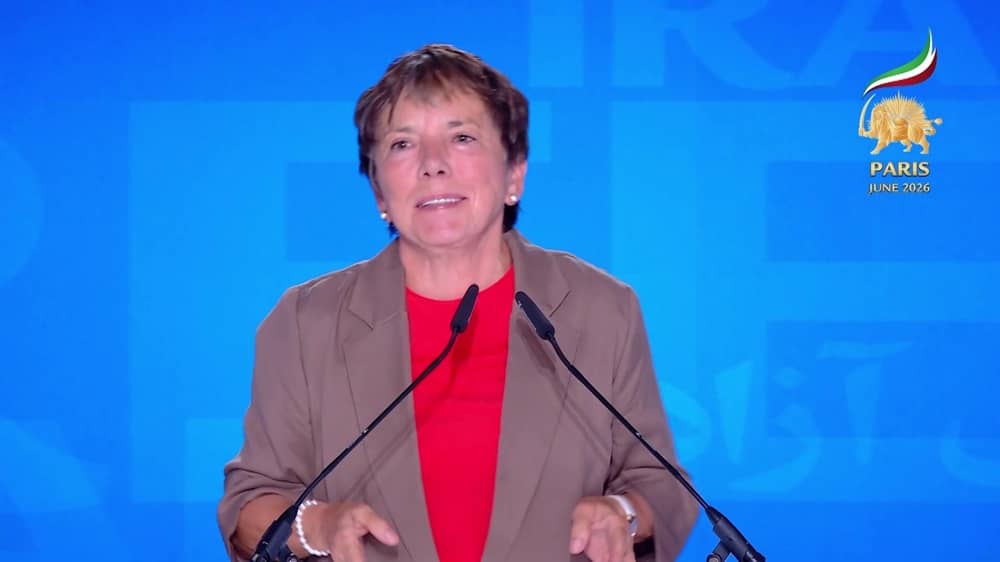

Thank you very much, Madam President-Elect.
I’m glad to be here again.
As one of 30 female and male bishops and rabbis, last week I co-signed a declaration signed by the former Anglican Archbishop Rowan Williams.
As religious dignitaries of Christian and Jewish faiths, we strongly condemn the wave of political executions in Iran and stand up for the rights of religious minorities.
Currently, the problem is that Iran is constantly spoken of as a geopolitical crisis, a nuclear threat, or a regional conflict, but first and foremost, it is about people. It is about women, men, young people, and children.
I am now a grandmother of seven grandchildren, and when I think of the children in Iran who suffer from fear, economic crisis, [and] from the war, then these children are the ones for whom we must stand up.
Wherever people are terrorized by a brutal regime, our religious, humane, and democratic conscience must not remain silent.
The declaration by the religious dignitaries stems from this sense of responsibility; we will not remain silent.
Regarding the oppression of Christians and other religious minorities in Iran: freedom of religion, expression, and belief must be guaranteed, also for people of the Muslim faith who want to practice their faith differently from what is prescribed by the regime.
And that is why the program of the National Council of Resistance of Iran [(NCRI)], which declares the separation of religion and state as well as the freedom of all religions, deserves our support.
It is currently often said that because the Iranian regime has survived the war started by the U.S. and Israel, it has been strengthened.
This analysis wants to tell the people in Iran [and] in the world: there is no hope for change, this regime is here to stay, come to terms with it.
We strongly object to this, because Iranian society has not fallen silent.
The anger, the despair of the families of the executed, the voices of the political prisoners we have seen, [and] the resistance of women and young people send a clear message: this regime has no future.
The war has certainly made the protests more difficult at times, but the will for freedom has not disappeared.
Dr. Margot Käßmann joins 30 global #religious leaders in condemning Iran’s political executions. Citing lessons from history, she argues that faith demands standing against injustice and endorses the NCRI’s Ten-Point Plan for a secular, free, and #democratic Iran. pic.twitter.com/1yHg9lLcjD
— NCRI-FAC (@iran_policy) June 29, 2026
This voice will continue to find its way. It is about resistance against humiliation, against lies, organized death, and a regime that wants to silence people.
And this resistance, as we have seen, reaches even into the prisons, torture chambers, and execution sites. And for that, I have the highest respect and admiration.
In the Christian tradition, and also in the history of my own country, we know of such resistance.
I think of Dietrich Bonhoeffer, who opposed National Socialism with his life, [and] Elisabeth von Thadden, who belonged to the Confessing Church and was executed.
Obviously, faith, real faith, can generate courage—the courage to stand up against injustice, the courage that living faith brings as the courage for the freedom of God’s children.
It is obvious, as all the speakers today have already said, that change must come from within Iranian society itself.
And therefore, I also want to express my solidarity with all those who, despite the terror, stand up for a democratic country.
I am convinced by the Ten-Point Plan of President Maryam Rajavi: separation of state and religion, equality between men and women. It is about people: men, women, and children.
It is about people, and for me, it is also about hope.
People of faith, no matter what faith, hope that God will give them the strength to preserve this hope for a future of justice and peace.
And so, along with everyone else, I hope to be able to meet you again one day in a free, democratic Iran.
Thank you very much.