

Three-minute read
The clerical regime in Iran is experiencing an unprecedented existential tremor. Following the assassination of Supreme Leader Ali Khamenei, a vicious power struggle has erupted within the highest echelons of the state. The fault lines became glaringly public on June 30, 2026, when state television abruptly cut off a pre-recorded broadcast by Parliament Speaker Mohammad-Baqer Ghalibaf mid-sentence. Ghalibaf, the regime’s chief negotiator for a memorandum with the United States, was defended by the parliamentary media center which blasted the state broadcaster for unauthorized censorship.
This media war exposes a deep structural schism over the regime’s survival strategies. Hardline factions loyal to Mojtaba Khamenei are fiercely resisting diplomatic concessions. On June 29, 2026, hardline MP Mahmoud Nabaviyan openly condemned the diplomatic team, stating, “The expediency that officials recognize but the Supreme Leader has a different opinion on is not expediency, it is pure corruption”. Presidential deputy Mohammad-Jafar Ghaempanah struck back against these vetoes, telling state media on June 30, 2026, “If only the Leader’s opinion is to be implemented, then the Parliament and the Supreme National Security Council make no sense”.
The regime’s paralysis is further highlighted by public humiliation of its top officials. Foreign Minister Abbas Araghchi was met with chants of “Death to the compromiser!” by hardline Iranian pilgrims in Karbala. State-aligned publications are sounding the alarm; the IRGC-affiliated Javan newspaper warned on June 30, 2026, that “if this agreement fails, the entire nation will pay the cost”. This structural unraveling ensures the regime cannot present a unified front to suppress public dissent.
"The regime is weaker than at any point in its history — its founder dead, his successor repudiated, its proxies degraded, its #economy in ruins, its streets seething with a generation that has nothing to lose. For four decades, Western capitals bet on every alternative to the…
— NCRI-FAC (@iran_policy) June 30, 2026
Socio-Economic and Ecological Collapse
While elites squabble, the Iranian public faces unlivable conditions surpassing the triggers of the January 2026 unrest. A catastrophic crisis is ravaging healthcare. According to a report by the state-run Donya-e-Eqtesad newspaper, hyperinflation and currency shortages have driven medical costs to astronomical heights. The paper reported that a single course of chemotherapy has skyrocketed from 7 million tomans two years ago to nearly 70 million tomans in mid-2026. Central Bank data confirms this, recording a monthly healthcare inflation rate of 23.1% in May 2026.
Simultaneously, decades of systemic corruption and environmental neglect are sparking intense localized revolts. An Energy Institute report revealed that Iran’s greenhouse gas emissions spiked past one billion tons in 2025—a 31% surge over the last decade—making it the world’s fifth-largest polluter. This translates to acute resource shortages. In late June 2026, citizens in Garmsar launched protests along the vital Tehran-North railway line over stolen water rights, issuing an ultimatum: “We are not joking with anyone over water; the transit road and the Mashhad railway line will be blocked”.
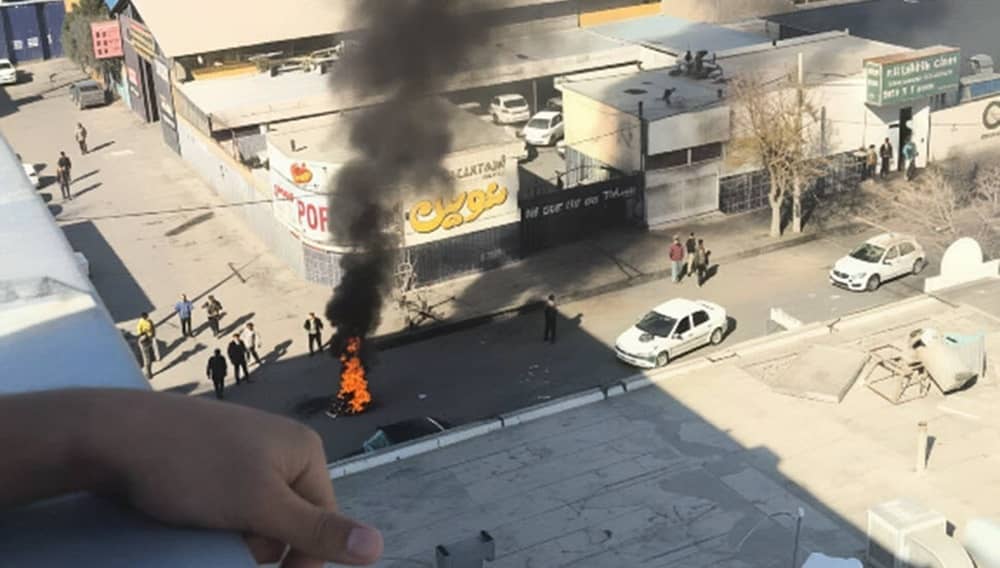
This public fury is widespread. Throughout late June 2026, telecommunication retirees marched across Tehran, Gilan, and Kurdistan, chanting “We don’t want an incompetent government!” as they protested the plundering of their pensions by IRGC-controlled foundations. From striking healthcare staff in Tabriz to student bodies demonstrating against forced in-person examinations in Karaj, every sector of Iranian society is in open defiance, uniformly identifying the ruling elite as the sole author of their misery.
"The Iranian political establishment is experiencing unprecedented institutional friction following the transition of authority to Mojtaba Khamenei," writes @MansoreGolestan.https://t.co/6UZCU4cjdx
— NCRI-FAC (@iran_policy) June 30, 2026
The Match that Ignites the Powder Keg
What makes the impending crisis far more volatile than the January 2026 uprising is the rapid radicalization of resistance from below. Armed attacks against regime forces are surging. On June 28, 2026, a newly emerged Kurdish group executed a targeted armed raid in Paveh, killing two IRGC operatives. The group stated the attack was retribution for the officers’ brutal roles in suppressing the 2022 democratic protests. The state-run Mehr News Agency confirmed the deaths on June 29, 2026, alongside another fatal armed ambush targeting an IRGC intelligence officer in Saravan.
The state’s judicial apparatus has completely lost its deterrent effect. Citizens are witnessing total state failure even in emergency management, such as the tragic death of volunteer firefighter Taghi Changalvayi in Behbahan, who succumbed to forest fire burns on June 27, 2026, after a rescue helicopter was delayed for over four hours due to bureaucratic incompetence. As legal and peaceful avenues for reform are entirely obliterated, the population increasingly views radical confrontation as the only viable path forward.
The convergence of an elite succession crisis, hyperinflation, environmental collapse, and rising armed pushback indicates that Iran is on the precipice of a definitive explosion. The upcoming uprising will seek the total overthrow of the clerical dictatorship. Backed by a growing domestic network aligning with the democratic Iranian Resistance, the Iranian street is poised to launch a wave of resistance far more coordinated, radical, and unyielding than anything the regime has faced before.