

Three-minute read
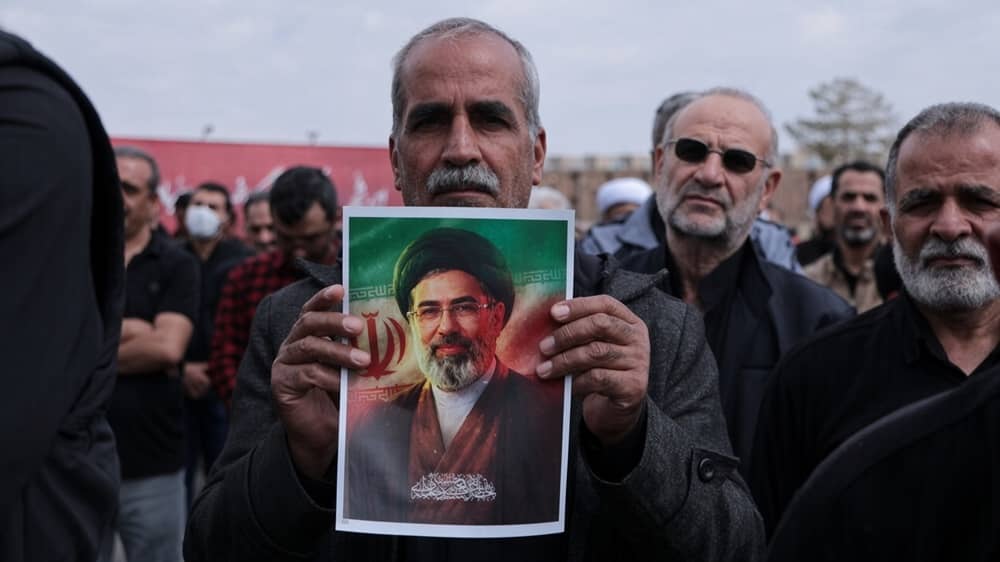
The shadow of the late Ali Khamenei still looms heavily over Tehran, but it is the invisible, ghostly presence of his son that now paralyzes the Iranian state. Elevated to the ultimate seat of power in the chaotic aftermath of his father’s assassination, Supreme Leader Mojtaba Khamenei is a man defined—and increasingly trapped—by the war that crowned him.
For a regime that has spent nearly half a century justifying its existence on the overthrow of a hereditary monarchy, the installation of a son to succeed his father shatters its most foundational ideological myth. Mojtaba was not thrust into power by consensus, but by the apocalyptic emergency of a devastating external conflict. Now, as the war grinds on and the country buckles under the weight of historic droughts, blackouts, and military strikes, the fierce internal debate over whether to continue fighting or sue for peace has become a proxy battle for Mojtaba’s political survival.
The outlet attached to Khamenei’s own office declared in editorial No. 371 that “the logic and nature of the war not ending must be considered as a key principle in all affairs of the country,” with every domain—economic, media, executive, social, and political—evaluated under “this grand idea, namely the continuation of the war”. Six weeks later, editorial No. 410 promised the Strait of Hormuz “will never return to the situation before the 40-day war”. Hossein Shariatmadari, the leader’s own appointee at Kayhan, demanded to know “why, and with what logical justification, are we supposed to lose this lever?” He dismissed the emerging arrangement with Oman as “worthless,” insisting officials “must not retreat from any bottleneck.”
Power Dynamics in Iran and #MojtabaKhamenei’s Inner Circlehttps://t.co/eTfcnFH14Z
— NCRI-FAC (@iran_policy) June 3, 2026
They are not merely defending a waterway; they are defending the leader’s title deed. Strip out the toll booth at Hormuz, the wartime powers, and the “combined war” alibi for unprecedented executions, mass arrests, and what remains is a mid-ranking cleric with no elected office, no public voice, and an office nobody trusts.
Yet continuation is no safer. Listen to the president the new leader inherited. Masoud Pezeshkian, in an unprecedented interview recorded by his own office and handed to state television on August 5 and 6, described “the hardest possible time in history after the revolution”: sanctions tightened, banks cut off, ports blockaded, an unprecedented drought, and a feared winter without power or gas. On attempts to adjust fuel and utility prices, he complained that “whenever you want to touch them, they say don’t touch them now”. “So when should we touch them?” he asked.
Note what else Pezeshkian volunteered on camera: while he could always go to Ali Khamenei who “supported us with all his might”, he bluntly stated that “contacting the leadership is now very difficult”. The president cannot reach his own leader—and says so on state television.
#Khamenei’s Succession Strategy: Using Palizdar’s “Corruption Revelations” to Legitimize Mojtaba’s Rise in #Iranhttps://t.co/gRTISVcuWD
— NCRI-FAC (@iran_policy) November 11, 2024
And the claimants are already circling. Hassan Rouhani, speaking to his former ministers on August 5, did something more audacious than criticizing policy: he attacked the underlying doctrine. Citing Ruhollah Khomeini’s 1989 letter to the constitutional revision council, he insisted the leader becomes “the elected guardian of the people” through the Assembly’s votes, and only then does “his ruling become binding”. Rouhani added that on continuing or ending the war, “the main decision-maker is the great nation of Iran”. From a man who spent sixteen years as national security council secretary, that is a bid, not a lecture. He also filed the charge sheet in advance, warning of “sanctions merchants” who “might be happy that the war and chaos continue”.
Meanwhile, Mohammad-Baqer Kharrazi, boasting of forty years of private meetings with Mojtaba, tells audiences the new leader’s approaches are “much harsher” than his father’s. He claimed Mojtaba was once “expelled from the office for three years” and that the supreme leader’s office itself is “corrupt”. Kharrazi further warned that Pezeshkian’s government “will not reach its end” and that 250,000 men await a single communiqué to march on Tehran. When the leader’s office called one of his claims entirely false, Kharrazi accepted the denial “provisionally,” pointedly hoping the denial survives “the important coming changes”. He even alleged that without Mojtaba, the leadership office “was moving toward Sadeq Larijani.” Even staunch loyalists are bargaining over the leader’s signature now.
Who Is Mojtaba Khamenei: The Iranian Regime’s Last Supreme Leader and Its Hereditary Gamble https://t.co/LwqnQZwdk7 @seanhannity @hughhewitt @marklevinshow
— Ali Safavi (@amsafavi) March 9, 2026
A leader who merely ratifies is a leader who can be replaced by another ratifier. Peace would retire the emergency that crowned him; war keeps grinding the economy that could bury him. Rouhani, ambitious functionaries, and every rival faction read that arithmetic as clearly as we do.
An invisible leader whose authority is borrowed from a war he cannot win and dare not end is not the strongman the regime advertises. He is the regime’s most fragile institution.