

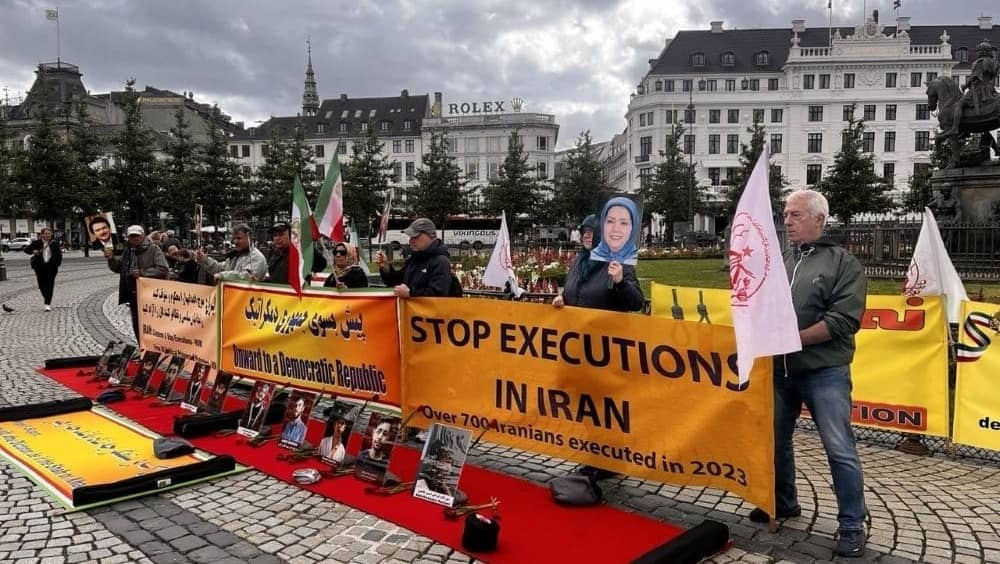
A highly coordinated wave of international protests and human rights exhibitions expanded across major European and American cities over the course of one week, from June 27 to July 4, 2026, marking a significant escalation in the global campaign against the Iranian regime’s intensifying use of capital punishment. Triggered by the brutal crackdown and subsequent executions following the January 2026 popular uprising, these diasporic actions underscore a deepening political crisis for the theocracy in Tehran. From continuous embassy sit-ins to demonstrations outside legislative bodies, freedom-loving Iranians and supporters of the National Council of Resistance of Iran (NCRI) are demonstrating a highly organized resistance. The operations covered in this week-long report reject both the current religious autocracy and a return to monarchy, demanding instead a secular, democratic republic.
July 4, 2026
The global campaign achieved significant momentum with simultaneous anti-execution initiatives across Europe. In Switzerland, an exhibition and book table targeting the criminal executions ordered by Supreme Leader Ali Khamenei highlighted local solidarity in Lugano. Concurrently, supporters of the Iranian Resistance in Paris organized a public book stand to channel international support toward the ongoing nationwide uprising. In Germany, activists in Heidelberg held a rally and photo exhibition dedicated to the political prisoners and protesters arrested during the January 2026 demonstrations. The organizers focused heavily on the Iranian people’s demand for a democratic republic, urging the German public to recognize the systemic human rights abuses perpetrated by the clerical regime.
1-July 4, 2026 – MEK supporters in Heidelberg rallied against executions in Iran, calling for a democratic republic.#StopExecutionsInIran #No2ShahNo2Mullahs #NCRIAlternative pic.twitter.com/FbitKRSJOH
— Iran Freedom (@4FreedominIran) July 5, 2026
July 3, 2026
The momentum carried into Scandinavia as supporters of the opposition movement staged a defiant rally in Copenhagen. Protesters gathered to strongly condemn the ongoing executions of political dissidents and called for immediate international intervention to halt death sentences. The rally served as a platform to articulate a clear political alternative, rejecting both theocratic and monarchical dictatorships in favor of popular sovereignty and democratic governance. Activists urged European governments to abandon the traditional policy of appeasement and increase diplomatic pressure on Tehran.
July 2, 2026
In the United Kingdom, coordinated human rights campaigns targeted major urban centers to expose the escalating wave of repression in Iran. Members of the Academics in Exile Association joined forces with activists in Manchester to establish an informational book table and photographic display documenting the regime’s internal crises. A parallel effort took place in London, where organizers held an exhibition to commemorate the martyrs of the January 2026 uprising. The participants emphasized the critical risk faced by current detainees facing imminent execution, using personal testimonies and publications to pressure the British government to officially designate the Islamic Revolutionary Guard Corps (IRGC) as a terrorist organization.
On 2nd July 2026, supporters in Manchester held a book table and photo exhibition to raise awareness of the Iranian regime's escalating executions and ongoing human rights violations. The event expressed solidarity with the Iranian people's aspirations for freedom, democracy, and… pic.twitter.com/anRDBKVunh
— Academics In Exile Association (@iranianacademic) July 4, 2026
July 1, 2026
Public awareness campaigns continued to expand across France and Germany. In Paris, activists set up an extensive photo exhibition detailing the courage and sacrifices of front-line Iranian protesters, drawing attention from the French public. Meanwhile, in Berlin, the continuous sit-in protest directly outside the Iranian regime’s embassy reached its 120th consecutive day. Demonstrators openly denounced the diplomatic compound as an active headquarters for state-sponsored espionage and terrorism, chanting defiant slogans proclaiming that the collapse of the clerical dictatorship is inevitable through the efforts of the domestic Resistance Units.
June 30, 2026
A global mobilization marked the final day of June, driven largely by the expanding momentum of the “No to Execution Tuesdays” campaign. In Paris, supporters gathered in front of the National Assembly to coincide directly with the 9th World Congress Against the Death Penalty, effectively amplifying the voices of condemned prisoners before an international legislative audience. In Berlin, the ongoing anti-regime sit-in marked its 119th day of continuous protest outside the embassy gates. In Zurich, freedom-loving Iranians organized a book table and photo exhibition to voice their solidarity with hunger-striking prisoners and demand the immediate release of all political detainees. Across the Atlantic, the Iranian-American community rallied in Irvine, where they displayed photographs honoring the victims of the recent uprisings and reaffirmed their commitment to a secular, democratic republic. Simultaneously, a major rally in Gothenburg marked both the 126th and 127th consecutive weeks of the “No to Execution Tuesdays” movement. The demonstrators warned that the authorities are utilizing mass executions and nationwide internet shutdowns to suppress dissent, calling for urgent global action to protect those on death row.
1-Paris – July 4, 2026: PMOI supporters organized a book table and photo exhibition condemning executions in Iran, rejecting all forms of dictatorship and calling for a democratic republic. #StopExecutionsInIran #NCRIAlternative #No2ShahNo2Mullahs pic.twitter.com/lP0gagiZtG
— Iran Freedom (@4FreedominIran) July 5, 2026
June 27, 2026
An earlier wave of coordinated actions established the framework for the week’s intense protests. In Gothenburg, protesters organized a rally demanding the immediate closure of the Iranian regime’s embassy in Sweden, condemning it as an operational outpost for terrorism and espionage. The participants emphasized that any legitimate transition must be rooted in democratic principles rather than a return to authoritarian pasts. Concurrently, a book stand and photographic exhibition were set up in Paris to protest the systemic executions of political prisoners and to forcefully criticize the ongoing Western policy of appeasement toward the mullahs’ regime.
The synchronized and unyielding global demonstrations observed over the past week underscore a profound structural deadlock within the Iranian regime. Despite its intensive use of state terror, sweeping internet blackouts, and an escalating wave of executions designed to suppress the societal shockwaves of the January 2026 uprising, the clerical dictatorship’s strategy has fundamentally backfired. Rather than absolute containment or societal subjugation, the regime’s reliance on violence has only galvanized the organized domestic resistance and unified the international diaspora. These sustained global actions expose the fragile reality beneath Tehran’s projected image of invincibility, demonstrating that neither mass hangings nor diplomatic maneuvers can extinguish the growing momentum for an organized, democratic alternative.