

THIS PAGE WILL BE UPDATED WITH THE LATEST NEWS
UPDATE: 7:30 PM CEST
Baghdad Rejects Iranian ‘Protection’ for Suspects Placed on Corruption Lists

The Iraqi government has rejected Iranian requests to exempt individuals facing judicial arrest warrants as part of corruption investigations and has urged Tehran to use official diplomatic channels to arrange visits by Iranian officials who have “customarily held secret meetings” in Baghdad, according to two informed sources on Sunday.
The developments followed what was described as a “secret” visit by Esmail Qaani, commander of the Quds Force, shortly after an official visit by Iranian Foreign Minister Abbas Araghchi, who met Iraqi Prime Minister Ali al-Zaidi on June 28.
One source said Qaani arrived in Baghdad a few days after Araghchi’s visit without any public announcement. It is believed to have been his first trip to Iraq since al-Zaidi took office on May 14.
As Iranian influence in Baghdad has expanded over the years, reports of undeclared visits by senior officials from the Iranian Revolutionary Guard Corps (IRGC) have become frequent, although many were never officially confirmed and some could not be independently verified.
Iraq Declares Iran’s Qaani Persona Non Grata Ahead of PM’s US Visit

Baghdad (IraqiNews.com) – A report published by the French international broadcaster Monte Carlo has detailed a major diplomatic escalation between Baghdad and Tehran regarding the upcoming funeral arrangements for the late Iranian Supreme Leader Ali Khamenei in the holy cities of Najaf and Karbala.
According to internal political sources originating from the Construction and Development Coalition led by former Prime Minister Mohammed Shia al-Sudani, the Iraqi government has officially designated the Commander of Iran’s Quds Force, Esmail Qaani, as persona non grata.
This high-stakes diplomatic maneuvering unfolds alongside leaked details from Baghdad political circles concerning a heated confrontation that transpired between Prime Minister Ali Falih al-Zaidi and Iranian Foreign Minister Abbas Araghchi during the latter’s recent visit to the capital.
The friction intensified significantly during meetings held to finalize the logistical program for the late Supreme Leader’s funeral procession, resulting in the total cancellation of any funeral ceremonies within Baghdad to mitigate political friction with the United States.
UPDATE: 11:30 AM CEST
19 On Trial Over Iran Terror Plot

A trial of 19 defendants, accused of allegedly establishing and managing a terrorist organisation, began at the High Criminal Court yesterday.
According to the Public Prosecution, the group was formed with the aim of calling for the suspension of the provisions of the Constitution and the law, preventing state institutions and authorities from carrying out their duties, undermining national unity, and seeking to alter the nation’s constitutional system and to remove its state authorities.
The defendants allegedly sought to promote and entrench the ideology of Wilayat Al Faqih, as an extension of the Iranian Revolution, advocating for complete allegiance to the Supreme Leader of the Islamic Republic of Iran and subordination to its political authority.
The Terrorism Prosecution claimed that the defendants pursued their aims by seeking control over places of worship like ma’atams (community centres), exploiting them to disseminate that ideology.
Old Wounds Reopened by Former Iranian Crown Prince’s Visit to the Dutch House of Representatives

Whenever members of the association Young Iranian Netherlands demonstrate, they chant a familiar slogan: “No shah, no mullah.” They want to end the religious dictatorship of the mullahs (clerics) in Iran, but they also reject a return to the authoritarian monarchy that was overthrown during the 1979 Islamic Revolution.
“My father was imprisoned for five years under the Shah’s rule because of his political activities,” says Sepiedeh Orafa (31), the association’s chairwoman. “Years later, I saw the torture scars on his legs for the first time. I was three years old when I asked what they were—three years old when I had to learn what torture means. This is the story of many Iranian Dutch people.”
According to Orafa, these are wounds that are being reopened by Reza Pahlavi’s visit to the Dutch House of Representatives on Monday. Pahlavi, 65, is the former Crown Prince of Iran and the son of the deposed Shah.
“Pahlavi has never distanced himself from his family’s past; on the contrary, he uses every interview as an opportunity to express his pride in it,” Orafa says.
In an interview with the Swedish public broadcaster SVT in April, Pahlavi was asked whether his family background undermines his role as the leading figure of a united Iranian opposition. He replied that he is proud of his heritage, his family’s history, and “everything they have done.”
UPDATE: 7:30 AM CEST
How PMOI Resistance Units in Zahedan Are Channeling Economic Collapse into a Democratic Revolution
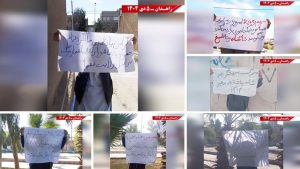
On July 3, the PMOI/MEK Resistance Units in Zahedan, southeast Iran, resumed their weekly activities, boldly defying the regime’s apparatus of repression. In public spaces across the city, these courageous activists held placards with messages of resistance, demonstrating that the organized resistance remains the vanguard for democratic change in Iran. They issued a direct call to students and educators, stating: “To the students: the only way to achieve your demands is solidarity, continuity, and the expansion of protests.”
The Resistance Units are directly addressing the regime’s systemic economic failures, transforming the daily struggle for survival into a rallying cry for the regime’s overthrow. Placards in Zahedan declared that “the stolen bread and water of our enchained nation must be turned into a hail of fire and fury to bring this regime down.” They noted that skyrocketing bread prices are “utterly intolerable.”
This resonates deeply with the current reality in Iran. According to state-affiliated media, the official minimum monthly wage for 2026 was set at approximately 166 million rials, while the minimum cost of living exceeds 450 million rials. Families are surviving on bread, cheese, eggs, and tomatoes, yet bread prices have seen an inflation rate exceeding 140 percent. The Resistance Units highlighted the root cause: “The plundering mullahs steal even the water in order to fund suppression and anti-patriotic nuclear, missile, and foreign warmongering projects.” State-affiliated voices acknowledge that this economic devastation has evolved into a political crisis of governance.
June 2026 Report: Working Iranian Women Erased from Labor Market

June 2026 Report: Behind macroeconomic indicators and the dry labor market statistics lies the painful reality of millions of creative, educated, and hopeful women. Their fundamental right to an independent professional identity and financial autonomy has been plundered by the fundamentalist laws of the ruling clerics.
The reigning religious fascism has transformed the right to employment from a basic human right into a tool of oppression. This misogynistic regime deliberately seeks to purge women from public and professional life by forcefully confining the active female population to the domestic sphere. The latest official data lays bare the systematic erasure of working Iranian women, trapped in the crushing grip of poverty and soaring inflation.
The national economic participation rate has plummeted below 40 percent in 2026, marking its lowest level in a decade. (ILNA, June 27, 2026)
With this unprecedented collapse, Iran now ranks among the countries with the lowest participation rates globally. Sixty-one percent of the working-age population effectively plays no role in the gross domestic product, placing the burden of their livelihood on the shoulders of the employed minority.
However, the true catastrophe lies behind the regime’s superficial 7.5 percent unemployment rate—a disaster that media outlets have labeled the “story of silent despair.” (Zoomon, June 30, 2026)
New Reports Expose Systematic Torture and Abuse Inside Iran’s Dastgerd Prison
Fresh reports from Dastgerd Prison in Isfahan paint a disturbing picture of systematic torture, degrading treatment, and widespread human rights violations against prisoners—particularly political detainees and those held on security-related charges.
Physical violence, psychological abuse, prolonged solitary confinement, denial of medical care, and severe restrictions on basic rights have become routine features of prison life. Rather than isolated incidents, these practices appear to constitute an institutionalized system designed to intimidate, punish, and silence dissent.
The allegations add to a growing body of evidence documenting the Iranian regime’s treatment of political prisoners, particularly in the aftermath of the nationwide protests that have led to mass arrests across the country.
The solitary confinement wards at Dastgerd Prison are staffed by specially selected personnel trained to manage these high-security units. Former prisoners and informed sources describe the guards as routinely employing violence, humiliation, and intimidation, with political prisoners facing the harshest treatment.
Prisoners are reportedly beaten for the slightest perceived infraction, including filing legal complaints or protesting prison conditions.
Iran Regime’s Deepening Internal Power Struggle Signals a System in Decline
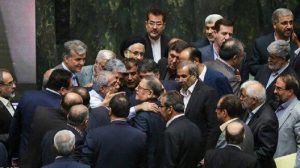
For decades, the Iranian regime has relied on a carefully managed balance between competing power centers, with the Supreme Leader serving as the final arbiter capable of containing factional conflict. That model is now showing visible signs of breakdown.
Today, the convergence of several crises—the unresolved dilemma between confrontation and negotiations with the international community, the aftermath of military conflict, mounting economic hardship, and an increasingly alienated population—is pushing the regime into one of its most dangerous periods since its establishment. Rather than presenting a united front, its rival factions are openly accusing one another of betrayal, incompetence, and even conspiracy.
The result is a political system increasingly consumed by internal conflict at precisely the moment it faces unprecedented pressure from society.
A defining feature of the current period is the weakening ability of the Supreme Leader to impose unquestioned authority across the regime’s competing factions.
Whether because of succession concerns, declining legitimacy, or growing institutional fragmentation, rival centers of power appear increasingly willing to challenge each other publicly rather than settling disputes behind closed doors. Political competition is no longer confined to differences over policy; it has become a struggle over control of the regime itself—and over the enormous political and economic privileges attached to it.
Khamenei’s Burial Becomes Stage for Power Struggles Among Regime Factions
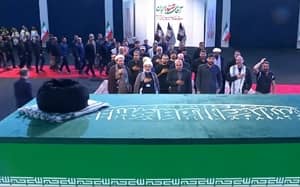
On the second day of the funeral ceremonies for former regime supreme leader Ali Khamenei, the event became a venue exposing divisions and internal rivalries among power factions within the Iranian regime. Contradictory slogans, warning placards, and open displays of support for certain regime figures reflected the intensifying power struggle at the highest levels of the regime following Khamenei’s death.
During the July 4 ceremony, participants repeatedly chanted slogans including “Revenge, revenge,” “Death to the infiltrator,” “Death to the compromiser,” and “This is the final message, negotiations are forbidden,” expressing their opposition to the regime’s current negotiations with the U.S. over Tehran’s nuclear program.
Alongside these chants, some attendees repeatedly shouted “Labbaik, Seyyed Mojtaba,” a slogan indicating efforts by certain regime factions to express support for Khamenei’s son, who was appointed as the new supreme leader.
New Uncertainty Surrounding Iran’s Underground Nuclear Facilities

According to the latest assessment by the U.S.-based Institute for Science and International Security (ISIS), headed by nuclear expert David Albright, satellite imagery of the Iranian regime’s nuclear facilities indicates that uranium enrichment activities have not resumed at the three main sites of Natanz, Fordow, and Isfahan. At the same time, however, signs of ongoing construction work and vehicle traffic have been observed at the underground Kolang Gaz La mountain facility near Natanz, a site whose exact purpose remains unclear.
The facility, Pickaxe Mountain (or Kuh-e Kolang Gaz La), is located south of the Natanz complex. According to the Albright Institute’s report, it remains accessible, open, and under construction. However, the institute emphasized that there is currently no indication that it is ready for operational use.
At Natanz, satellite imagery shows that large sections of the complex remain devastated, with no significant repair work observed at the main entrances or in areas associated with uranium enrichment. The electrical infrastructure and industrial systems also remain damaged, and according to the institute, there is no indication that enrichment operations are being restored at the site.
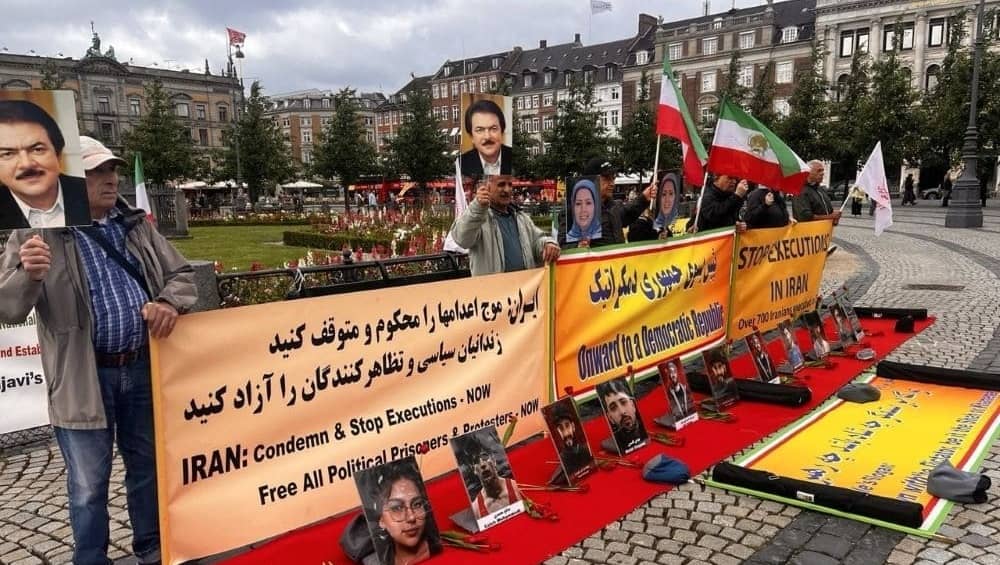
PMOI Supporters Rally in Copenhagen Against Executions, Call for a Democratic Republic in Iran
Copenhagen, Denmark – July 3, 2026 – Supporters of the People’s Mojahedin Organization of Iran (PMOI/MEK) held a rally to protest the execution of PMOI political prisoners, as well as protesters arrested during the January 2026 uprising.

Organizers called on the international community to increase pressure on the Iranian regime to end executions and reaffirmed their support for a democratic republic for Iran. The rally rejects both monarchical and theocratic dictatorships, emphasizing a third alternative rooted in democracy and popular sovereignty.
Heidelberg Rally Denounces Iran’s Executions, Supports Democratic Alternative
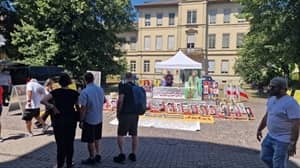
Heidelberg, Germany – July 4, 2026 – Supporters of the People’s Mojahedin Organization of Iran (PMOI/MEK) held a rally and exhibition to protest the execution of PMOI political prisoners, as well as protesters arrested in January 2026. The event also expressed solidarity with the “No to Execution” campaign.
The event emphasized the Iranian people’s demand for a democratic republic led by the Iranian Resistance as a path toward peace and freedom.
Organizers called on the German public and the international community to recognize the suffering of the Iranian people and their firm rejection of all forms of dictatorship—whether monarchical or theocratic. Through powerful images and personal testimonies, the exhibition showcased the courage and sacrifices of Iranian protesters during the 2026 Iran protests, while strongly condemning ongoing human rights violations, including the execution of political prisoners.