

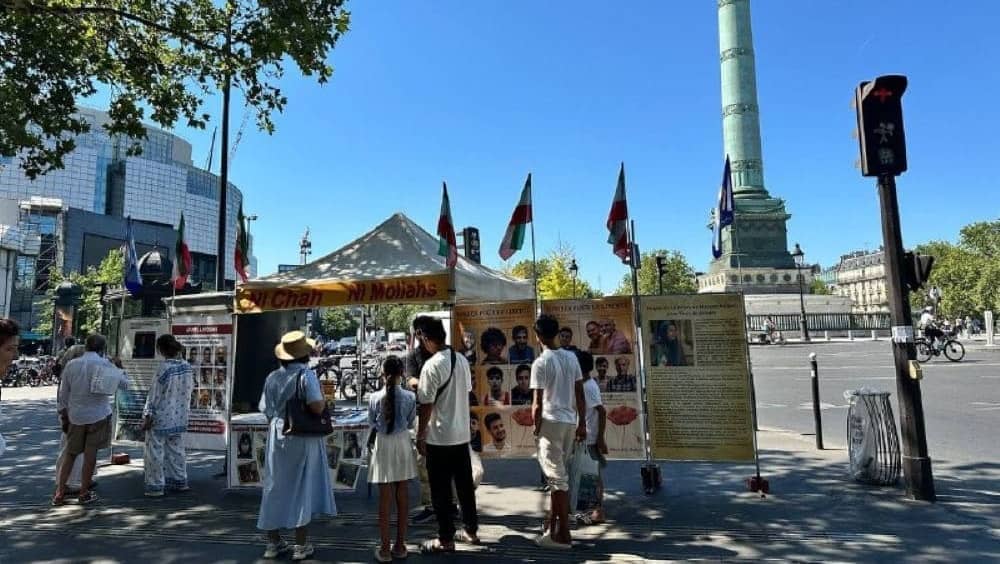
THIS PAGE WILL BE UPDATED WITH THE LATEST NEWS
UPDATE: 8:30 AM CEST
Condolences on the Passing of Reza Olia, a Master of Art and Resistance for Freedom in Iran

The master painter and sculptor, Mr. Reza Olia—a committed Iranian artist and member of the National Council of Resistance of Iran (NCRI), who seamlessly intertwined his art with a steadfast and unyielding struggle for freedom and justice—has left us.
I pay tribute to this noble figure, who was a loyal companion and steadfast ally of the National Council of Resistance from its very first weeks, consistently defending its positions and remaining a sincere, devoted supporter of the NCRI Chairman.
I offer my deepest condolences on the profoundly lamented passing of this eminent master of art and resistance to the NCRI Chair, NCRI members, and the community of Iran’s freedom-loving and committed artists. Indeed, he was an extraordinary and exemplary figure among resistance artists, whose name will eternally endure in the history of Iranian art.
Reza Olia’s steadfast commitment to his principles and his unwavering adherence to the red lines of the Iranian people’s democratic revolution against both the Shah and the Mullahs were renowned among the members, allies, and supporters of the Iranian Resistance, and a source of profound pride. In this regard, he was truly a master and a mentor for the younger generation of artists.
Defying the Dictator’s Heir: Zahedan Resistance Units Expose the Regime’s Frailty Following Khamenei’s Death
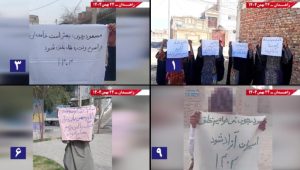
On July 10, PMOI/MEK Resistance Units in Zahedan, southeast Iran, continued their weekly campaigns of defiance against the clerical regime. In their public activities, the activists displayed placards rejecting all forms of dictatorship and reaffirming their unwavering commitment to overthrowing the mullahs’ regime. Taking great risks, they held up messages declaring, “Down with the bloodthirsty tyrant ‘King’ Mojtaba! Damnation upon the bloodthirsty Khomeini and the despotic Khamenei!”
In the wake of Ali Khamenei’s death, the Resistance Units aimed their messages squarely at the regime’s desperate attempts to project power. Activists in Zahedan held a placard reading: “Khamenei’s funeral is a desperate, large-scale political and security farce designed to preserve the regime, force through the hereditary and artificial succession of ‘King’ Mojtaba Khamenei, and terrorize any rival factions.”
The reality on the ground during the highly militarized funeral confirmed this assertion. State-organized crowds were an illusion built on coercion. On July 6, 2026, reports indicated that over 70 percent of attendees were forced to participate under threats of job termination or the severing of vital financial aid from state welfare organizations. While the regime desperately tried to mask its vulnerabilities, the newly installed supreme leader, Mojtaba Khamenei, was entirely absent from the public ceremonies, reportedly hiding due to injuries and fear of assassination.
Iran: Continued Ban on Phone Calls for Political Prisoners in Evin
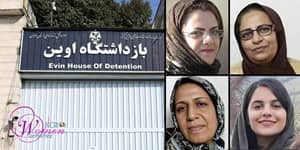
Fresh reports from Evin Prison indicate that four female political prisoners, Shiva Esmaeili, Marzieh Farsi, Forough Taghipour, and Zahra Safaei, continue to be subjected to a ban on phone calls with their families. At the same time, informed sources have reported the deteriorating health of Shiva Esmaeili and Elaheh Fouladi, as well as inadequate medical facilities and poor nutritional conditions for women prisoners.
In early May, reports revealed that five political prisoners, Golrokh Iraee, Zahra Safaei, Marzieh Farsi, Shiva Esmaeili, and Sakineh Parvaneh, were subjected to a disciplinary ban on phone calls. Evin Prison authorities invalidated their phone cards, preventing them from contacting their families.
The measure was imposed after the prisoners participated in the “No to Execution Tuesdays” campaign and chanted slogans protesting the implementation of execution sentences.
Although the phone restrictions have since been lifted for some of the prisoners, Shiva Esmaeili, Marzieh Farsi, Forough Taghipour, and Zahra Safaei remain deprived of the right to telephone contact with their families.
Iran Regime Defies Nuclear Oversight While Rebuilding Sensitive Facility

The Iranian regime has intensified international concerns over its nuclear activities by refusing to allow inspectors from the International Atomic Energy Agency (IAEA) access to its nuclear facilities while simultaneously undertaking reconstruction work at a sensitive military site linked to its nuclear program.
The developments reinforce long-standing fears that Tehran continues to pursue nuclear capabilities behind a veil of secrecy, despite repeated international demands for transparency and accountability. Following a United Nations Security Council meeting on Friday, the Iranian regime reaffirmed that it would not permit IAEA inspectors to visit its nuclear facilities.
The meeting, requested by Bahrain and several European countries, focused on the deteriorating state of international monitoring after months of escalating regional tensions.
In its latest assessment, the IAEA reported a “significant deterioration” in its knowledge of Iran’s nuclear activities, stating that it has effectively lost continuity of information regarding all of Tehran’s declared nuclear facilities.
Resistance Units Defy Security Crackdown with Nationwide Operations During Khamenei Funeral
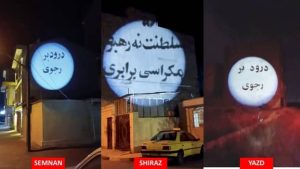
While the Iranian regime sought to transform the funeral and burial of Ali Khamenei into a carefully choreographed display of religious legitimacy, Resistance Units responded with one of their broadest coordinated waves of anti-regime operations in recent months.
The regime buried Khamenei within the shrine of Imam Reza in Mashhad—a decision widely viewed by opponents as an attempt to associate the late Supreme Leader with one of Shiite Islam’s holiest figures and reinforce the regime’s religious narrative at a time of unprecedented political weakness.
Instead of projecting unity, however, the ceremony was met with acts of defiance across the country.
Despite an extensive security deployment, heightened surveillance, and the mobilization of intelligence and security forces, Resistance Units carried out dozens of operations targeting symbols of the regime, demonstrating that opposition activity continues even under the most restrictive conditions.
U.S. Officials Call for Iran’s Regime to Publicly Declare an End to Attacks on Ships in Strait of Hormuz

Reuters reported that senior U.S. officials said on Friday, July 10, that Washington has asked Iran’s regime to formally and publicly commit to ending attacks on ships in the Strait of Hormuz and to ensure that all shipping lanes through the international waterway remain open to vessels without tolls or restrictions.
Speaking to a group of reporters during a conference call, the officials described the recent talks between the two sides as constructive. One U.S. official said: “What we’re demanding is that the Iranians issue a public statement that acknowledges all channels of the Strait of Hormuz are open and they’re not shooting at ships anymore. They’re either going to give us that statement or we’re not having a good outcome for them.”
Another senior U.S. official said that Iran’s regime had informed Washington that the recent attacks on ships in the Strait of Hormuz were carried out by “an errant part of their system.”
Another U.S. official also claimed that a power struggle is underway within Iran’s ruling establishment between hardline and pragmatic factions, and that these internal divisions have affected decision-making.
The remarks came after attacks on three ships earlier this week prompted U.S. President Donald Trump to order military strikes against targets in Iran and declare that the ceasefire established between the two countries in June had come to an end.
Sharp Increase in Bread Prices in Iran
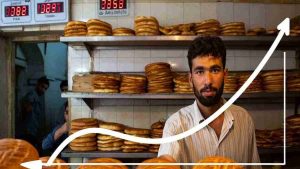
For years in Iran, it was commonly said that even if people could no longer afford meat, chicken, dairy products, or fruit, at least bread—the staple of the country’s food basket—would never disappear from their tables. Today, however, even that assumption is collapsing.
Official reports by the Statistical Center of Iran show that food inflation in recent years has forced households to sharply reduce their consumption of red meat, dairy products, fruit, and even rice. According to the data, consumption of these items has fallen by an average of about 50% in recent years, with bread becoming the primary substitute for meeting calorie needs. (State-run Donya-ye Eqtesad newspaper)
Year-on-year inflation for bread and cereals reached approximately 81.8% in July 2025, according to the Statistical Center of Iran. Some reports have stated that bread prices in Tehran have increased by as much as 52%.
Overall food inflation has, during certain periods, exceeded 100%, and even reached 110% to 134% in some months. These figures indicate that bread—once the cheapest source of calories—is now directly placing additional pressure on the poorest segments of society.
Iran: Ward 37, Unit 3 of Ghezel Hesar Prison

Following the suppression of the nationwide protests of January 2026, a number of those arrested were transferred to Ward 37, Unit 3 of Qezel Hesar Prison. The conditions prevailing in this high-security ward indicate that its purpose extends far beyond the deprivation of liberty. The combination of severe restrictions, the methods by which the ward is administered, and the treatment of detainees point to a structured mechanism designed to isolate prisoners, maintain constant psychological pressure, tightly control communication, and systematically erode both the physical and mental resilience of those detained.
Many of the detainees held in this ward face broadly defined national security charges carrying severe penalties, including the risk of death sentences. At the same time, judicial proceedings are conducted in an environment of extreme secrecy and security. In many cases, families remain without reliable information regarding the legal status of their relatives, the progress of investigations, scheduled court hearings, or even their overall condition. This prolonged uncertainty, combined with the hardships of detention itself, has become an additional form of punishment imposed on the detainees.
Families likewise endure continuous psychological suffering. Telephone calls are brief and infrequent, visits are restricted to short cabin meetings, and the flow of information is tightly controlled. Restricting contact with relatives is not merely an administrative measure; it serves as a means of intensifying psychological pressure on detainees while simultaneously reducing the ability of families and the public to monitor their condition or seek accountability.