

Six-minute read
The recent diplomatic pause between the United States, Israel, and Iran—anchored by the June ceasefire memorandum—was viewed by many global observers as a momentary stabilization of the Middle East. But in politics, a vacuum is quickly filled. For the clerical regime in Tehran, which has long relied on the specter of foreign conflict to justify internal repression, this strategic interregnum did not bring stability. Instead, it stripped away the regime’s primary external alibi, opening a critical window during which the true locus of agency shifted decisively back to the Iranian people. The structural lesson of this period is clear: when the threat of foreign intervention recedes, the domestic resistance expands.
A Convergence of Dissent: The Quantitative and Qualitative Surge
During this distinct window of reduced external conflict, the domestic theater inside Iran experienced an unprecedented escalation in anti-regime activity, marked by both its broad societal composition and its sophisticated organizational depth. No longer fragmented or purely reactive, the protests during this period spanned virtually every major socioeconomic sector. In June 2026 alone, at least 135 separate strikes, demonstrations, and protests were documented across the country. This cross-strata mobilization united factory workers, educators, nurses, pensioners, truck drivers, and bazaar merchants in a synchronized rejection of the economic and political status quo.
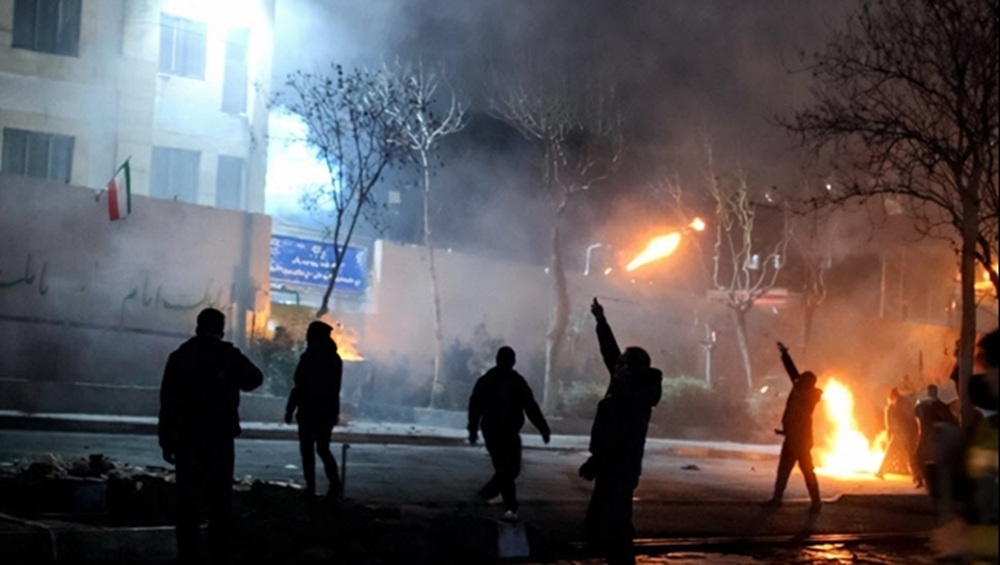
Simultaneously, the organized domestic opposition underwent a profound qualitative evolution. The network of Resistance Units associated with the People’s Mojahedin Organization of Iran (PMOI/MEK) capitalized on the geopolitical lull to ramp up asymmetrical operations against the state’s security infrastructure. In the first ten days of July 2026, the PMOI recorded more than 100 coordinated operations across more than 20 cities. These were not random acts of vandalism; they were highly targeted strikes against Islamic Revolutionary Guard Corps (IRGC) Basij bases, state propaganda installations, and intelligence offices. This culminated on July 7 with 46 distinct anti-regime actions executed in 15 cities in a single day, illustrating a level of command, control, and nationwide synchronization previously unseen.

The data below is drawn from official NCRI statements and mojahedin.org reports. A single “operation” encompasses one discrete action: an arson attack on an IRGC base, the torching of a regime banner, the hanging of a banner on a bridge, etc.
Pre-War Baseline (December 2025 – February 2026)
- January 2, 2026 — 40 operations across 26 cities (Tehran and 25 others). Targets included 17 IRGC and Basij centers, 7 government offices, and 3 Ministry of Intelligence posts used for espionage and recruiting informants. Cities involved: Tehran, Mashhad, Isfahan, Karaj, Qom, Qazvin, Hamadan, Kerman, Zanjan, Yazd, Dezful, Izeh, Khorramshahr, Mahshahr, Chabahar, Damghan, Masjed Soleyman, Azna, Khorramabad, Aligudarz, Langarud, Bandar Abbas, Gonabad, Homashahr, Zahedan, and Dorud.
- February 17, 2026 — 50 activities across 17 cities (Tehran and 16 others), marking the 47th anniversary of the anti-monarchical revolution. Activities included image projections, slogan broadcasting in public spaces, hanging banners from bridges, and graffiti. Cities: Tehran, Mashhad, Shiraz, Isfahan, Babol, Tabriz, Karaj, Sari, Bandar Abbas, Zahedan, Kermanshah, Sanandaj, Ilam, Aligudarz, Qaemshahr, Bojnurd, and Marvdasht.
- February 20–23, 2026 — NLA flag operations and the audacious assault on Khamenei’s compound. Resistance Units raised the National Liberation Army flag on overpasses in Tehran and other cities. On February 23, 250 fighters launched an armed assault on Khamenei’s compound in Tehran — the most heavily guarded site in the country. One hundred fighters were killed or arrested; 150 returned to their bases.

Wartime Operations (Late February – April 7, 2026)
- March 2, 2026 — Banner and poster offensive across Tehran, Tabriz, Isfahan, Rafsanjan, Qazvin, Khorramabad, and Shiraz. NLA flags displayed on overpasses; leaflets reading “The Liberation Army is Coming” distributed.
- March 4, 2026 — 31 operations across 20 cities (Tehran and 19 others). This was the most kinetically aggressive campaign to date: fires set at two regime seminaries in Mashhad, a blaze at an IRGC Basij command in Tabriz, a fire at an IRGC Basij command in Falavarjan (Isfahan), attacks on Basij bases in Ahvaz, Karaj (two bases torched in Fardis), Khorramshahr, and Tehran, and the torching of the IRGC Basij espionage headquarters signboard in Tehran. Additional cities: Shiraz, Kermanshah, Qazvin, Bandar Abbas, Sari, Abadan, Lordegan, Nimruz, Chabahar, Sonqor, Torbat-e Heydarieh, Gonabad, and Chenaran.
Post-Ceasefire Surge (April 7 – July 11, 2026)
- April 19–26 — Multi-day coordinated campaigns. Graffiti, poster installations, and slogan writing in visible public locations across Zahedan, Isfahan, Kermanshah, Damavand, Dezful, Qaen, Karaj, Bushehr, Sari, Chabahar, Mashhad, and additional cities. The campaign focused on supporting the NCRI’s announcement of a Provisional Government and honoring executed MEK members Hamed Validi and Mohammad Masoum-Shahi.
- May 3–10 — Major operational wave. On May 7 alone, 20+ targeted operations were carried out in 15 cities: Mashhad (fire at IRGC headquarters), Chabahar, Karaj, Isfahan, Dehdasht, Zahedan, Kazerun, Ahvaz, Dezful, Kermanshah, Buin Zahra, Hamedan, Kerman, Hafshejan, and Charam. Targets included Basij bases, a Culture Ministry center, and student Basij installations.

- May 25 (4 Khordad anniversary) — 100 operations by 100 Resistance Units across 30 cities in a single day. This was the largest single-day mobilization in the movement’s history. Cities: Tehran, Karaj, Tabriz, Mashhad, Isfahan, Shiraz, Kermanshah, Zanjan, Rasht, Qazvin, Kerman, Ahvaz, Gorgan, Kashan, Boroujerd, Shushtar, Zahedan, Bandar Abbas, Hamedan, Bandar Anzali, Gohardasht, Masjed Soleyman, Yasouj, Nikshahr, Yazd, Nishapur, Qom, Shahrekord, and Sari. Activities included banner installations on pedestrian bridges with images of MEK founders, symbolic fires in peripheral districts, nighttime slogan chanting, and poster campaigns.
- June 20 — 45 operations marking the anniversary of the June 20 crackdown. Activities in Tehran, Ahvaz, Eslamshahr, Qaemshahr, Zahedan, Karaj, Iranshahr, Farrokhshahr, Borujen, and additional cities. Multiple IRGC Basij bases attacked; a fire set at a fundamentalism center in Borujen.
- June 29 — 35 operations across 21 cities: Tehran, Saqqez, Kermanshah, Khash, Boroujen, Mashhad, Isfahan, Karaj, Shiraz, Sari, Kerman, Qazvin, Yazd, Hamedan, Bandar Abbas, Zanjan, Zahedan, Sabzevar, Amol, Saveh, and Shahrud. The State Security Force command center in Saqqez was attacked; the Saqqez Municipality was targeted; a suppression center in Boroujen was set ablaze. Banners, posters, and images of regime leaders were torched in 15 cities.
- June 27–July 4 — “Unprecedented wave.” On July 4 alone, 30 synchronized operations were carried out across Sari, Nowshahr, Nishapur, Torbat-e Jam, Zahedan, Torbat-e Heydarieh, Mahshahr, Esmailabad, Shahriar, Fooladshahr, Rezvanshahr, Isfahan, Mashhad, Qaemshahr, Tehran, Karaj, Shiraz, Ardabil, Lahijan, Behshahr, Chabahar, Saveh, Rask, and more. Key actions: a dual strike — fire set at a Basij base and an artillery club in Torbat-e Heydarieh; a blaze at Rajaei Cultural Center in Mahshahr.

- July 5 — Multi-city propaganda and action campaign. Activities in Tehran, Shiraz, Sanandaj, Bandar Abbas, Sari, Hamedan, Kashan, Azna, Sardasht, Rudsar, Behshahr, Karaj, Bushehr, and Zanjan. Posters, placards, and graffiti linking the bread crisis to the need for uprising.
- July 6 — 30 operations in 15 cities coinciding with Khamenei’s funeral procession: Tehran (3 operations), Isfahan (3), Zahedan (5), Mashhad (multiple), Shiraz, Kermanshah, Shahrekord, Ardabil, Birjand, Fasa, Dehloran, Azna, Najafabad, Rezvanshahr, and Alashtar. Joint portraits of Khomeini, Khamenei, and Mojtaba torched; IRGC logos set ablaze.
- July 7 — 46 anti-regime activities across 15 cities as the regime’s coffin processions continued: Tehran, Shiraz, Yazd, Semnan, Qaemshahr, Mashhad, Isfahan, Kashan, Arak, Sanandaj, Aq Qala, Shahr-e Kurd, Chalus, Bandar Abbas, and Gorgan. The MEK emblem was hung on bridges in Qaemshahr. “Hail to Rajavi” was written at 24 separate locations across 7 cities. Extensive graffiti in Sanandaj, Aq Qala, Shahr-e Kurd, and Chalus.
Breaching the Supreme Redline
The most sociologically significant indicator of this shifting tide is the widespread emergence of a specific political marker. In urban centers ranging from Tehran and Mashhad to Shiraz and Isfahan, the slogans “Hail to Rajavi” and “Viva Rajavi” have moved from clandestine whispers to prominent displays on public walls and placards.
To a Western audience, spray-painting a political slogan may seem like a standard act of civil disobedience. In Iran, it is a revolutionary act carrying the highest possible stakes. Under the clerical regime’s penal code, promoting or expressing affiliation with the organized resistance constitutes moharebeh—”waging war against God”—a charge that carries mandatory capital punishment. The regime has consistently enforced this redline, carrying out multiple executions of suspected PMOI affiliates following brief, closed-door tribunals. The fact that thousands of young Iranians are knowingly risking the gallows to display these specific names points to a profound psychological shift: the threshold of fear has been decisively breached.

The slogans promoted by the MEK’s Resistance Units and rebellious youth reflect a clear and increasingly unified message: the Iranian people seek the overthrow of the clerical regime, but they will not accept the restoration of the monarchy or the replacement of one dictatorship with another. Chants such as “Death to the oppressor, be it the Shah or the Leader,” “No to the crown, no to the turban,” and “No Mojtaba, no Pahlavi—democracy and equality” demonstrate that Iran’s younger generation rejects the entire century-long cycle of monarchical and religious tyranny. Their objective is not a return to the past, but the establishment of a democratic republic founded on freedom, equality, popular sovereignty and the separation of religion and state.
Within this political landscape, slogans of “Hail to Rajavi” have risen sharply alongside calls for “Democracy and freedom with Maryam Rajavi” and “A democratic republic is the only way to save Iran.” Their growing prominence signifies support for the Resistance’s Third Option: neither appeasement of the existing regime nor foreign military intervention, but democratic change by the Iranian people and their organised resistance. Combined with slogans supporting the National Liberation Army and the path of the Mojahedin, this messaging presents a concrete alternative to both the mullahs and the monarchy—one centred on a democratic, pluralistic and secular republic capable of delivering freedom and social justice to Iran.
The Paradigm Shift: From Foreign Intervention to Homegrown Agency
This behavioral shift carries immense geopolitical implications. For decades, foreign policy debates in Washington and European capitals revolved around a rigid, binary triangle: either accept the survival of the clerical dictatorship through diplomatic appeasement or alter it via foreign military intervention. Both paradigms shared a fundamental flaw—they treated the Iranian population as passive bystanders.
🚨 Exclusive | Iran: Resistance Units Broadcast Anti-Khamenei Slogans During Funeral Procession in Mashhad
Exclusive footage obtained by Simay Azadi shows members of the PMOI Resistance Units broadcasting the slogans "Curse Khamenei, Hail Rajavi" at two locations in Mashhad… pic.twitter.com/2l5UoD9RLu
— SIMAY AZADI TV (@en_simayazadi) July 9, 2026
The current domestic surge shatters this binary. By elevating slogans that explicitly reject both the current theocracy and any restoration of the pre-1979 monarchical dictatorship—evidenced by the chant, “Death to the oppressor, be it the Shah or the Leader”—the resistance is asserting an independent, third path. It dismisses both foreign war and external appeasement in favor of a homegrown, public mobilization to oust the regime. This democratic alternative is structurally organized around the NCRI’s provisional government framework—first initiated in October 1981—and Maryam Rajavi’s Ten-Point Plan, which outlines a future secular republic based on gender equality, pluralism, and the total abolition of the death penalty.
The Diminishing Returns of Totalitarian Violence
In a desperate effort to contain this burgeoning internal challenge, Tehran has resorted to the only tool it has left: unmitigated judicial terror. The scale of the crackdown remains immense. Iran recorded at least 2,159 executions in 2025, and that lethal pace has surged into 2026, with at least 370 executions in the first half of the year, including 101 in June alone.
Yet, the data reveals a critical paradox for the autocracy: the escalation of state violence is yielding diminishing returns. Every wave of hangings has been met with an intensification of Resistance Unit operations. By seizing the political initiative during this historic window, the Iranian street has redefined the terms of the conflict. The future of Iran will not be dictated by external military powers or international compacts, but by the organized, domestic willpower of its own citizens.