

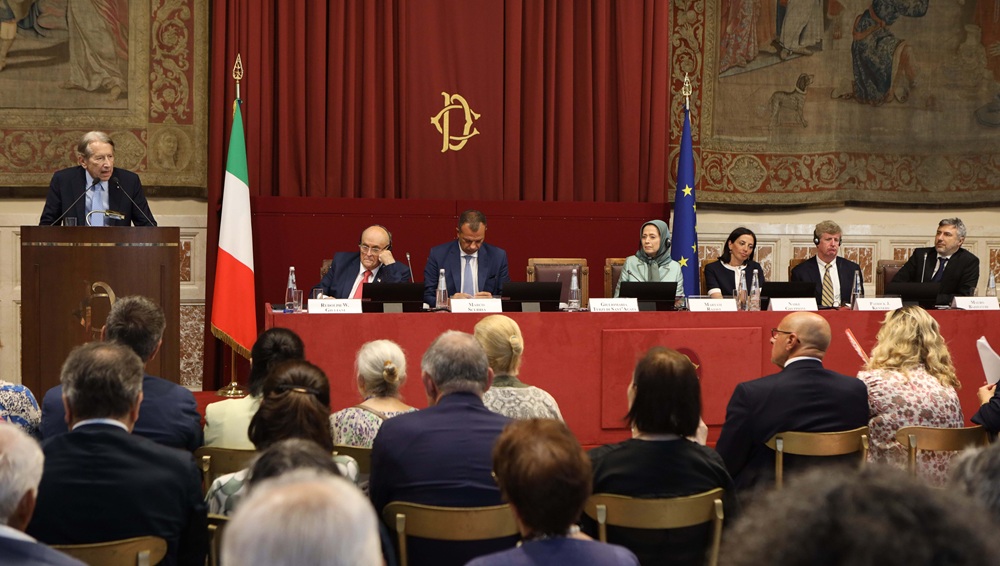
On July 16, 2026, Italian Senator Giulio Terzi delivered a forceful endorsement of the Iranian Resistance during an international conference at the Italian Parliament, declaring that Europe must abandon its policy of appeasement toward Iran’s clerical regime. Addressing the escalating human rights abuses in Iran, Senator Terzi, who previously served as Italy’s Minister of Foreign Affairs and Ambassador and currently sits on the Commission for European Union Affairs, insisted that negotiations with the current ruling theocracy amount to mere capitulation.
Senator Terzi directed a significant portion of his remarks to the visionary leadership of Maryam Rajavi, President-elect of the National Council of Resistance of Iran (NCRI). He praised Mrs. Rajavi as the definitive hope and absolute certainty for the Iranian people’s pursuit of a democratic and free republic. Recognizing the historical depth of the NCRI’s struggle, the Italian lawmaker emphasized that the Resistance movement perfectly aligns with Western democratic values and the fundamental rule of law.
Elevating the strategic importance of adopting a firm European foreign policy, Senator Terzi warned against the global security threats posed by Tehran, likening the regime’s oppressive tactics to some of history’s worst dictatorships. He sharply criticized the regime’s use of its diplomatic missions for state-sponsored terrorism, recalling the thwarted bomb plot against the Iranian Resistance gathering in Villepinte by an accredited diplomat. Pledging his solidarity, Senator Terzi called on the international community to safeguard the free expression of the Iranian people and firmly reject any form of foreign censorship or pressure exerted by the criminal regime.
A translated version of Giulio Terzi’s speech follows:
"Il Parlamento accoglie la Resistenza iraniana: il CNRI può dare la spallata al regime" @ilriformista https://t.co/LCBbHjvJpV
"La Repubblica Islamica sta affrontando tensioni interne senza precedenti, una crescente rabbia popolare e un’instabilità politica sempre più profonda».… pic.twitter.com/M1yCqRXX5B— Giulio Terzi (@GiulioTerzi) July 21, 2026
Initially, I would like to thank President Pucciarelli and the President-elect of the National Council of Resistance of Iran, Mrs. Rajavi, as well as the colleagues present, because I consider this hearing today to be of extraordinary importance. This extraordinary importance is not only because Iran sinks deeper every day into the horrific abyss of human rights violations and the crimes it continues to commit, especially against the People’s Mojahedin Organization, but it has also embroiled the entire international community for several months now. And therefore, this issue is of high importance.
But the second importance lies in the fact that today in this commission we have the opportunity to hear the true voice of the Iranian people through this organization and a vast segment of Iranian society who see themselves in your movement, Mrs. Rajavi; a movement whose members, I remind you, since their settlement in Camp Liberty and prior to that in Camp Ashraf, were recognized by the United Nations as individuals subjected to political persecution, and later these groups joined the resistance in all European countries and a large part of Western countries such as the United States. Therefore, this is the significance and I can even say the historical depth of the matters you told us today; matters which, when one knows the Iranian Resistance movement that you represent well, one must at least acknowledge that this movement has the greatest alignment with the fundamental concepts of the rule of law and the defense of human rights that we support, and which Mrs. Rajavi reaffirmed today.
Therefore, my question is, what is your perspective? What is your assessment and outlook on where this brutal regime is heading? And what else can be done? You previously mentioned increasing the pressure of sanctions against the regime, but how much more must be done to ensure and guarantee that the voice of the Iranian people through the People’s Mojahedin continues to remain loud and free in all arenas of the free world, and is not subjected to the restrictions demanded by a criminal regime?
Iran. Terzi (FdI): Rajavi lotta contro Stato terrorista https://t.co/QuUC9rRx3k via @vocedelpatriota
— 🇮🇹 La Voce del Patriota (@vocedelpatriota) July 17, 2026
It is a great emotion to take the floor after the President-elect of the National Council of Iranian Resistance. And it is a very great emotion, even more so after having heard the illustrations, but also the perfect political position expressed by Vice President Fabio Rampelli, and what was said by the creator of this meeting, of this reunion, with such eminent personalities who will take the floor, who are on the panel, but who I am sure will take the floor also later in the debate. I see some long-time friends of the resistance of Iran in its true nature of what must be a great country of democracy and freedom, rich in an extraordinary tradition, which has a historical identity that cannot be destroyed and massacred by the criminals we find ruling that country, who are criminals of a species that can be comparable only to that of Hitler, of Stalin, of Mao, of Pol Pot, or of the worst plagues of humanity that we have seen in the 20th century after the Second World War.
It is a privilege to take the floor at this exact moment after what Maryam Rajavi said and what President Rampelli said, because Rampelli made a picture truly dynamic, passionate, of what is the work of the Italian Parliament and of the European institutions, of the commissions. He cited the third commission, the other commissions of the Senate, the commissions of the Chamber that deal with these matters, and I would like to cite in particular the Human Rights Commission which had the honor of hosting Maryam Rajavi this morning. And so it is an important picture that shows how in many ways Europe, Italy, and all the countries—I would like to say the core of the West which is represented by the identity, by this Euro-Atlantic relationship on the great issues of peace and international security—is a strong core that believes in freedom without ifs and without buts, in democracy, in the rule of law, but is also a reality that must take a more precise, more determined, more courageous, more conscious route regarding what is happening in the world, in the Middle East, in the conflicts we are experiencing.
It is on this that I would like to say first of all a thank you to President Rajavi for being here, for what she said, and for being what Naike Gruppioni rightly said in her beautiful speech: she is the hope of all men and all women of Iran. She is the hope—I would like to add, Naike, if you allow me a small footnote—she is the certainty, Maryam Rajavi, of all men and all women of Iran. And I believe that what she said is a light that rekindles powerfully on that darkness that had fallen many years ago, in ’79-’80, a darkness that had fallen at the moment in which another strong flame was rekindling at the bottom of the tunnel of democracy and freedom with the fall of the Shah, a regime in many ways odious and criminal, let’s tell ourselves the historical truth.
"#Iran: oggi conferenza internazionale a Roma con Terzi.
Roma, 17 lug. (LaPresse) – Conferenza internazionale sull’Iran a Westin Excelsior (via Vittorio Veneto 125) a Roma dalle 16 alle 18, con leader politici italiani ed europei, personalità che hanno ricoperto incarichi… pic.twitter.com/mit6Njjr79— Giulio Terzi (@GiulioTerzi) July 17, 2026
It is not as the son of the Shah says in television interviews when he is asked what the legacy of his father was for his country, and he says regularly—repeating it recently at the Parliament of Amsterdam where he was booed and mocked: “Ah, I don’t talk about these things because only history can talk about them.” I seemed to hear that phrase of Zhou Enlai when someone asked him if there was something in Maoism that resembled the French Revolution, and he replied: “But it is too early to talk about the French Revolution, history will tell us.” This is somewhat the mental attitude of a monarch who would like to propose himself with self-painted noble titles and who is certainly not up to representing that charge of freedom, of strength, and of the will to go forward of the Iranian people, which is that of Maryam Rajavi.
For this, I want to say to President Rajavi how grateful I am to her. Europe must be strong, must have courage, must have political certainties, must have cardinal points in understanding what Iran has been in these many years from ’79 to today and what it has instead become—more and more and always worse. Not only for the disasters that are happening in the Middle East and that have now spread to the world economy, but to the disaster of growing food poverty in many areas of the world because of what the equivalent of two atomic bombs put together in Hormuz and Bab el-Mandeb are creating with the closure of fundamental supply chains, the capacity to provide energy to work, to agriculture, to the support of people all over the world, especially in the poorest countries.
This is the Iran of today. An Iran whose fundamentalist Islamic nature, but of a Nazi-communist character of the worst kind—made of exploitation of the people through continuing to feed wars to stay in power—this Iran has become a disaster for the world. We are suffering it and Europe must mature the conviction that there is no appeasement with those criminals. There is no appeasement, as a great Secretary of State, George Shultz, said: “Negotiation is a euphemism for capitulation if the shadow of power does not loom over the negotiating table.”
#Iran: Terzi (FdI), Rajavi lotta contro Stato terrorista Roma, 17 lug. (LaPresse) – “Madame Rajavi, Presidente eletta del Consiglio della Resistenza Iraniana, è uno straordinario faro di libertà, democrazia, volontà di parità e pluralismo. Oggi in Iran il regime colpisce uomini,… pic.twitter.com/w9wVUNB1gZ
— Giulio Terzi (@GiulioTerzi) July 17, 2026
Europe has given the impression to many observers that everything can be resolved always by seeking, insisting, almost begging to continue to dialogue with those who instead use dialogue to postpone, to delay, arming themselves and continuing to kill hundreds of thousands of political opponents—30,000 in one fell swoop in a few weeks, let’s remember, in 1988 with a fatwa of Ayatollah Khomeini—and to continue to this day through a network of embassies in the world that serve as a base for terrorist operations.
I would like to recall the case that Iranian foreign policy is made also of the terrorist instrument and that Iranian diplomats—let’s remember Assadollah Assadi, diplomat of the Iranian embassy in Vienna—sent to Villepinte where there was the great convention of the People’s Mojahedin, had sent a hitman to blow up this great hall of 60,000 people and dozens of foreign delegations. I say this because we must understand that yes, embassies are useful, but we cannot accept from Iranian embassies any form of pressure on our European countries. We have seen, for example, in France the cancellation of the important demonstration in Paris of the NCRI because surely there had been a phone call or pressure from the Iranian embassy.
We cannot accept censorship by foreign countries in our free territories and in our free countries! We do not accept censorship from ourselves; there is no censorship within our countries. Censorship is a nonexistent, banished term, and we can even less accept it from someone who does not belong to our people and who does not belong to our rule of law.
In thanking Madame Rajavi, I believe we are indebted to the great action of the People’s Mojahedin, indebted for a teaching and an example of courage. And also, for a teaching of great clarity on how to make a foreign and security policy capable of preventing this monstrosity of violence, totalitarianism, and dominance which is the Islamic regime that has tried to expand to Lebanon, Syria, Iraq, Yemen, the Gulf countries, and now would even like to expand further. Let’s cite, for example, the Gulf countries where there are consistent Shiite minorities, and it has brought fears in those same countries, not to mention the Mediterranean countries.
So, a European foreign policy must be a policy that looks at reality for what it is, the history of a regime and the people who are part of it, and that knows how to draw an example from a beautiful people. The reference to Mazzini is only the conviction of a people wanting to be free and having a mission together in its community to assert its own nation. This is the sense of courage, the example of the hope of the future, and of the certainty of peace and security that all our peoples seek, that Maryam Rajavi today is giving us.
Thank you.