

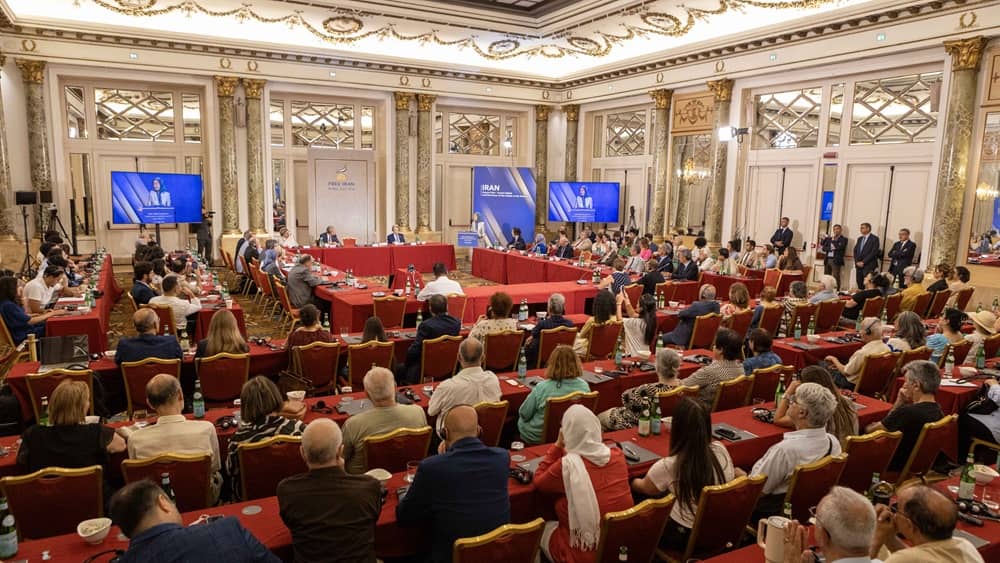
On July 17, 2026, the Italian capital Rome hosted a major international conference titled “Iran Beyond War, the Power of the People.” The central themes were the decisive role of the Iranian people’s organized resistance—especially the MEK Resistance Units that carried out 630 operations during the January 2026 uprising and an attack on Khamenei’s headquarters—the rejection of any return to the deposed Shah’s monarchy, and the proven strength and endurance of a movement that has sacrificed more than 120,000 lives, including 30,000 in the 1988 massacre, while remaining independent and rooted inside Iran. Speakers agreed that neither foreign military intervention nor continued Western appeasement offers a solution; only the Iranian people and their democratic Resistance can overthrow the theocracy and establish a secular republic based on the NCRI’s Ten-Point Plan.
NCRI President-elect Mrs. Maryam Rajavi opened by recalling 48 years of crisis since the 1979 revolution was hijacked by Ruhollah Khomeini, listing the hostage crisis, the Iran-Iraq war, mass executions, nuclear ambitions, regional interventions and transnational terrorism, including the assassination of Mohammad Hossein Naqdi in Rome.
“Without a doubt, the solution lies neither in clinging to the present status quo by preserving this regime, nor in retreating to the past by reviving the deposed dictatorship of the Shah. The true solution lies in looking forward to the establishment of a democratic republic.” She stressed that both dictatorships reached historical dead-ends and that any form of dictatorship only perpetuates catastrophe.
Address to the Conference: “Iran Beyond War, the Power of the People as the Solution”
The prospect of change in Iran is grounded in objective, undeniable realities. These include:
– An unprecedented socioeconomic chasm between the social classes.
– Chronic poverty alongside… pic.twitter.com/0atuvptCsR— Maryam Rajavi (@Maryam_Rajavi) July 17, 2026
Mrs. Rajavi detailed the objective conditions for change: socioeconomic chasms, chronic poverty, collapsing regime pillars, internal fractures, and the organized nationwide resistance. A viable alternative, she said, must confront the IRGC, remain independent of foreign powers, and consist of conscious youth willing to sacrifice. “The People’s Mojahedin Organization of Iran (PMOI/MEK) and its Resistance Units, embodying these very traits and capabilities, represent the defining catalyst for change in Iran.” She noted that despite repression the Units conducted 630 operations in the January 2026 uprising and, on 23 February, 250 fighters struck Khamenei’s headquarters in Tehran. “Over the past year, these Resistance Units have evolved into units of a liberation army.”
She presented the provisional government and Ten-Point Plan for a republic based on separation of religion and state, gender equality, autonomy for nationalities and a non-nuclear Iran—a model “forged from the profound suffering and the blood of 100,000 PMOI freedom fighters.” Recalling the approaching 38th anniversary of the 1988 massacre of 30,000 political prisoners (more than 90 percent PMOI), she quoted executed prisoner Babak Alipour: “Everything we long for—unconditional freedom, a society free from discrimination, gender equality, and justice—can only be achieved through the overthrow of this regime. There is no other way.”
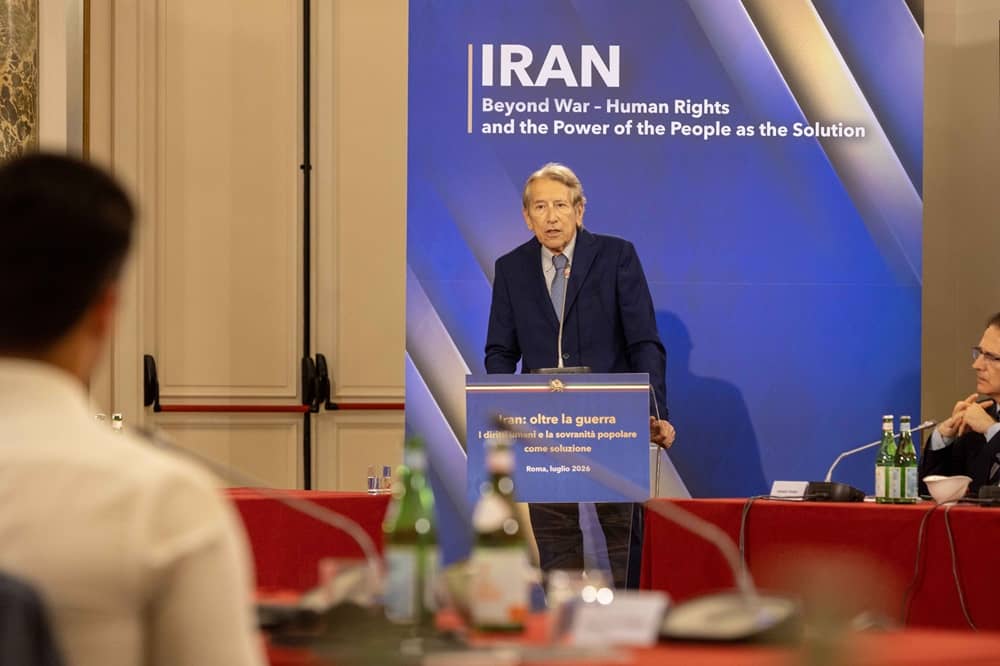
Senator Giulio Terzi, President of the Italian Senate’s EU Affairs Committee, addressed self-proclaimed monarchist groups seeking a return of the pre-1979 regime, describing the Khomeinist takeover as the “odious advent of a nazi-islamist regime” that brought only death and extermination with the brutality of Hitler. Senator Terzi recounted a Senate Human Rights Committee hearing in which a professor claimed parts of the IRGC had good relations with the “baby Shah” and could negotiate a transition.
He asked: “Are you aware that the IRGC is on the terrorist list of the European Union, of the major Western countries and of the international community? They are under sanctions and all their activities are under sanctions from a large part of the world? How do you reconcile this fact with proposing a regime that includes a component already sanctioned by the international community?”
Senator Terzi stated that the regime ruling Iran has definitively lost the capacity to export war and terrorism. “The IRGC is the Iranian state, and the Iranian state is the IRGC,” with 210,000 to 220,000 personnel embedded in banking and production. He welcomed the February 2026 EU decision listing the IRGC as terrorist and called for full implementation. Recalling the 1988 massacre of 30,000, the murders of Kazem Rajavi and Mohammad Hossein Naqdi, the Villepinte plot and the attack on Alejo Vidal-Quadras, the Italian senator concluded: “Enough! It is time to say enough with the yeses, the buts and the obscuring of the truth. It is a terrorist state, yet inside it there is a great wave of freedom that is driven by your movement, Madame Rajavi. We can only be proud to be your friends.”
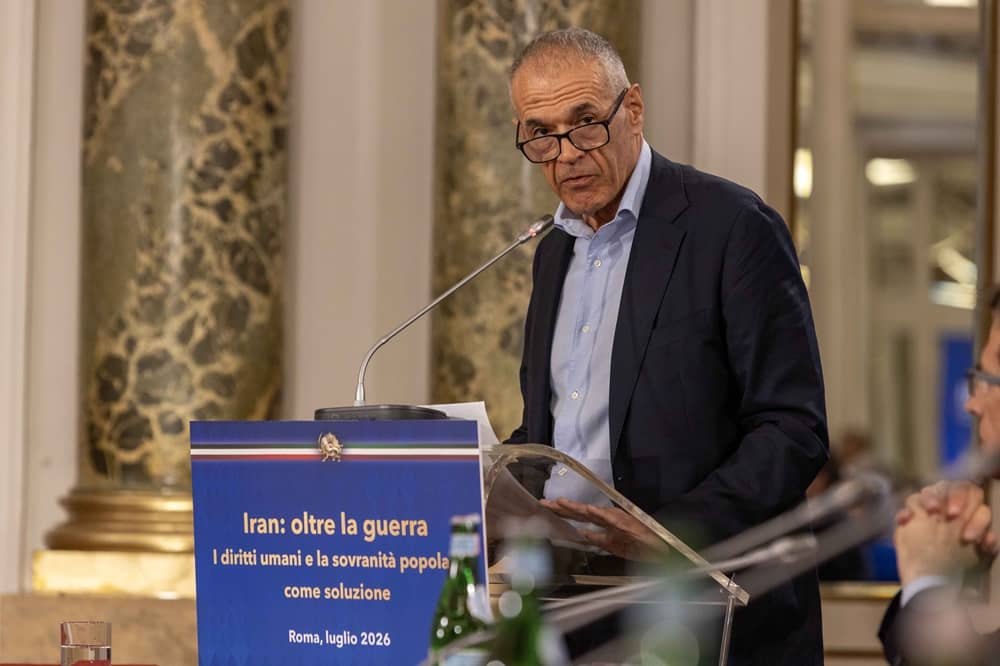
Professor Carlo Cottarelli, former IMF executive director and Italian Prime Minister-designate, emphasized that the ongoing political crisis in Iran can only be resolved by its own citizens rather than through external forces. He noted that the clerical regime’s reliance on mass arrests, intimidation, and executions reveals a deep-seated institutional fear of its own populace rather than genuine strength. Pointing out that systemic dissatisfaction has long been driven by women, students, and workers, he underscored that future self-determination belongs exclusively to the population. Cottarelli explicitly stated, “The future of Iran will ultimately be determined, not by foreign powers, but by the Iranian people themselves.”
Cottarelli also examined the limitations of relying solely on military interventions or diplomatic arrangements to achieve a democratic transition. He explained that strategic bombings and external pressures have historically failed to dictate political outcomes on their own, while standard international engagement cannot force a ruling theocracy to moderate its actions. Highlighting the balance required in foreign policy, he observed, “Dialogue, of course, remains an essential instrument of foreign policy, but the experience suggests that lasting political change cannot emerge automatically from diplomatic agreements.”
Emphasizing the democratic aspirations of the population, Cottarelli specifically highlighted the platform put forward by the opposition. Praising the strategic framework presented by the leadership, he stated, “The NCRI, here I’m underscoring the importance of Madame Rajavi’s ten points, have developed proposals for a future based on free elections, the separation of religion and state, the independence of the judiciary, gender equality, minority rights, and the rejection of nuclear militarization.” Drawing historical parallels to the sudden collapse of rigid, violent regimes, he concluded, “Systems founded on violence, and this is a system founded on violence, often appear stronger than they truly are, until unexpectedly they collapse under the weight of their own contradictions.”
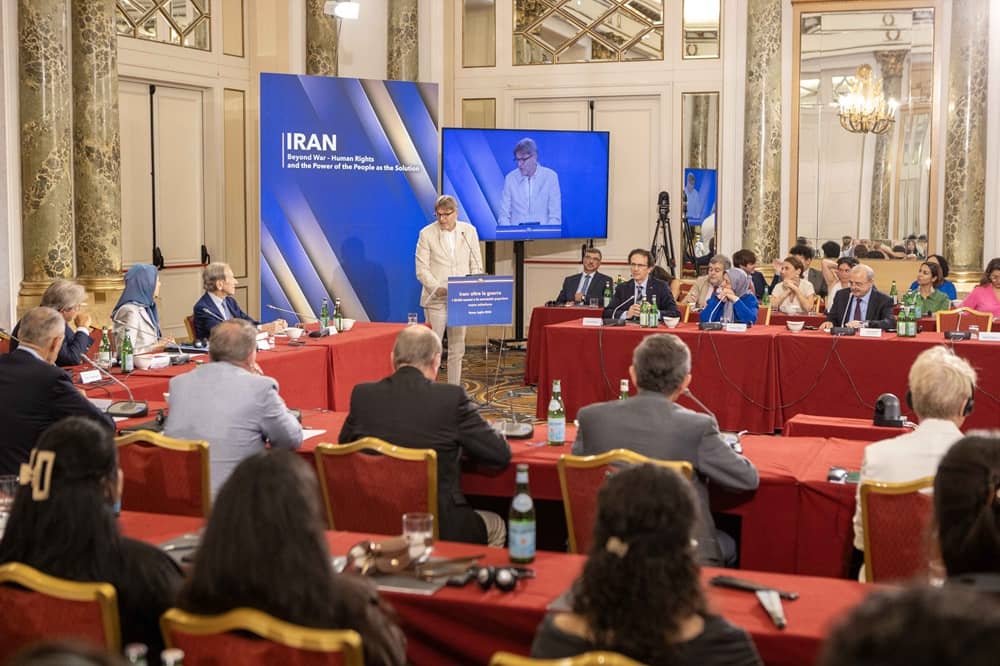
Former Belgian PM Guy Verhofstadt praised the leadership of NCRI President-elect Mrs. Maryam Rajavi during this existential and critical juncture for Iran. Rejecting the passive European policy of appeasement and futile diplomatic agreements with the clerical regime, he asserted that current negotiations are entirely counterproductive.
Outlining a robust alternative to endless war or appeasement, Verhofstadt proposed a strategy of active engagement with the Iranian resistance and complete isolation of the theocratic regime. This includes expanding sanctions beyond the Islamic Revolutionary Guard Corps (IRGC) to target all backbone elements of the regime, expelling diplomats, and seizing foreign assets. Crucially, he urged democratic nations to formally recognize the organized resistance as the sole legitimate representative of the people. Endorsing the democratic roadmap offered by the movement, he emphasized, “I think that the Ten-Point Plan of Mrs. Rajavi is a very good starting point for that constitution, for that recognition of the democratic opposition and the organized resistance.”
Detailing what official recognition entails—such as collaborating with the provisional government, assisting in drafting a democratic constitution, and replacing regime agents in international organizations with opposition representatives—Verhofstadt sharply criticized European leaders for adopting a passive “silence policy” that is even worse than appeasement. Reaffirming his steadfast support for the democratic opposition, he concluded with a clear call to action: “The active role in this conflict can be the recognition of the democratic opposition and of the organized resistance, the fastest as possible, as the real, real formal representatives of the Iranian people.”
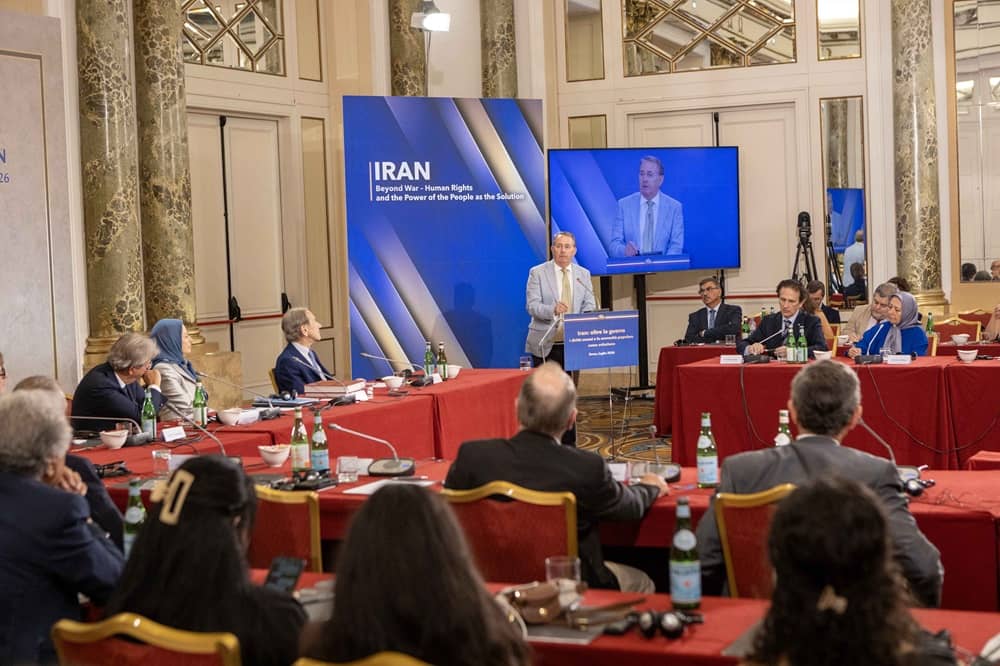
Former United Kingdom Secretary of State for Defence and Secretary of State for International Trade Sir Liam Fox delivered a fierce condemnation of the clerical regime and historical Western policies of appeasement, such as the 2015 JCPOA. Arguing that the theocracy is entirely unreformable and that seeking a middle-ground compromise is a dangerous illusion, Dr. Fox asserted that genuine regional peace requires the total dismantling of the regime. He firmly stated, “There is only one single solution to the Iranian problem, and that is regime change.”
Directly addressing NCRI President-elect Mrs. Maryam Rajavi, Sir Fox emphasized the vital importance of organized resistance and praised the principles she has outlined for the democratic operation of a free Iran. Highlighting the rejection of all forms of dictatorship, Dr. Fox delivered a sharp rebuke against both the ruling theocracy and the defunct monarchy, declaring: “Only the Iranian people can establish a democratic republic free from the twin oppressions, the oppressions of the mullahs and the oppressions of monarchs, and Iran must be free from both.”
Address to the Conference: “Iran Beyond War, the Power of the People as the Solution”
What is the Solution to the Iranian Crisis?
Without a doubt, the solution lies neither in clinging to the present status quo by preserving this regime, nor in retreating to the past by reviving… pic.twitter.com/2tRWcHk2Qg— Maryam Rajavi (@Maryam_Rajavi) July 17, 2026
Underscoring that democratic emancipation must be achieved by the population itself rather than granted from abroad, Sir Fox noted, “Madame Rajavi, as I said when we were in Paris, freedom does not fall from the skies. It never has. Freedom comes from the ground up. It always has.” Concluding his address, he urged the international democratic community to prepare economic and political support for a liberated Iran while recognizing that the ultimate triumph belongs solely to the Iranian people.
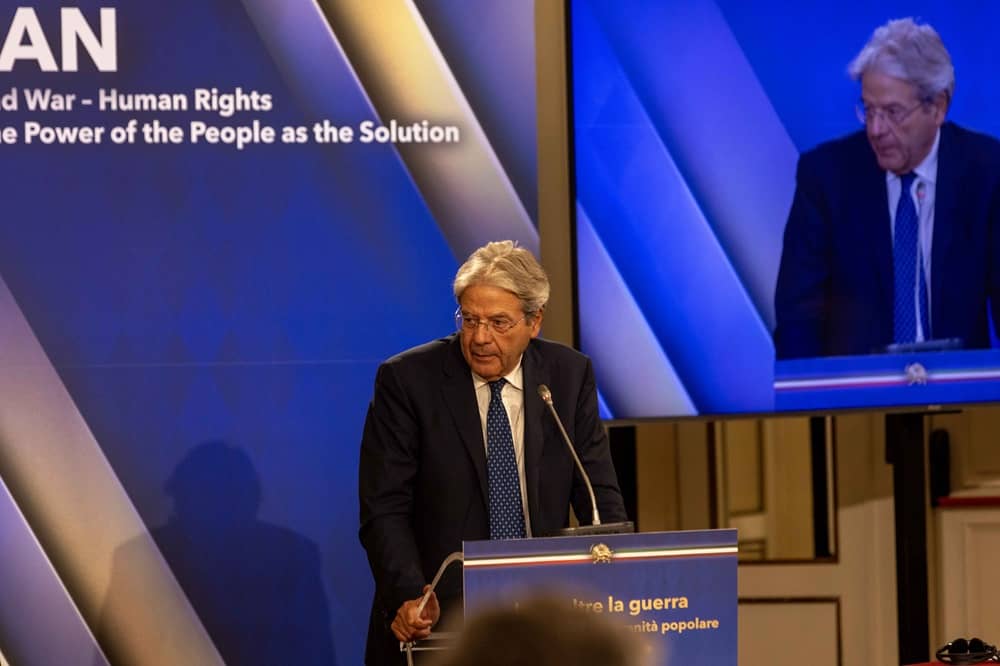
Former Italian Prime Minister Paolo Gentiloni outlined the critical juncture facing Iran, emphasizing that current developments must open the door to an alternative and resistance rather than just war and destruction. Analyzing the consequences of recent conflicts, he noted that the regime is facing a growing power vacuum and internal weakening, even as the Revolutionary Guards attempt to assert heavier autocratic control. Reflecting on the limitations of past policies, Gentiloni declared, “The solution is, we could say, in your hands, in the hands of the Iranian people and on the support of the international community to the Iranian people. There is not another solution, not the diplomatic way, not the war, and even not the sanction.”
He firmly dismissed both the expired illusions of past diplomatic frameworks and the destructive fallacy of external military intervention, noting that while economic sanctions help exert pressure, they cannot serve as the decisive solution. Instead, Gentiloni emphasized that true change rests entirely with the Iranian people and their organized resistance, rejecting any misleading narrative that portrays the clerical regime as fundamentally strengthened by ongoing crises.
“There is a way beyond the war,” Gentiloni stressed, affirming his enduring support for the NCRI and the democratic aspirations of the population. “The way beyond the war is freedom and democracy.”
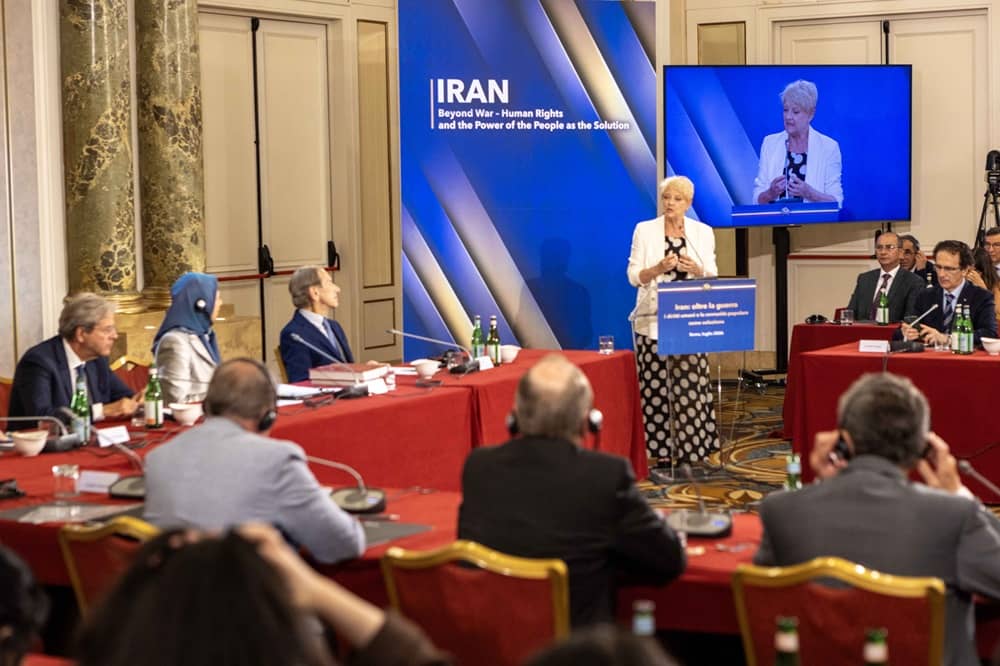
Addressing the international conference, former Italian MP and representative of the association “Nessuno tocchi Caino” (Hands Off Cain) Rita Bernardini brought a vital human rights perspective to the discussion, emphasizing her organization’s decades-long mission since 1993 for the global abolition of the death penalty. Highlighting the dire humanitarian situation inside the country, Bernardini exposed Iran as the global epicenter of state-sanctioned executions. She pointed out that Iran ranks second in the world only to China, despite possessing a fraction of China’s population, making it a stark “concentrate of violence and lack of fundamental human rights.”
Turning to the political roadmap for the nation’s future, Bernardini offered a powerful endorsement of the democratic alternative led by the NCRI. Upon reading the strategic blueprint put forward by the movement’s leadership, she affirmed, “Yes, they serve Iran to arrive at free elections, to arrive at democracy, to arrive at the rule of law.” She praised Mrs. Maryam Rajavi’s vision, noting that these principles provide the precise structural foundation necessary to steer the country away from tyranny and toward a secular, democratic republic.
Furthermore, Bernardini emphasized that the Ten-Point Plan carries profound global significance, particularly at a time when international geopolitics is experiencing deep instability. Highlighting its universal moral value, she stressed: “Those ten points serve above all at this moment when geopolitics is going a bit crazy, they serve democratic states so that they respect those principles which are fundamental principles, and others so that they manage to conquer democracy, freedom, the rule of law.” Concluding her remarks, she expressed profound solidarity with the extraordinary courage of the Iranian Resistance in their ongoing struggle.
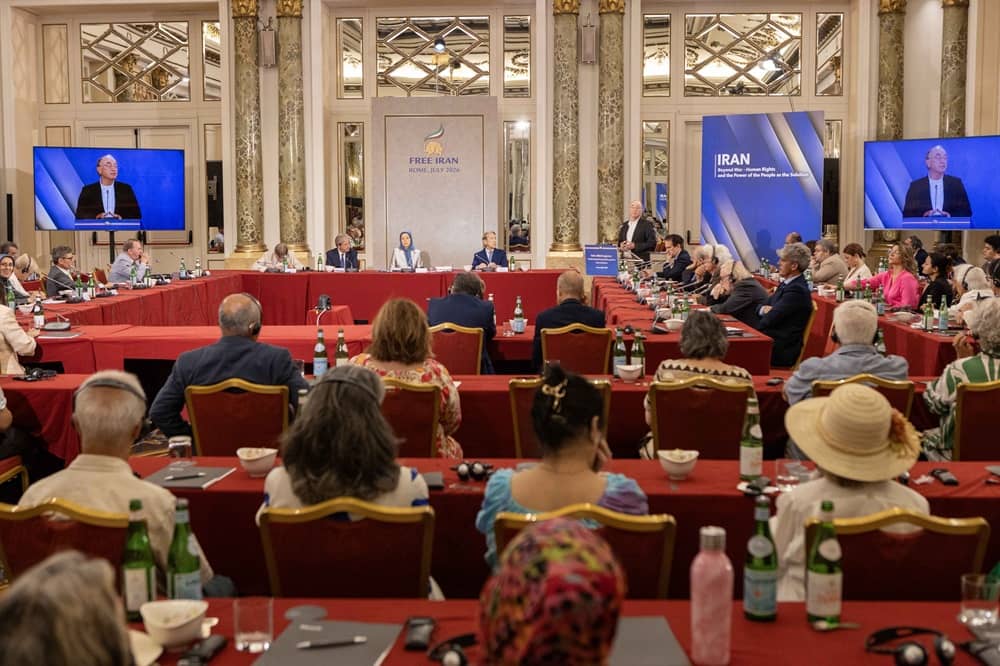
Former President of the UNHRC Joachim Rücker delivered a comprehensive analysis of the multi-layered crises confronting Iran, firmly rejecting both the illusion of foreign military intervention and the trap of diplomatic appeasement. Highlighting that current military actions fail to address the core suffering of the population, Rücker emphasized the importance of leveraging international influence where possible, noting: “Maybe stopping the executions immediately would have been a reachable goal for the United States. So, whoever has influence could still insert that into the game and should in my view. Stopping the executions, if you have a leverage, you might as well use it.”
Rücker cautioned against misinterpreting current geopolitical complexities as signs of regime stability, asserting that the theocracy is severely weakened by a deep structural and economic crisis, widespread public uprisings, and internal factional divisions. Warning against superficial media narratives, he stressed: “The failure of overwhelming military superiority to bring about regime change should not be mistaken for proof of the regime’s strength.”
Instead, he championed the “Third Option,” which calls for robust international support for the Iranian people and formal recognition of the democratic alternative. Praising the leadership shown by the European Parliament, Rücker stated: “It would mean supporting and recognizing, as has been said, recognizing a credible, organized opposition like the National Council of Resistance, and I think the European Parliament has taken a leadership role in this, and I would like to congratulate its members on this achievement.” Furthermore, addressing the monarchist faction, he expressed full confidence in the Iranian people’s democratic discernment while noting unsettling extremist undertones, remarking: “We have seen in Germany people from that so-called opposition, monarchist opposition, with SAVAK T-shirts… So that speaks volumes, I think.”
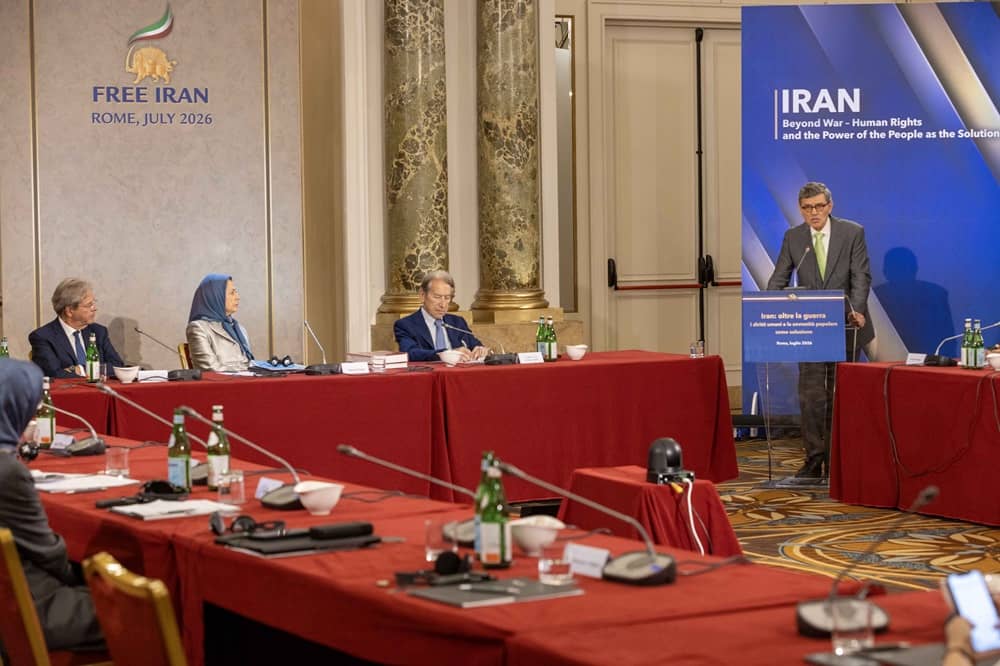
Former German Ambassador Hans-Ulrich Seidt analyzed the crumbling foundations of the Iranian ruling theocracy across three strategic domains: military, economic, and political. Highlighting the limitations of military actions, Amb. Seidt noted that foreign air campaigns cannot achieve political change, stating, “We have to be realistic. Political change in Iran will not be brought about by the American and Israeli air campaigns.” He added that the regime’s severe economic crisis—marked by inflation, currency depreciation, and chronic shortages—will only accelerate under ongoing conflict, serving as a catalyst for domestic protests.
Turning to the political landscape, Amb. Seidt emphasized that the regime’s leadership is deeply fragmented and shaken rather than strengthened, while noting that proud and patriotic Iranians strongly resent foreign intervention. Crucially, he warned against external attempts to steer the democratic movement astray, declaring: “Recent attempts to present Reza Pahlavi as a serious diplomatic leader were not a push, but if we analyze it correctly, it was an obstacle for the democratic forces inside the country.”
Advocating for the genuine democratic alternative, Amb. Seidt affirmed that the future of Iran rests on the domestic resistance led by the NCRI. He strongly endorsed Mrs. Maryam Rajavi’s platform, concluding: “Maryam Rajavi’s Ten-Point Plan reflects the aspirations of the Iranian people. Under this platform, or on this platform, free and fair elections would be held within six months after the end of the current regime. Today, such a scenario is no utopian idea. It is a realistic option for the future.”