

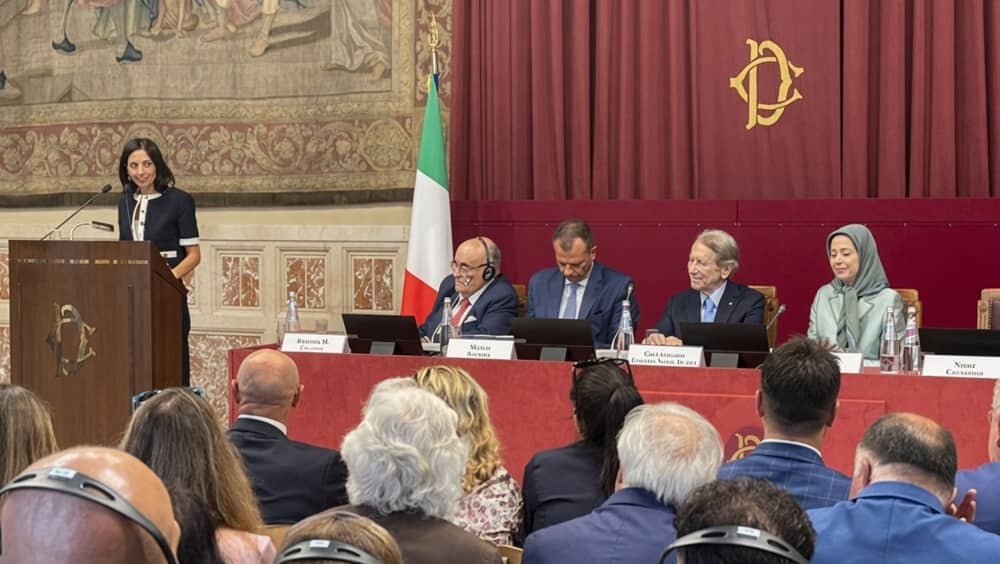
On July 16, 2026, Italian Parliamentarian Naike Gruppioni moderated a high-level conference titled “The Future of Iran” at the Italian Parliament, delivering a steadfast commitment to the Iranian Resistance and calling on democratic institutions to reject international indifference. Addressing a distinguished assembly that included institutional figures, diplomats, and NCRI President-elect Maryam Rajavi, Gruppioni stressed that defending fundamental human rights is a core obligation of Western democracies.
Opening the proceedings, Gruppioni thanked Chamber of Deputies Vice-President Fabio Rampelli for hosting the initiative, alongside acknowledging the support of Fratelli d’Italia group leader Galeazzo Bignami. Transitioning to the core geopolitical focus, the Italian lawmaker directed high praise toward Maryam Rajavi, emphasizing that her leadership symbolizes the aspirations of millions of Iranians striving for a peaceful, free, and democratic society. Gruppioni specifically endorsed Rajavi’s democratic blueprint, highlighting the Ten-Point Plan as a clear, credible roadmap for a pluralistic Iran grounded in the separation of religion and state, gender equality, and the rule of law.
Underscoring the moral imperatives of foreign policy, Gruppioni warned that indifference in the face of tyranny effectively breeds complicity, stating that democracies cannot afford to look away when citizens risk their lives for basic liberties. She also acknowledged the foreign policy direction under Prime Minister Giorgia Meloni, noting that Italy has regained central credibility internationally by coupling open diplomatic dialogue with an uncompromising defense of human rights and the rule of law. Concluding her address, Gruppioni pledged to continue steering political efforts toward supporting the democratic project represented by the National Council of Resistance of Iran, reinforcing that the fight for freedom belongs to humanity as a whole.
A translated version of Naike Gruppioni’s speech follows:
🇮🇹 MP @naike_gruppioni said it was both a great responsibility and an honour to host, in the Italian Parliament, a conference dedicated to a free Iran and the defence of human rights.
Addressing #MaryamRajavi directly, she said that her presence represented far more than that of… pic.twitter.com/lEYO6ZX33f— Javad Dabiran (@JavadDabiran) July 16, 2026
Thank you very much. Mr. Vice President, honorable colleagues, authorities, ladies and gentlemen, you see, there are moments when institutions are not asked to administer the present, but to take on a much higher responsibility, which is that of indicating a direction, defending principles, and giving a voice to freedom. Here, this is one of those moments. We are opening today, I am opening today with—for me it is a great honor but it is a great responsibility—in the seat of Italian democratic representation, as the Vice President recalled earlier, we are opening the conference on the Iran of the future, aware that freedom, rights, and international responsibility are not abstract words, but concrete commitments that call upon each of us. Every time the destiny of a people is discussed in this hall, it is not merely a political act, but an affirmation of a moral, civil, and institutional duty.
First of all, I wish to express my heartfelt thanks to the Vice President of the Chamber of Deputies, Honorable Fabio Rampelli, colleague and friend, for his institutional greeting and for having wished to welcome this initiative in the seat of Italian democratic representation. His presence confers further prestige upon a comparison dedicated to the values of freedom, democracy, and human rights. I also bring the greetings of the group leader of Fratelli d’Italia in the Chamber of Deputies, Honorable Galeazzo Bignami, who is unable to be present due to unavoidable institutional engagements. He has tasked me with expressing his closeness to this initiative and his sincere appreciation for a conference that draws the international community’s attention to the protection of human rights, freedom, and human dignity. His attention to these themes represents a very important signal of the commitment with which our parliamentary group looks to major international challenges, in the conviction that the defense of freedom and fundamental rights constitutes an unrenouncable patrimony of democracies.
Allow me also to extend a heartfelt and affectionate greeting to our distinguished speakers who, with their presence, confer upon this conference a political, institutional, and human value of extraordinary importance.
Now, I wish to address a truly special greeting to Mrs. Maryam Rajavi, President-elect, and I emphasize elected, of the National Council of Resistance of Iran. Dear President Rajavi, we have known each other for several years now, but for me it is always a very great honor, and I welcome her with emotion once again to the Chamber of Deputies. You see, her presence represents much more than that of an authoritative political leader. It represents the hope of millions of Iranian women and men who wish to live in a free, democratic country at peace. With courage, determination, and extraordinary coherence, she has continued for years to carry forward a battle founded on the universal values of freedom, democracy, the rule of law, the separation of religion and state, equality between men and women, and the full respect of human rights. Her Ten-Point Plan constitutes a clear and credible political proposal for a free, pluralistic Iran that respects the dignity of the person. Hers is a vision that looks to the future and continues to inspire those who believe that change can be born from the strength of ideas and the will of the people.
#Italian MP @naike_gruppioni calls for global action against the #Iranian regime's crimes, urging sanctions, diplomatic pressure, and unwavering support for Iranian civil society. pic.twitter.com/JwddjjHcKn
— NCRI-FAC (@iran_policy) November 1, 2024
I therefore wish to express, also on behalf of all present, our deepest gratitude for having accepted our invitation and for her tireless commitment in favor of the freedom of the Iranian people. Her presence today honors this conference and reinforces the meaning of our political commitment.
Allow me also to express sincere thanks to all my colleagues present, to the ambassadors, to the representatives of the diplomatic corps, to the representatives of institutions, of the academic world, of associations, and of civil society. Your presence makes this conference even more authoritative and above all demonstrates that the defense of human rights does not belong to a single political part but represents a common patrimony of democracies.
The numerous and qualified presence that we see in this hall today demonstrates that this is not an appointment like any other. When human dignity, the freedom of peoples, and peace are at stake, no democracy can afford the luxury of indifference. History teaches us that indifference too often ends up breeding complicity. When a woman risks her life to be free, when a young person asks only to live without fear, when a people reclaim the right to choose their own future, silence is not neutrality, but resignation.
We are talking about Iran, but in reality, we are talking about a universal principle for us: the right of every human being to live free and express their ideas, as well as to participate democratically in the life of their country, without fear, without repression, and without violence. As I was saying, there is nothing abstract about this. On the contrary, the defense of human rights cannot be limited to the declarations of a principle, but must translate into responsibility, coherence, and political action.
Italian MP @naike_gruppioni: "Thanks to the strength, courage, and determination of #Iranian women… I am certain that one day, #equality between women and men will be a reality, a historic reality even in that part of the world." pic.twitter.com/W8JFjCtm4Z
— NCRI-FAC (@iran_policy) May 18, 2024
Now, within this framework, I also wish to recall the work of our government led by Prime Minister Giorgia Meloni, which has restored authority, credibility, and centrality to Italy on the international stage. A government that has chosen a clear line: dialoguing with everyone but never renouncing the defense of freedom, the dignity of the person, the rule of law, and the values that constitute the foundation of Western democracies.
Today, speaking of the Iran of the future, we are not simply formulating a wish. We are recognizing the right of a people to build a different tomorrow, a tomorrow founded on pluralism, democratic participation, respect for human dignity, equality between women and men, religious freedom, and the full protection of fundamental rights. And I come to the significance of this conference, which goes far beyond today’s debate and places Iran and its people at the center. It calls each of us to an important responsibility, that of not limiting ourselves to observing events, but contributing to steering history toward freedom, justice, and peace. Because great democracies are also measured by their capacity not to look the other way when peoples ask for freedom.
With this spirit, I officially declare open the “Iran of the Future” conference, with the hope that today’s discussion—because here, besides legislating, we must discuss in a free and democratic manner—can transform into a concrete commitment, a stronger awareness, and a renewed shared responsibility. Because freedom, democracy, dignity, and human rights do not belong to a single nation, but to humanity as a whole.