

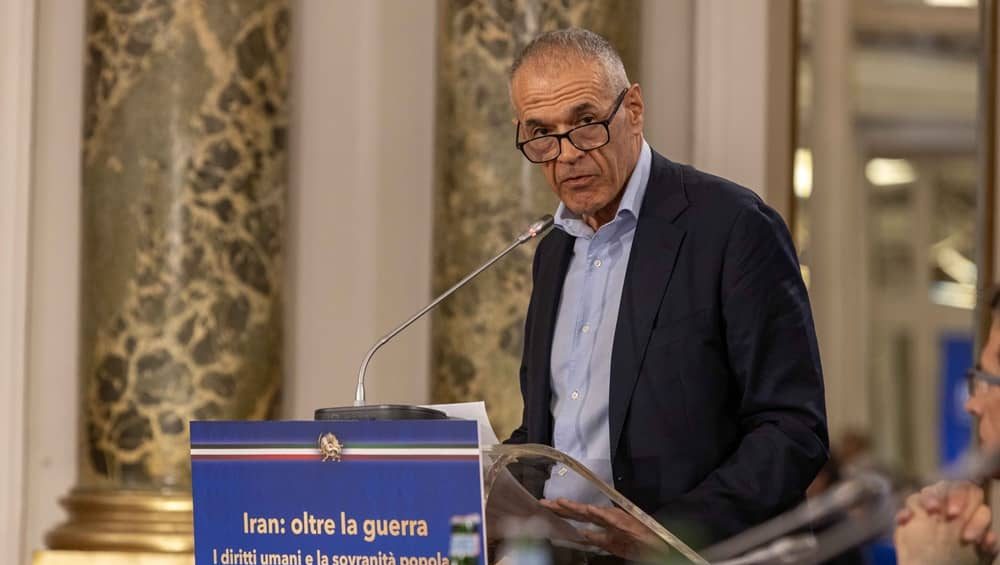
On July 17, 2026, former Italian Prime Minister-designate Carlo Cottarelli delivered a powerful address at an international conference in Rome, emphasizing that the future of Iran must be determined solely by its own citizens rather than foreign powers or military intervention.
Prof. Cottarelli highlighted that a surge in arrests and executions reflects the regime’s systemic fear and deep-rooted societal dissatisfaction. He noted that this discontent stems from years of domestic repression rather than recent geopolitical crises, pointing out that generations of women, students, and workers have continuously demanded democratic freedoms.
Addressing the nation’s severe economic crisis, the former executive director at the International Monetary Fund stressed that Iran’s struggles predate current international sanctions. Instead, they stem from structural weaknesses, systemic corruption, excessive state control, and the diversion of national resources toward ideological and geopolitical ambitions at the expense of ordinary citizens.
Furthermore, Prof. Cottarelli cautioned that military force and strategic bombings alone cannot dictate a nation’s political trajectory or deliver lasting political stability. Citing historical parallels such as the fall of apartheid in South Africa and the collapse of the Berlin Wall, he noted that rigid authoritarian regimes often appear resilient until they implode under internal contradictions.
Finally, Prof. Cottarelli endorsed the democratic roadmap outlined in Maryam Rajavi’s Ten-Point Plan. He concluded that while democratic nations should not dictate Iran’s future, the international community has a moral obligation to champion universal human rights, uphold democratic principles, and recognize that Iran’s ultimate liberation rests in the hands of its people.
Excerpts of Professor Carlo Cottarelli’s speech follow:

Thank you very much, Mr. Charvin, I’m very honored to have been invited once again to be here with you, ladies and gentlemen. I’m very happy to be here. We meet, obviously, at a crucial moment for Iran, and I would say, for Europe and for the world.
The recent events have, once again, focused the attention of the world on a country whose people has endured decades of political repression, economic hardship, and international isolation. And yet, although it is understandable that the attention of the world is devoted to military developments and diplomatic negotiations, we should not lose sight of a fundamental reality, of a fundamental truth: the future of Iran will ultimately be determined, not by foreign powers, but by the Iranian people themselves.
The wave of arrests and executions early this year, and it’s not the first time, certainly, is deeply troubling, but, far from demonstrating the strength of the regime, these measures reveal the insecurity of the regime that fears its own citizens, that has to kill because they are afraid of losing their power. The authorities continue to rely on prisons, intimidation and violence because they know that dissatisfaction runs deep across the Iranian society. This dissatisfaction did not emerge with the latest military crisis.
Long before the attacks of the United States and of Israel on Iran, Iran witnessed repeated protests and uprisings led by women, students, workers and young people demanding greater freedom and better economic prospects. Those movements, although brutally repressed, showed the existence of a society that aspires to change and refuses to surrender their future.
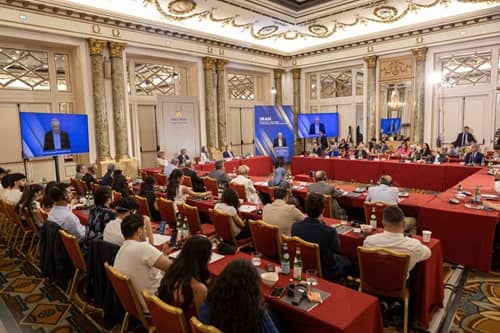
For too long, much of the international debate has focused almost exclusively on the Iranian regime itself, on its sanctions, on its factions, on diplomatic negotiations, on the hope that engagement alone may moderate its behavior. That expectation, as it has been underscored repeatedly by previous speakers, has not been fulfilled. Dialogue, of course, remains an essential instrument of foreign policy, but the experience suggests that lasting political change cannot emerge automatically from diplomatic agreements.
At the same time, recent events remind us of another historical truth: military power, and air power in particular, bombing, rarely determines political outcomes on their own. There’s a long tradition of believing that strategic bombing can decisively transform realities on the ground. History, however, offers many examples that caution against such, such an assumption.
During the Second World War, for example, massive bombing campaign inflicted enormous destruction over Great Britain, first, with no results, obviously, later on Germany, but the Third Reich surrendered only after the collapse of its military forces. Later on in Vietnam, years of bombing failed to achieve the political objectives that had been envisaged. More recently, external military intervention has sometimes altered the course of internal conflicts, but durable political change has ultimately depended on developments within the societies concerned.
The current situation in Iran raises the same question. Even the most powerful military campaign is unlikely by itself to determine the country’s political future. External pressure may weaken military capabilities, but a new political order, when it emerges, and it will emerge, can only be built by the Iranian people themselves.
There is another dimension of the Iranian crisis that deserves particular attention: the economy. I cannot avoid this topic, given my background. Iran’s economic difficulties did not begin with the most recent tensions, nor can they be explained solely by sanctions or international isolation. For decades, Iran’s economic performance has fallen short of its potential. Iran is a country with huge resources, huge human resources, huge natural resources, and yet, economic growth has been weak and unstable, inflation has repeatedly eroded living standards, youth unemployment has remained high, many talented Iranians have, over the years, left the country in search of opportunities elsewhere.
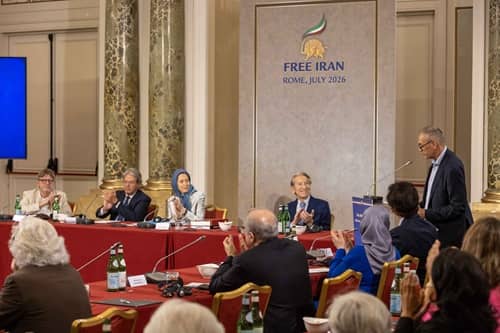
Sanctions have worsened these problems, but the roots of Iran’s economic malaise are much older. These recent developments, this bombing, are actually hiding the truth. The truth is that even without this bombing, even without the sanctions, even without everything else, the Iranian economy has been performing very poorly for years. For years, economists have pointed to structural weaknesses created by misguided policies, excessive state control, deep corruption across the, the power, the powerful, and the dominant, and the dominant role of political and military institutions in large sectors of the economy. Too often, ideological and geopolitical ambitions have taken precedence over economic development and the well-being of ordinary citizens.
The result has been a prolonged deterioration of living standards, living conditions, for millions of Iranians. Against this background, many Iranians seek profound changes. Their aspirations are broad. They seek accountable government, political pluralism, equality before the law, religious freedom, and respect for human dignity.
The NCRI, here I’m underscoring the importance of the ten points of Madame Rajavi’s ten points, have developed proposals for a future based on free elections, the separation of religion and state, the independence of the judiciary, gender equality, minority rights, and the rejection of nuclear militarization.
History teaches us that political systems that appear immovable can change with remarkable speed. Few people believe that, for example, apartheid in South Africa would come to an end when it did. Few imagined that the Berlin Wall would disappear so suddenly. Systems founded on violence, and this is a system founded on violence, often appear stronger than they truly are, until unexpectedly they collapse under the weight of their own contradictions. Our responsibility, as representatives of democratic societies, is not to decide Iran’s future; that choice belongs to the Iranian people. But we do have a responsibility to defend universal principles, to support human rights, and to avoid the illusion that military force alone can shape the destiny of a nation.