

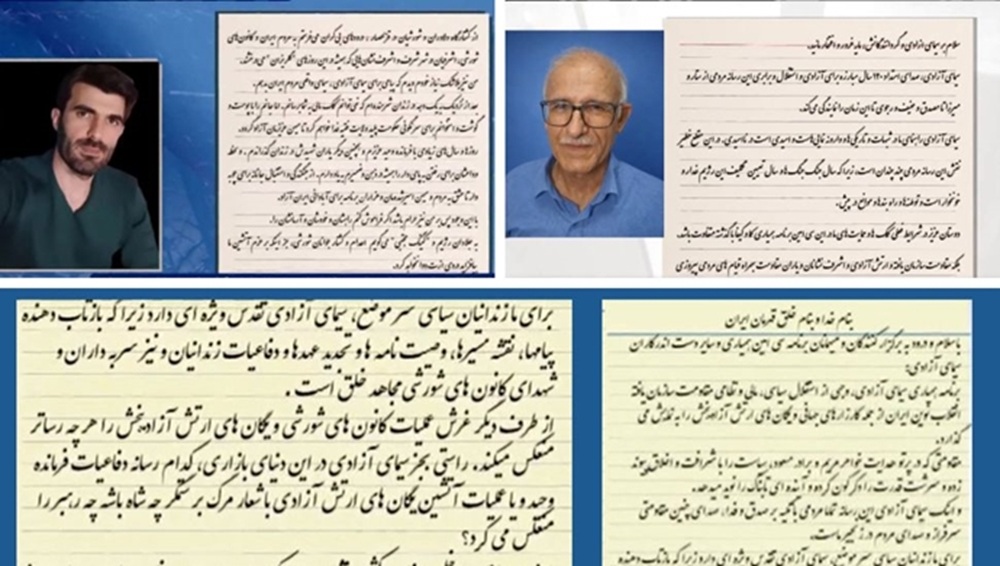
Amid executions, intense repression and relentless pressure on political prisoners, supporters of the People’s Mojahedin Organization of Iran (PMOI/MEK) held in Evin, Ghezel Hesar and Central Karaj prisons have openly declared their support for Simay-e Azadi’s 30th national telethon, turning their prison cells into platforms of defiance against the Iranian regime.
In an extraordinary display of political defiance, Iranian political prisoners supporting the People’s Mojahedin Organization of Iran (PMOI/MEK) have sent messages from several of the country’s most heavily controlled prisons in support of the 30th national telethon of Simay-e Azadi, Iran National Television (INTV), the television network of the Iranian Resistance.
The messages have come from political prisoners in Ghezel Hesar, Central Karaj and Evin prisons at a time when the Iranian authorities have intensified repression and executions and placed political prisoners under enormous pressure. Yet rather than conceal their political allegiance, these prisoners have chosen to publicly identify themselves with the PMOI and the Iranian Resistance.

Their statements carry particular significance precisely because they have been issued from inside prisons where support for the organised opposition can bring severe consequences. They show that imprisonment, executions and intimidation have failed to extinguish political resistance among prisoners who continue to regard themselves as part of the broader struggle against the ruling system.
Ali Moezzi: “Simay-e Azadi is our guide through doubts, darkness and distortions”
Veteran political prisoner Ali Moezzi, writing from Ghezel Hesar Prison, described the present period as the year of the “ultimate battle” and called for exceptionally strong support for Simay-e Azadi’s telethon.
Moezzi wrote: “In the year of the ultimate battle and the final reckoning for this treacherous and bloodthirsty regime, our contributions and support in this 30th telethon must be quantitatively and qualitatively different from the past.”
He paid tribute to the television network and those who operate it, telling them: “Greetings to Simay-e Azadi and its operators; you are our pride and honor.”
For Moezzi, the importance of Simay-e Azadi goes far beyond that of an ordinary broadcasting organization. He presented it as part of the historic struggle of the Iranian people for freedom, writing that it represents a continuation of “120 years of struggle for freedom, independence, and equality”, from figures such as Sattar Khan, Mirza Kuchak Khan and Mohammad Mossadegh to the founders of the PMOI and the contemporary Resistance.
“Simay-e Azadi is our guide through doubts, darkness, and distortions; it is hope amidst despair,” Moezzi wrote.
He concluded his message by expressing support for the organized Resistance, the National Liberation Army, PMOI supporters and the popular uprisings, and paid “endless tributes” to members of the Resistance Units who have lost their lives.
PMOI supporters in Ghezel Hesar and Central Karaj: “Simay-e Azadi holds a special sanctity”
A separate message signed by political prisoners supporting the PMOI in Ghezel Hesar and Central Karaj prisons describes Simay-e Azadi as the voice of an organised resistance whose political and financial independence comes from relying on its own supporters.
The prisoners wrote that for those who have remained steadfast inside prison, the network has a particular meaning:
“For us, the steadfast political prisoners, Simay-e Azadi holds a special sanctity because it reflects the messages, roadmaps, testaments, renewals of vows, and defense statements of prisoners, as well as those who were hanged and the martyrs of the MEK Resistance Units.”
🚨 From Inside Iran: A Resistance Unit Member Donates Her Monthly Salary
Setareh from Karaj, a member of the PMOI Resistance Units, sent a message to Simay Azadi’s 30th Telethon, paying tribute to those who have lost their lives in the struggle for freedom.
Despite describing… https://t.co/MGsRORqZxk pic.twitter.com/owWnjecAit
— SIMAY AZADI TV (@en_simayazadi) August 9, 2026
They specifically referred to Vahid Bani Amerian, known among his fellow prisoners as “Commander Vahid”, and to the operations of the Resistance Units:
“Truly, in this commercialized world, what other media beside Simay-e Azadi would broadcast the defense statements of Commander Vahid or the fiery operations of the Liberation Army units with the slogan ‘Death to the oppressor, be it the Shah or the Supreme Leader’?”
The prisoners called on Iranians both inside and outside the country to support the telethon, describing support for Simay-e Azadi as support for “the people’s front and national solidarity”.
Their reference to Vahid Bani Amerian is particularly significant. Bani Amerian and his fellow MEK prisoners faced execution without abandoning their beliefs. Their conduct in prison and at the gallows has clearly left a deep impression on surviving political prisoners, several of whom refer to them not merely as victims of repression but as examples to be followed.
Loghman Aminpour: “I will sacrifice my life—with my skin, flesh and bones”
Perhaps one of the most powerful messages came from political prisoner Loghman Aminpour, also held in Ghezel Hesar.
Aminpour began his letter by sending greetings from what he called the “slaughterhouse of heroes and rebels in Ghezel Hesar” to the Iranian people, the Resistance Units, PMOI members and supporters of the Iranian Resistance.
After nearly a decade in prison, he explained that he was unable to contribute financially to the telethon. Instead, he offered something far greater:
“After nearly a decade in prison, I am ashamed that I cannot provide you with financial assistance. But I will sacrifice my life—with my skin, flesh, and bones—for the overthrow of the sinister velayat-e faqih regime so that our beloved homeland may be freed.”
🚨 Message from Ghezel Hesar Prison for Simay Azadi’s 30th Telethon
In a message from Ghezel Hesar Prison, political prisoner and PMOI supporter Loghman Aminpour, imprisoned for nearly a decade, expressed his support for Simay Azadi’s Telethon:
“I regret that I cannot offer you… pic.twitter.com/S0amCkM7TH
— SIMAY AZADI TV (@en_simayazadi) August 9, 2026
Aminpour then recalled the years he spent imprisoned alongside Vahid Bani Amerian and his executed companions.
“I spent many days and years in prison with my dear Commander Vahid and his other martyred companions. And I will forever keep in my mind and heart the moment they bid farewell to go to the gallows.”
He remembered their “fighting spirit”, their embrace of the noose, their attachment to the Iranian people and the plans they had envisioned for rebuilding a free Iran.
Aminpour declared that forgetting their path and ideals would be impossible for him.
Addressing the regime’s executioners, he warned: “Executing and massacring rebellious youth will not cure your pains; it will only add to our fiery resolve.”
And he ended with an unequivocal pledge: “I swear by the blood of the companions, we will stand until the end.”
His message illustrates one of the central contradictions confronting the Iranian authorities: executions intended to terrorise political opponents can instead transform those executed into symbols of resistance for the prisoners who survive them.
Vahid Bani Amerian and his fellow prisoners are a powerful example. Facing the ultimate punishment, they remained openly committed to the PMOI and their political beliefs. Aminpour’s testimony shows that their execution did not erase their influence inside prison. On the contrary, their example continues to reinforce the determination of other political prisoners.
Evin prisoners: “Every block and every cell”
The same defiance is visible in a message sent by a group of imprisoned PMOI supporters from Evin Prison.
Writing from behind what they described as the “cold and heavy walls” of Evin, they addressed Iranians and supporters of the Resistance inside and outside the country and thanked them for their material and moral support.
The prisoners emphasised what they see as a defining principle of the Iranian Resistance: financial independence and reliance upon the Iranian people rather than foreign powers. They wrote that throughout decades of struggle, the Resistance “has never extended a hand for help to anyone but its own people”.
Because they were imprisoned, they explained, they could not themselves send money to Simay-e Azadi. Their answer was to pledge something else: continued resistance from inside prison.
They invoked those who had been killed, including Vahid Bani Amerian, Yeganeh, Behrouz, Mehdi Hassani and Mehdi Khanaki, and pledged to carry what they called the “blood-stained flag of the Resistance”.

Their declaration was uncompromising: “To our last breath, we will shout the message of this red flag at every moment and in every place, in every block and every cell, in our minds, our hearts, and our throats.”
They continued: “We will never be caught off guard by the regime, we will not retreat, and we will remain steadfast and resolute to the very end.”
From behind the walls and barbed wire of Evin, their letter concludes with a threefold declaration: “Ready, ready, ready!”
A declaration that repression has failed
These letters should be understood against the backdrop in which they were written.
Iranian political prisoners face the threat of interrogation, isolation, additional charges and execution. The regime has repeatedly used capital punishment against political prisoners in an attempt to impose fear not only inside prisons but throughout society.
Yet these messages show political prisoners doing precisely what such repression is intended to prevent.
They are not merely expressing private sympathy for the PMOI. They are openly identifying themselves as supporters of the organisation, invoking its leaders and fallen members, praising the Resistance Units, supporting Simay-e Azadi and pledging to continue the struggle from inside prison.
The courage involved is difficult to overstate.
For prisoners already deprived of their freedom, openly declaring support for the regime’s principal organised opposition means knowingly exposing themselves to further punishment. Their decision to do so illustrates the extent to which the policy of executions and intimidation has failed to eliminate organised political resistance.
When a prisoner awaiting an uncertain fate says he is prepared to sacrifice his “skin, flesh and bones”; when prisoners remember comrades who went to the gallows but vow not to abandon their path; and when supporters of the PMOI declare that every prison block and every cell can become another place from which the message of resistance is heard, the regime is confronted with something executions alone cannot extinguish: the conscious decision to continue resisting despite knowing the possible cost.