

Weekly Report | August 23–29, 2026
Resistance Units affiliated with the People’s Mojahedin Organization of Iran (PMOI/MEK) carried out a nationwide wave of coordinated underground operations across dozens of Iranian urban centers during the week of August 23–29, 2026, targeting state security apparatuses, intelligence hubs, and government propaganda facilities. Driven by public anger over impending fuel price hikes and an aggressive surge in state-sanctioned executions, Resistance Units executed targeted strikes and public defiance campaigns from the southeastern provinces to the central political heartland. The scale and geographic breadth of these actions highlight a deepening political crisis, exposing significant operational vulnerabilities within the regime’s security network as it attempts to maintain domestic control amid broader geopolitical tensions.
August 28, 2026
Despite stringent security measures, resistance units in Zahedan resumed public activities by displaying political placards across major thoroughfares, explicitly rejecting both the ruling theocracy and any restoration of a monarchical system. Activists posted slogans declaring that dictatorship remains unacceptable regardless of form, while calling for a secular, democratic republic based on free elections and the separation of religion and state. The campaign directly challenged the state’s use of wartime conditions to justify heightened domestic repression. Furthermore, street messages condemned exiled political figures like Reza Pahlavi, criticizing calls for foreign military intervention and alleging connections between his circle and state security organs, including the Ministry of Intelligence and Security (MOIS) and the Islamic Revolutionary Guard Corps (IRGC). Slogans such as “Down with the oppressor, be it the Shah or the supreme leader” emphasized the stance that systemic political change must be driven independently from within Iran.
🚨 EXCLUSIVE | Highlights of PMOI Resistance Units Operations Across Iran
Footage received exclusively by Simay Azadi shows highlights of operations carried out by PMOI Resistance Units across Iran on August 27, targeting IRGC Basij and other regime-affiliated centers and… pic.twitter.com/ut1RDpm1ME— SIMAY AZADI TV (@en_simayazadi) August 28, 2026
August 27, 2026
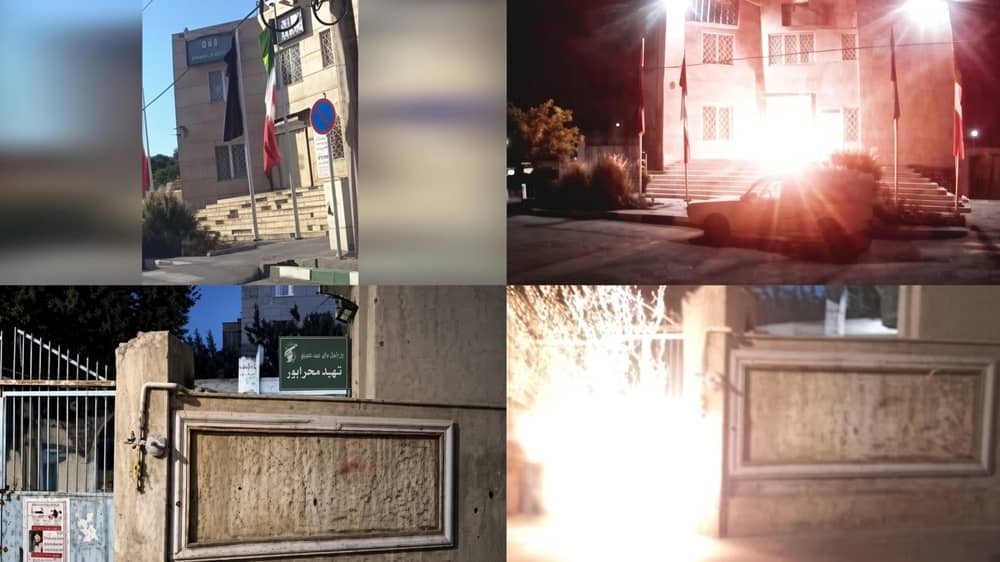
Resistance Units launched a coordinated nationwide campaign titled “60 Fiery Warnings” in response to government plans to increase gasoline prices, warning that price increases would trigger widespread unrest comparable to the 2019 protests. In Tehran, operatives used Molotov cocktails to ignite a blaze at the Supreme Leader’s Representative Office for Hajj and Pilgrimage, while state banners depicting Ali Khamenei and Qassem Soleimani were set on fire across three separate locations. In Karaj, an IRGC Basij base was struck with incendiaries alongside the destruction of state banners. Institutional and administrative sites were also targeted; in Mashhad, fires were set at a local seminary, a municipal building in District 6 utilized by security forces, and multiple propaganda sites. In Kermanshah, operatives torched a seminary, an anti-student Basij center, and several state banners.
Direct strikes against security and espionage facilities expanded across provincial regions. In Shadegan, an IRGC Basij facility was hit with Molotov cocktails. Units in Iranshahr set fire to a Basij center and two additional IRGC Basij posts. Operational gathering points were targeted in Borazjan, while in Chabahar, intelligence directional signboards for both the IRGC Basij and the MOIS were destroyed by fire. A security and intelligence center in Borujen was set ablaze, and an IRGC Basij post in Dezful was torched alongside banners honoring Soleimani.
PMOI Resistance Units echo the ‘No to Executions’ call across Iran’s streets https://t.co/PWOojJmzJe
— People's Mojahedin Organization of Iran (PMOI/MEK) (@Mojahedineng) August 26, 2026
Simultaneously, propaganda removal operations were conducted across a broad geographic area. Banners displaying figures of the supreme leadership were torched in Khomeyn, Babol, Damavand, Shiraz, Yazd, and Arak. Additional acts of propaganda destruction occurred in Bandar Abbas, Khorramabad, Ilam, Nurabad Mamasani, and Damghan. In Zahedan, Saravan, and Sarbaz, operations specifically targeted imagery of Mojtaba Khamenei. Further banner burnings were reported in Zabol—where imagery of the regime’s president Masoud Pezeshkian was destroyed—as well as Lordegan, Bam, Aligudarz, Azna, and Semirom. In Saveh, units destroyed banners featuring Soleimani and Iraqi proxy leader Abu Mahdi al-Muhandis.
August 25, 2026
Marking the 135th week of the “No to Executions Tuesdays” campaign, which has seen striking political prisoners across 61 prisons protest capital punishment, resistance groups conducted public demonstrations and memorial actions in urban areas. The Resistance Units served as a direct counter-response to the judicial execution of over 4,000 individuals since 2024, including 378 recorded since March 2026. In Isfahan, activists placed a memorial wreath for Hamed Validi, a 45-year-old civil engineer executed in April. In Arak, a similar memorial was displayed for Pouya Ghobadi, a 33-year-old electrical engineer executed in March following severe detention conditions in Evin Prison.
Street-level campaigns focused heavily on active death row cases. In Ahvaz, placards were posted condemning the confirmed death sentence of female political prisoner Arghavan Fallahi. Activists in Sanandaj installed posters reading “From Kurdistan to Tehran, everyone is against executions”. Synchronized visual campaigns, graffiti, and anti-execution messaging were also documented in Rasht, Mashhad, and Varamin, demonstrating organized coordination despite active surveillance.
August 21—Zahedan, southeast Iran
PMOI/MEK Resistance Units resume weekly anti-regime activities, rejecting all forms of tyranny, including the mullahs' religious fascism and the shah's dictatorship. pic.twitter.com/PiMELsUeqO— People's Mojahedin Organization of Iran (PMOI/MEK) (@Mojahedineng) August 22, 2026
The operations conducted between August 23 and 29 indicate that the Iranian regime’s reliance on executions and external conflict rhetoric to intimidate the domestic population is failing to contain civil resistance. The persistent, widespread strikes against IRGC facilities and state symbols across both major cities and regional towns highlight an operational vulnerability in the state’s internal security apparatus. Rather than projecting an image of invincibility, the regime faces an internal political deadlock, confronted by an organized underground movement that systematically challenges state authority while rejecting both current theocratic rule and past monarchical governance.