

Three-minute read
Mojtaba Khamenei’s attempt to suppress factional warfare inside Iran’s clerical dictatorship is already producing the opposite effect. On August 28, he ordered officials to avoid “discouraging” statements and declared that “anything that harms social cohesion is forbidden,” specifically warning against polarization over “war or negotiation.” His concern went beyond political etiquette: he also warned that openly describing weaknesses could damage the morale of the regime’s own supporters.
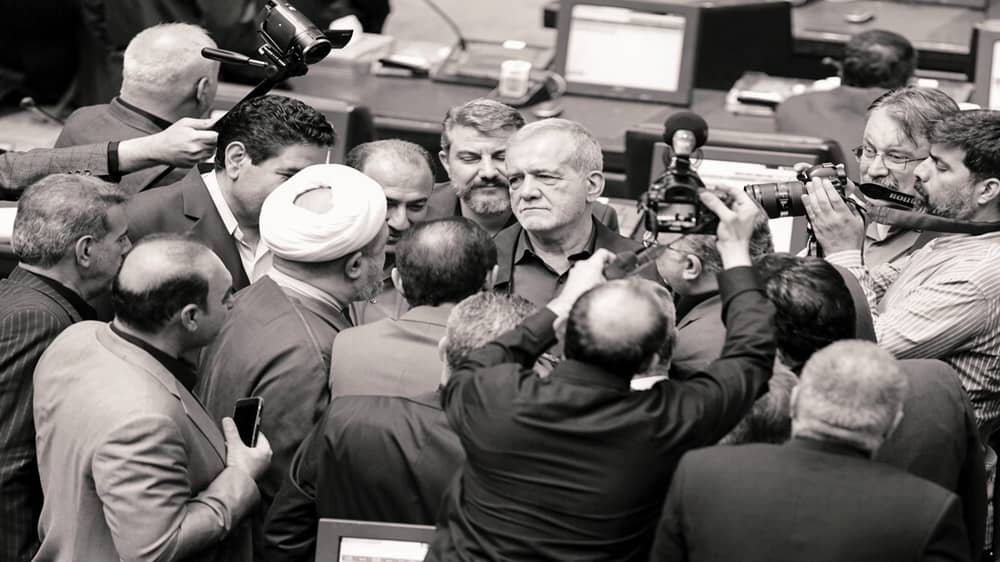
But hardline forces immediately turned that injunction against the regime’s president, Masoud Pezeshkian, and his circle. Kayhan, whose director is appointed by the supreme leader, accused elements in the government of promoting “weakness” and urged Pezeshkian to purge what it called a “unity-breaking” current from the executive branch. The target included executive vice president Mohammad Jafar Ghaempanah and Yusef Pezeshkian, the regime president’s son and adviser, who argued that Iran’s “survival is not dependent on enrichment” and that nuclear policy should be judged by costs and benefits rather than treated as untouchable.
The dispute exposes the contradiction in Mojtaba’s order. Pezeshkian presents himself as a champion of “unity,” yet his case for changing course depends on publicly describing economic damage—the very practice Mojtaba cautioned against. Pezeshkian has argued that sanctions are driving prices higher and has challenged those claiming sanctions have no effect. The IRGC-run Tasnim carried his lengthy televised defense of the government’s approach on August 28.
Mojtaba Orders Iran’s Factions to Stop Fighting as Pezeshkian Uses #Economic Crisis to Press for Talks
by @MansoreGolestan https://t.co/BF4MO3L3GL— NCRI-FAC (@iran_policy) August 29, 2026
Hardline MP Hamid Rasaei went further, accusing the regime’s president of effectively defying Mojtaba Khamenei only hours after his call for cohesion. Rasaee said Pezeshkian had “lit the green light for disregarding the leader’s recommendations” by announcing a possible rise in the third-tier gasoline price to 10,000 tomans and by publicly emphasizing the regime’s economic weaknesses. He compiled some 20 examples of what he called Pezeshkian’s “black-painting and magnification of weaknesses,” including his admissions that Iran cannot currently sell oil normally, lacks sufficient revenue and foreign currency, faces banking, electricity, water and gas problems, and could suffer still higher prices if sanctions persist. Rasaee concluded: “If you cannot [govern], instead of pumping despair and hopelessness, return the people’s trust.”
Currency, Fuel and Medicine
The political battle is intensifying because the economic pressures are becoming harder to conceal. The currency crisis worsened further on August 31, with the free-market dollar crossing the 210,000-toman threshold and setting another record. By contrast, Tasnim reported the official remittance rate at the Iran Exchange Center at 158,955 tomans, underscoring the widening gap between the managed official rate and the price prevailing in the open market.
Dollar Hits 208,000 Tomans as #Fuel Strains Deepen and Tehran Fears Another Price Shock
By @MansoreGolestan https://t.co/GSfpgaAEIi— NCRI-FAC (@iran_policy) August 30, 2026
Fuel remains another vulnerability. Tasnim acknowledged that Tehran’s queues are occurring alongside severe damage to its distribution infrastructure: two principal fuel depots were put out of operation and another was functioning at sharply reduced capacity, forcing additional tanker deliveries from outside the capital. Officials have blamed increased consumption and rumors, but their own reporting shows that the supply network has lost substantial resilience.
The medicine sector shows how the currency problem is spreading into basic services. On August 19, the head of the regime’s Food and Drug Administration told state media that foreign-exchange transfers for medicine had been stalled or severely slowed for roughly six months. For one to two months, he said, transfers had “almost stopped,” even though pharmaceutical companies had already paid the rial equivalent. He directly linked the disruption to the surge in medicine shortages.
"Iran’s clerical establishment is confronting several crises at once, but the most dangerous feature is that each is feeding the others," writes Amir Taghati.https://t.co/w0JJirUpgB
— NCRI-FAC (@iran_policy) August 28, 2026
From Economic Crisis to Security Threat
The ruling establishment is increasingly preparing for the political consequences rather than merely the economic ones. On August 31, judiciary chief Gholamhossein Mohseni-Ejei said the regime’s intelligence, security and police forces were at their “highest level of readiness” and warned that attempts to create domestic unrest would receive a “firm response.” Tasnim’s own headline framed the issue explicitly as the threat of “internal unrest.”
The warning comes as both protest activity and punitive measures are continuing across the country. On August 31, retirees demonstrated in Isfahan, Sanandaj and Shush over living costs, corruption and unpaid demands, chanting that neither parliament nor the government “thinks about the people.” Health workers in Hamadan had also protested over delayed payments and deteriorating working conditions. At the same time, the judiciary has continued imposing heavy sentences on people arrested during the January 2026 protests: one Mashhad protester received more than 12 years in prison, 13 defendants in Qorveh were collectively sentenced to more than 26 years and 196 lashes, and reports from Isfahan say 10 defendants in the “Meydan Shohada” case were sentenced to death, while others received lengthy prison terms.
"State-affiliated media in Iran have recently acknowledged what ordinary Iranians have experienced for years: the country’s #economic resilience is weakening," Farid Mahoutchi writes.https://t.co/fZKKlfQMkn
— NCRI-FAC (@iran_policy) August 27, 2026
Separate reporting has documented additional arrests, prosecutions and new sentences against political prisoners and protesters in several provinces. The pattern suggests that the regime is confronting renewed socioeconomic protests while simultaneously expanding the legal and security pressure on those involved in the previous nationwide uprising.
That is the significance of the convergence now confronting Iran’s clerical dictatorship. Mojtaba wants weaknesses kept from public view to preserve cohesion; Pezeshkian’s camp needs those same weaknesses acknowledged to justify a change in policy; hardliners portray such admissions as defeatism. Meanwhile, currency pressure, damaged fuel infrastructure and medicine shortages continue independently of the propaganda battle. The regime is therefore approaching unavoidable economic decisions while its own security apparatus is already warning about the unrest those pressures could help produce.