

THIS PAGE WILL BE UPDATED WITH THE LATEST NEWS
UPDATE: 7:30 AM CEST
PMOI Resistance Units Mark 61st Anniversary with Nationwide Acts of Defiance
Ahead of the 61st anniversary of the founding of the People’s Mojahedin Organization of Iran (PMOI/MEK), Resistance Units have marked the occasion with activities across Iran, including a march by a Resistance Unit in Karaj and 30 slogan-writing activities in cities across the country.
The activities, reported on September 3, took place in Tehran, Karaj, Mashhad, Qom, Shiraz, Rasht, Ahvaz, Kermanshah, Bandar Abbas, Hamedan, Zanjan, Ilam, Sanandaj, Sabzevar, Saveh, Ivan Sarab, Bukan, Minab, and Islamabad-e Gharb. They come ahead of September 6, the anniversary of the PMOI’s founding in 1965.
🚨 EXCLUSIVE | PMOI Resistance Unit Holds Parade in Karaj
Exclusive footage received by Simay Azadi shows a unit of the PMOI Resistance Units holding a parade in Karaj on September 3, 2026, marking the 61st anniversary of the founding of the People’s Mojahedin Organization of… pic.twitter.com/7Y4RUDIx5y— SIMAY AZADI TV (@en_simayazadi) September 4, 2026
The slogans displayed by the Resistance Units connected the anniversary directly to the PMOI’s political history and its rejection of both the former monarchy and the ruling clerical establishment.
Among the messages were: “The PMOI means 61 years of ‘neither Shah nor mullahs,’” “61 years of struggle,” “Death to the oppressor, be it the Shah or the Supreme Leader,” and “Neither monarchy nor mullahs’ rule—democracy and equality.”
‘This Beginning Has No End’: Mehdi Vafaei Sani Marks 61 Years of PMOI Resistance from Prison

As the People’s Mojahedin Organization of Iran (PMOI/MEK) approaches the 61st anniversary of its founding on September 6, political prisoner Mehdi Vafaei Sani has sent a message from Ghezel Hesar Prison reflecting on how more than six decades of repression have failed to extinguish the movement or prevent a new generation from continuing its resistance. Looking back at the PMOI’s history, Vafaei Sani argues that the movement has “created evolution within itself” while paying an immeasurable price in its struggle against dictatorship.
But the most significant part of his message concerns what he has witnessed inside Iran’s prisons: prisoners who have never lived within the PMOI’s organizational structure, but who nevertheless reproduce the same culture of resistance.
Vafaei Sani writes that most PMOI supporters and Resistance Units he encounters in prison “have never been within the ranks and collective of the Mojahedin.” Yet, he says, they “stand firm and grow” with an extraordinary resemblance to the PMOI’s organizational culture and with a resistance similar to that of the political prisoners massacred in 1988.
Iranian Political Prisoner Shiva Esmaeili Denied Urgent Spinal Surgery

Iranian political prisoner Shiva Esmaeili, who is serving 10 years in Evin Prison, is being denied medical treatment despite suffering from a serious spinal condition and severe back pain.
Doctors determined more than a year ago that spinal surgery was necessary for Shiva Esmaeili. However, Evin Prison authorities and the regime’s judiciary have so far refused to allow her to undergo surgery or continue receiving the medical care she needs. The severity of her pain has left Esmaeili unable to move normally, and she can perform everyday tasks only with the assistance of fellow prisoners. Her severe pain is caused by spinal canal stenosis and problems with the vertebrae in her lower back.
Prison authorities had previously returned her to the ward when she was being taken to the hospital, citing insufficient funds in her bank account. They also denied her permission to contact her family to obtain financial assistance for her medical treatment.
Born in 1965, Shiva Esmaeli is the mother of three children. She holds a degree in agricultural engineering and is a resident of Tehran.
PMOI Resistance Units Report 150 Actions Across Iran on 61st Anniversary
Resistance Units of the People’s Mojahedin Organization of Iran (PMOI/MEK) carried out 150 reported activities across Iran to mark the 61st anniversary of the organization’s founding, according to material released by the Iranian Resistance.
The reported actions included collective activities, banners and emblems displayed in public locations, images of the organization’s founders, mountain-climbing actions, flower tributes, and graffiti in numerous cities. The activities were reported in Tehran, Tabriz, Urmia, Mashhad, Karaj, Isfahan, Shiraz, Qom, Ahvaz, Sari, Kermanshah, Kerman, Hamadan, Arak, Khorramabad, Sanandaj, Zabol, Kashan, Saveh, Iranshahr, Marvdasht, Qaemshahr, Behshahr, Fasa, Malayer, Baneh, Shirvan, Tabas, and other locations.
The actions focused on the PMOI’s six decades of political struggle and its stated opposition to both the former monarchy and the current clerical regime.
A recurring message throughout the reported activities was the commemoration of 61 years of what participants described as uninterrupted resistance.
War and Repression: The Iranian Regime’s Twin Tools for Preventing Another Uprising
The Iranian regime has once again intensified its warnings about “riots” and “disorder,” accompanied by increasingly explicit threats against the Iranian people, particularly young people. The language used by senior officials reveals more than a security policy. It reflects a profound fear that the country’s mounting economic, social, and political crises could once again converge into a nationwide uprising. The issue has become prominent across different factions of the regime. Parliament Speaker Mohammad Bagher Ghalibaf described the current confrontation as a “hybrid war,” claiming that its objective was to create “disorder and unrest” inside Iran.
Judiciary Chief Gholam-Hossein Mohseni Ejei issued an even more direct warning, saying that if anyone attempted to create “riots” or “disorder,” the response from the police, security and intelligence forces, as well as the judiciary, would be “very strong and decisive,” adding that it would be harsher than in previous periods.
These statements point to a shared fear among the regime’s factions: the possibility of another uprising. Yet, despite their common concern, they disagree over how best to prevent it.
Iran’s Regime Rejects Retrial Request by Protester Sentenced to Death

On Wednesday, September 2, human rights media outlets reported the continued detention and interrogation of opponents of Iran’s regime, and announced that the regime’s judiciary, after rejecting Alireza Sepahi’s request for a retrial without holding a hearing, had sent his case to the sentence enforcement branch for implementation of the death penalty.
Shahrzad Shahbazi, the lawyer of Alireza Sepahi, announced that a parallel branch of the Isfahan Revolutionary Court, despite the authorization for a retrial by Branch 39 of Iran’s Supreme Court, rejected her client’s retrial request without holding a hearing and sent his case to the sentence enforcement branch for implementation of the death penalty.
Ms. Shahbazi emphasized that despite the rejection of the previous request, she would submit another retrial request on Saturday, September 4, and would pursue “all legal avenues to halt the implementation of the sentence and have the case reviewed again.”
Alireza Sepahi, one of the defendants in the case known as the “Isfahan Alikhani Square” case, was scheduled to be executed early Tuesday morning, July 28, along with Abolfazl Sepahi Badehjani and Amirhossein Safar-Hosseiniabadi. However, before being transferred to the execution site, he suffered a stroke and was taken to a hospital due to his critical physical condition. Two days later, after receiving medical treatment, he was returned to Dastgerd Prison in Isfahan.
Corruption in Iran’s Ports Reaches the Regime’s Parliament
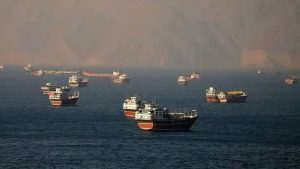
The corruption case in Iran’s ports has once again become one of the controversial issues in the regime’s parliament. According to Didban Iran website, during the parliament’s virtual session on Tuesday, September 1, the members reviewed a report by the parliament’s Civil Engineering Commission concerning a request to investigate and audit the performance of the Ports and Maritime Organization. The request was approved with 152 votes in favor, 27 against, and eight abstentions, out of 245 members present.
Majlis member Moslem Salehi has reported financial irregularities at some of the country’s ports. He said that at certain points, more than 1 trillion rials had been withdrawn from financial accounts. Salehi also spoke of weak internal controls and regulatory gaps. He called for a thorough review of the financial processes and monetary systems of the Ports and Maritime Organization.
However, the published documents raise more serious questions. An audit report has reported an embezzlement of 1.08 trillion rials at the port known as Imam Khomeini Port. The same report also pointed to weak oversight of the banking payment process.
At least 82 people executed in Iran in August, including four political prisoners

Iran News Wire’s monthly review of repression and human rights violations in Iran recorded at least 82 executions, 152 arrests and the deaths of nine people in shootings by security forces in August 2026. Four of those executed were identified in the review as political prisoners.
The published report on human rights violations in Iran shows that at least 82 people were executed in prisons across the country in August 2026, including six women and four political prisoners. The compiled data also recorded at least 152 arrests and the deaths of nine people in shootings by security forces in cities and on roads across Iran. Two women who had previously been arrested during the January 2026 protests were also rearrested, subjected to flogging and then transferred to prison to serve their sentences.
According to the review, among the 82 people executed in August, six were Baluch, eight were Kurdish and one was an Afghan national. The compiled figures include six women, 72 men and four political prisoners.
Paris Exhibition Exposes Iran Executions, Demands Accountability for Mullah Regime’s Crimes
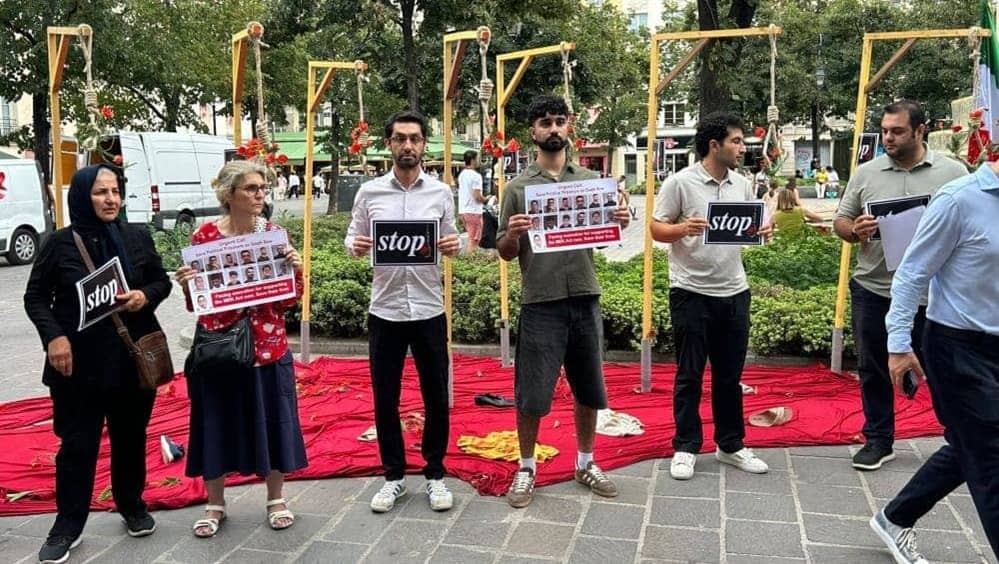
Paris, France – September 3, 2026 – Supporters of the People’s Mojahedin Organization of Iran (PMOI/MEK) set up a book table and photo exhibition in Paris to denounce the execution of political prisoners and the ongoing detention of protesters arrested during Iran’s January 2026 uprising.
The event underscored what organizers described as the Iranian people’s demand for a democratic republic and their aspirations for peace, freedom, justice and fundamental rights. It also highlighted the Iranian Resistance’s call for greater international solidarity with the people of Iran.

Organizers called on the French public and the international community to acknowledge the suffering of the Iranian people and their rejection of all forms of dictatorship, whether monarchical or theocratic.
Through photographs, personal testimonies, and other materials, the exhibition highlighted the courage and sacrifices of those who participated in the January 2026 uprising. It also drew attention to what organizers described as the Iranian regime’s ongoing human rights violations, including the execution of political prisoners and the continued detention of protesters.