

THIS PAGE WILL BE UPDATED WITH THE LATEST NEWS
UPDATE: 8:00 PM CEST
US Issues Sanctions on Turkish Bank That It Calls A ‘Critical Financial Lifeline’ For Iran

WASHINGTON (AP) — The Trump administration announced Friday that it has imposed sanctions on a Turkish financial institution as part of its latest effort to sever “critical financial lifelines” for the Iranian government.
The actions against Golden Global Yatirim Bankasi Anonim Sirketi come after Treasury Secretary Scott Bessent last week launched “Operation Economic Outcast, ” Washington’s new effort to isolate already heavily sanctioned Iran from its remaining trading partners to try to get it to capitulate to U.S. demands after more than six months of war.
The Treasury Department accused the Turkish bank and its entities of being established to enable Iran’s efforts to transfer oil revenues from China to Turkey, where they could then be converted to cash and gold. It also said the institution “knowingly offered” banking services to Iranian financial entities, including those already sanctioned by the U.S. government in 2022 for funneling Tehran’s oil sales.
Bessent, who had told The Associated Press earlier this week that another bank would face economic penalties, said financial institutions with ties to Iran will “continue to find out the hard way that we are serious about Operation Economic Outcast.”
UPDATE: 3:00 PM CEST
Oman Quietly Rejects Iran’s Pitch for Strait of Hormuz Fees — Despite IRGC Claim of Deal

WASHINGTON — Oman has quietly rejected Iran’s request to jointly charge service fees on commercial ships in the Strait of Hormuz, The Post has learned — averting a clash with President Trump, who has threatened to rain down bombs on the US ally. A high-ranking regional official said that Muscat declined to consent to charging fees — even on a voluntary basis — for environmental and security services, contrary to a statement last week from Iran’s Islamic Revolutionary Guard Corps.
The terms of a proposed revenue-sharing deal had not been finalized, even by Tehran, a US official told The Post last week — indicating the IRGC jumped the gun.
Trump twice threatened to bomb Oman if it agrees to de facto tolling of the waterway, saying on Aug. 17: “If Oman gets in the way, we’ll bomb the s–t out of them.”
Reward Up to $10 Million for Informaiton on Amir Yaryab

Rewards for Justice is offering a reward of up to $10 million for information leading to the identification or location of any person who, while acting at the direction or under the control of a foreign government, participates in malicious cyber activities against U.S. critical infrastructure in violation of the Computer Fraud and Abuse Act (CFAA).
Under this reward offer, RFJ is seeking information on Amir Yaryab, a senior official in Iran’s Islamic Revolutionary Guard Corps Cyber-Electronic Command (IRGC-CEC). Yaryab leads the IRGC-CEC’s Cyber Operations Command.
He also directs multiple components of Iran’s IRGC-CEC, including Shahid Hemmat and Shahid Shushtari. These malicious cyber groups have conducted cyber and cyber-enabled information operations targeting critical infrastructure sectors including defense, news, shipping, travel (hotels and airlines), energy, and financial and telecommunications systems in the United States, Europe, and the Middle East.
U.S. ‘Economic Outcast’ Operation Gains Momentum as EU Joins Sanctions; South Korea Weighs Military Backing

The European Union has formally joined the U.S.-led sanctions campaign against Iran, while South Korea said it’s weighing a military role to help reopen the Strait of Hormuz, as Washington presses allies to back its war against Tehran on both the financial and military fronts.
U.S. Treasury Secretary Scott Bessent praised the EU for signing on to “Operation Economic Outcast,” the campaign aimed at severing Tehran from the global financial system.
“We appreciate their strong and early stance,” Bessent said in a social media post Thursday evening stateside. “The world is sending a clear message to the Iranian regime: We will not stop until every remaining financial lifeline has been severed,” he added.
The comments came after Brussels, in a statement on Aug. 31, said it supported efforts aimed at stopping the “destabilizing activities” by Tehran and resuming peace talks, including through Operation Economic Outcast, to apply additional economic pressure against the Islamic regime.
Former US Energy Secretary Predicts Iranian Regime’s Collapse
Former U.S. Energy Secretary Dan Brouillette said the Iranian regime will eventually collapse under mounting economic pressure, predicting that the Strait of Hormuz will subsequently reopen fully to international trade and navigation.
Speaking to Fox News Business host Larry Kudlow, Brouillette said the continued need for U.S. Navy escorts for oil tankers showed that the Strait remains a major risk to global energy markets. He argued that once the conflict subsides and the Strait is fully open, oil prices could fall significantly.
“The day is coming when this regime will collapse,” Brouillette said, adding that the Strait would then be open to trade and navigation and that oil prices would drop.

The former energy secretary also pointed to economic measures against Iran and efforts to expand U.S. energy infrastructure as factors that could reshape global oil markets. He said increased U.S. production and refining capacity would contribute to downward pressure on prices.
Brouillette said the timing of such changes remained uncertain but insisted that a decline in oil prices was ultimately inevitable.
UN Investigators Urge Iran to Withdraw Bill Punishing Foreign Contact

A team of United Nations investigators called on Iran Thursday to immediately withdraw draft legislation that could lead to decades-long prison sentences for simply communicating with foreign persons or entities.
The U.N.’s Independent International Fact-Finding Mission on Iran said it was “appalled” by the bill currently before the Iranian parliament, warning that it constituted “a dangerous escalation in suppressing fundamental freedoms and isolating Iranians from the international community.”
The text has yet to be finalized, but the draft says “any activity or communication by natural or legal persons, whether Iranian or foreign, that undermines independence, national unity, Islamic standards, or national sovereignty” would be prohibited.
The draft legislation is aimed at protecting “the independence, sovereignty, national unity, and cultural identity” of Iran, it says.
UPDATE: 7:00 AM CEST
‘Prison And the Gallows Cannot Silence Us’: Political Prisoners Mark PMOI’s 61st Anniversary
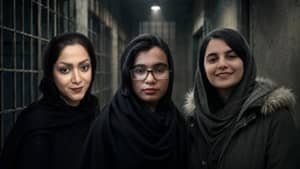
On the eve of the 61st anniversary of the founding of the People’s Mojahedin Organization of Iran (PMOI/MEK) on September 6, political prisoners in Evin and Yazd prisons have sent messages marking the occasion and declaring that decades of imprisonment and executions have failed to extinguish the resistance that began in 1965.
In a joint message from Evin Prison, political prisoners Arghavan Fallahi and Forough Taghipour trace their struggle from the PMOI’s founders to the political prisoners executed in 1988 and a new generation of PMOI supporters who have been executed in recent months. Their message culminates in a direct response to the regime’s repression: “Put us in prison or close our throats with the hangman’s noose; we have become one living spirit that never dies.”
From Yazd Central Prison, political prisoner Parisa Kamali describes the anniversary in deeply personal terms. “If today I stand on the right side of history, I owe it to the People’s Mojahedin Organization of Iran,” she writes, adding that the organization “opened my eyes to the realities.”
Pezeshkian–State TV Clash Exposes Deepening Divisions Inside Iran’s Regime
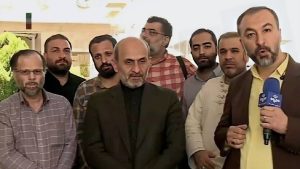
A public exchange between regime President Masoud Pezeshkian and Peyman Jebelli, head of Iran’s state broadcaster, has exposed another layer of growing factional tensions at the top of the regime. The dispute is particularly revealing because it erupted almost immediately after Mojtaba Khamenei called for unity and warned against political “dualities” within the ruling establishment.
A new public dispute between Masoud Pezeshkian and Peyman Jebelli, head of the Islamic Republic of Iran Broadcasting (IRIB), has brought internal tensions within the Iranian regime into the open.
What began as criticism of state television’s coverage has developed into an unusually direct exchange between the regime’s president and the head of its main propaganda apparatus. More importantly, the confrontation comes at a time when the regime’s leadership is publicly demanding greater unity amid mounting political, economic, and military pressures.
Iran’s Gasoline Crisis: Poor Fuel Quality Puts Millions at Risk
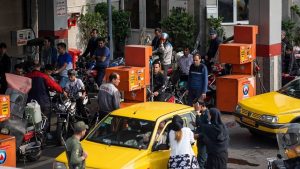
Iran’s gasoline crisis is increasingly being defined not only by shortages, long lines, and rising prices, but also by a less visible danger: the poor quality of the fuel itself. Elevated levels of sulfur, benzene, and other chemical pollutants in gasoline are raising serious environmental and public-health concerns, potentially exposing millions of Iranians to toxic emissions.
For years, public discussion of Iran’s gasoline crisis has largely focused on shortages, rationing, price increases, and the long queues outside filling stations. Yet another dimension of the crisis has received considerably less attention: the quality of the gasoline being produced and distributed across the country.
Iranian authorities have repeatedly claimed that domestically produced gasoline meets Euro 4 and Euro 5 standards. However, available reports and comments from specialists raise serious questions about these claims.
One of the most significant concerns involves sulfur content. Under Euro 4 and Euro 5 fuel standards, sulfur in gasoline is generally limited to 10 parts per million (ppm).
Before the War, Iran’s Economy Was Already in Crisis
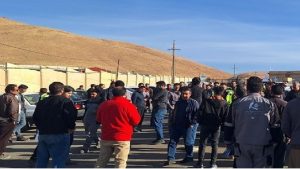
As Iran moves through a turbulent period of war, negotiations, and conflicting political messages, regime officials and affiliated commentators are engaged in an increasingly visible effort to shift responsibility for the country’s economic collapse. But mounting evidence and even admissions from regime-linked analysts indicate that inflation, soaring food prices, and widespread economic distress were already accelerating before the war began.
These days, Iran’s political landscape is dominated by a confusing mix of war rhetoric, negotiations, proposed agreements, and counter-agreements. Amid this turmoil, regime officials and insiders have increasingly turned the economic crisis into a political blame game.
The underlying issue, however, is difficult to conceal: years of mismanagement, corruption, rent-seeking, and organized economic plunder have left the Iranian economy deeply weakened. The war and sanctions are now being invoked as convenient explanations for problems that were already becoming acute.
This effort to control the public interpretation of the crisis recalls the political dynamics described by political theorist Franz Neumann, particularly the use of political power to influence and manage popular reactions. In Iran, the regime’s messaging appears increasingly focused not only on managing the economy, but also on managing how society understands its economic suffering.
Iran: Surge in Executions & Protest Death Sentences

In recent days, alongside heightened warnings and threats from judicial and security officials of the Islamic Republic of Iran regarding the suppression of potential protests, grave concerns have escalated over the status of individuals facing the death penalty in connection with protests and political/security-related cases.

On August 31, 2026, Gholamhossein Mohseni Eje’i, the Head of the Judiciary of the Islamic Republic of Iran, stated: “If they intend to spark riots or unrest in Iran again, they should be certain that they will receive a very strong and decisive response.” Referring to what he described as “anti-security actions,” he also affirmed the readiness of responsible bodies to confront such activities.
Prior to this, the Intelligence Organization of the Islamic Revolutionary Guard Corps (IRGC) issued a statement on August 27, 2026, warning against what it characterized as “exaggerating and exploiting internal weaknesses, shortages, and limitations,” “inciting the public to bring dissatisfaction to the streets,” and “disrupting stability and diminishing national resilience,” framing “confronting any action that disrupts public peace” as one of its primary duties. Additionally, Ahmad Bakhshayesh, a member of the Islamic Consultative Assembly (Majlis), acknowledged that livelihood hardships and prevailing economic conditions have heightened the motivation for protest among a segment of society.
Out-of-School Children in Iran: A Statistical Account

As the 2026–2027 academic year approaches, official reports and statistics published by Iranian educational authorities highlight serious concerns regarding children’s continuous access to education and the rise in out-of-school children. Although authorities report the enrollment of more than one million students in the first grade of primary school, official data and domestic media reports indicate that a significant proportion of children either do not enter the educational system from the outset or drop out of the learning cycle in subsequent years.
Rezvan Hakimzadeh, Deputy for Primary Education at the Ministry of Education, announced that out of 1,154,000 children eligible for first-grade enrollment, more than one million have finalized their registration; however, the status of a portion of eligible children remains undetermined. This situation indicates that the educational gap begins at the very point of entry into school.
While statistics report millions of enrollments in the first grade, realities reveal deep structural gaps—ranging from children who are denied the opportunity to register from the beginning to students who drop out during middle grades.
According to official statistics recorded in the “Shahid Mahmoudvand” system, a total of 141,837 out-of-school students aged 6 to 11 have been identified, including 78,670 boys and 63,167 girls. According to the Deputy for Primary Education, boys account for approximately 55.5%, and girls account for 44.5% of this total.
MEK Supporters Stage Paris Exhibition Condemning Iran Executions and Calling for a Democratic Republic

Paris, France – September 2, 2026 – Supporters of the People’s Mojahedin Organization of Iran (PMOI/MEK) held a book table and photo display in Paris to denounce the executions of political prisoners and the continued detention of protesters arrested during Iran’s January 2026 uprising.
The event highlighted what organizers described as the Iranian people’s call for a democratic republic and their aspirations for peace, freedom, justice, and fundamental rights. It also emphasized the Iranian Resistance’s appeal for greater international solidarity with the Iranian people.
Organizers called on the French public and the international community to acknowledge the suffering of the Iranian people and their rejection of all forms of dictatorship, whether monarchical or theocratic.
Through photographs, personal testimonies, and other materials, the exhibition highlighted the courage and sacrifices of those who participated in the January 2026 uprising. It also drew attention to what organizers described as the Iranian regime’s ongoing human rights violations, including the execution of political prisoners and the continued detention of protesters.
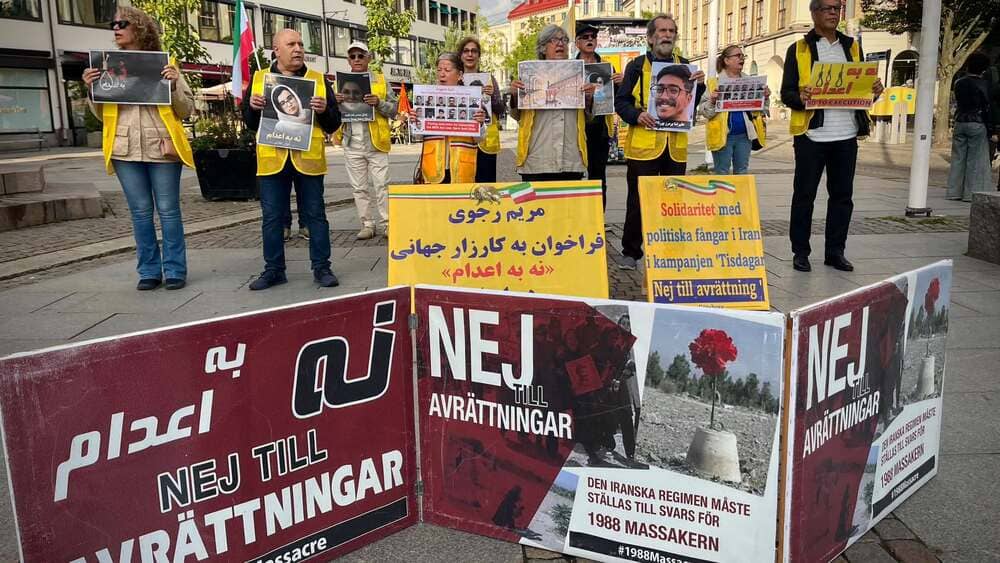
Gothenburg Rally Supports 136th Week of “No to Execution Tuesdays” in 62 Prisons Across Iran
Gothenburg, Sweden — September 1, 2026: Supporters of the People’s Mojahedin Organization of Iran (PMOI/MEK) held a rally in solidarity with the 136th consecutive week of the “No to Execution Tuesdays” campaign, a movement protesting the Iranian regime’s escalating executions and systematic repression.

Participants also highlighted the regime’s intensifying crackdown, the rising number of executions, and broader repressive measures. They chanted slogans such as “Down with the executioner regime” and called for the immediate release of all political prisoners.
Freedom-loving Iranians in Gothenburg expressed support for Mrs. Maryam Rajavi, President-elect of the National Council of Resistance of Iran (NCRI), and her call to expand the “No to Executions” campaign globally.