

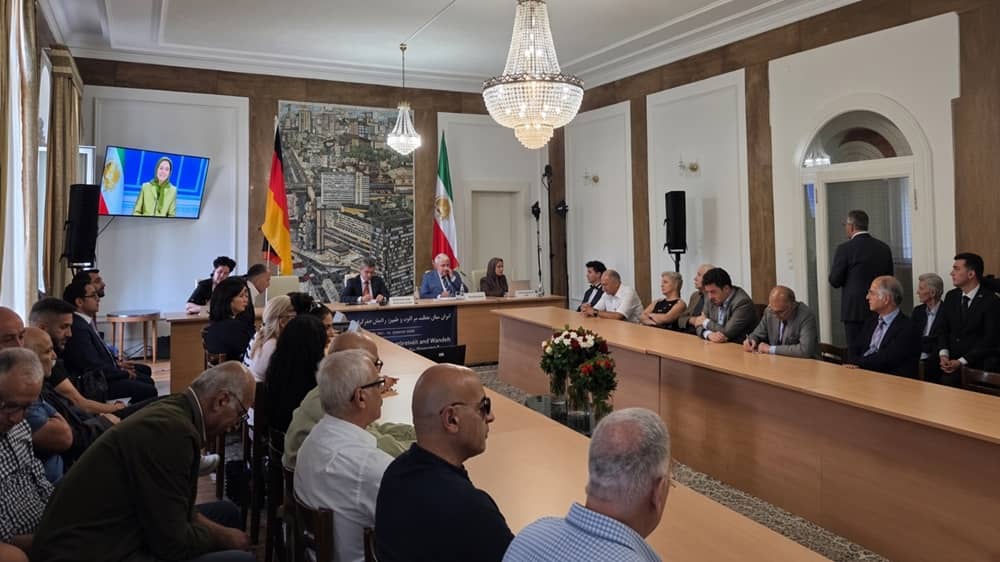
An online Germany conference on Iran, dated August 31, 2026, organized with the participation of the Union of Iranian Communities in Germany and members of the German Solidarity Committee for a Free Iran, brought together German lawmakers, former diplomats, legal experts, religious figures and civil-society advocates to debate Iran’s political crisis and prospects for democratic change.
Across the meeting, speakers argued that neither foreign military intervention nor renewed accommodation with Tehran offers a durable solution, and repeatedly pointed instead to domestic protest, the PMOI and the network of Resistance Units as the organized force capable of converting public discontent into political change. The conference also placed the NCRI’s Ten-Point Plan at the center of discussion as a framework for a secular democratic republic, while several participants rejected efforts to restore the monarchy or elevate Reza Pahlavi as an alternative. Human rights, executions, accountability, and a tougher European policy toward the regime and its coercive institutions were recurring themes.
In a message to a conference in Germany, Mrs. Maryam Rajavi framed the central confrontation as one between Iranian society and what she called “religious fascism,” arguing that the external war had not displaced the deeper conflict inside the country. She said the regime’s strategy for survival rested on executions, repression and permanent street deployment, while the opposing force consisted of continuing protests and “the unrelenting operations of Resistance Units.”
Mrs. Rajavi said the PMOI had built a nationwide social and operational structure over years of repression and asserted that Resistance Units carried out 630 operations during the December 2025–January 2026 uprising, particularly against the IRGC’s suppression apparatus. She described that network’s significance as its ability to transform “the explosive, protesting energy of Iranian society into an organized, fighting force.”
Politically, Rajavi rejected both continued accommodation with the clerical system and a return to the Shah’s dynasty, calling monarchist restoration “a mirage.”
A conference was held in Germany in support of a democratic solution in Iran, featuring members of parliament, German dignitaries, and human rights advocates.
In a message to this conference about the major events of the past year, I answered questions about the path the Iranian… pic.twitter.com/4zKPOnjDWD
— Maryam Rajavi (@Maryam_Rajavi) August 31, 2026
“The international policy, particularly in Europe, ignores the principal force for change in Iran,” Mrs. Rajavi stated. “As a result, foreign powers have still not abandoned the dream of coming to terms with this brutal regime and continue to pursue flawed strategies. The other is the role of the remnants of the Shah’s dictatorship, who serve the regime’s interests by disrupting uprisings, sowing division among the opposition, promoting fascist slogans, and calling for attacks on Iranian cities.”
Citing Masoud Rajavi, the leader of the Iranian Resistance, she said: “The great lesson of the two wars and the uprising of 2025–2026 is that a return to puppet monarchical fascism is nothing more than a mirage.”
She presented the NCRI’s transition plan, free elections and Ten-Point Plan as safeguards against a post-regime power vacuum and as the route to a democratic republic.
Carsten Müller, a member of the German Bundestag and chair of its Legal Affairs Committee, said Western governments had repeatedly failed to identify and engage the forces genuinely working for freedom inside Iran. He argued that months of military attacks had neither liberated the Iranian people nor brought democracy closer and had instead coincided with intensified domestic repression. Müller pointed to the continued victimization of PMOI members as evidence of whom the authorities regard as a serious threat. The more credible path, he said, was support for democratic forces that combine international connections with “the corresponding infrastructure in Iran itself.” He said the purpose of the conference was also to make that perspective more audible in Germany and influence Berlin’s Iran policy. Müller criticized the penetration of regime narratives into official debate, saying German institutions had too often repeated arguments originating with Tehran. “That must come to an end,” he said, calling for a change in German and European policy rather than reliance on military intervention or the assumptions that have guided past engagement.
Amb. Dr. Joachim Rücker sagte auf der Hybrid-Konferenz „Iran: Der Weg zur Demokratie“: „Krieg & Appeasement sind nicht die einzigen beiden Optionen.“ Die dritte Option sei die aktive Unterstützung des iranischen Volkes im Kampf für säkulare Demokratie, Menschenrechte,… pic.twitter.com/9hllPgN48z
— Javad Dabiran (@JavadDabiran) September 2, 2026
Leo Dautzenberg, a former Bundestag member, developed that argument by contrasting the organized resistance with both the clerical state and Reza Pahlavi. He said executions, arrests, security-force mobilization and propaganda attacks against the PMOI and Resistance Units were “not signs of strength” but signs of fear of an uprising and of an organized force for change. Dautzenberg rejected two familiar policy tracks—appeasing the religious dictatorship and foreign military intervention—and urged political, moral and practical support for Iranians organizing inside the country. Turning to the monarchy debate, he said Pahlavi’s media profile and lobbying did not substitute for democratic legitimacy, domestic organization or a clear break with the repressive legacy of the Shah and SAVAK. “Iran needs no transition from one dictatorship to another,” he said. By contrast, he argued, the NCRI combines organization, an in-country presence and a transition roadmap. He described Mrs. Rajavi’s Ten-Point Plan as compatible with European democratic values and called for structured, public political dialogue between Berlin, Europe and the NCRI.
Joachim Rücker, former president of the UN Human Rights Council, said Germany and Europe should resist the false choice between war and appeasement. Human rights, he argued, “must not be sacrificed to geopolitics,” and the immediate priority should include pressing for a halt to executions and protection of political prisoners. Rücker said the regime’s survival after external military blows should not be confused with stability, pointing instead to economic decline, social discontent, loss of legitimacy and widening fissures within the ruling elite. He proposed a third course: active support for Iranian society’s struggle for secular democracy, equality, the rule of law and a non-nuclear state. For Rücker, the decisive test of any opposition was not media visibility, a famous family name or access to Western capitals, but organization, a verifiable program, roots inside Iran and a democratic transition mechanism. He warned against “glorification of the monarchy” and SAVAK nostalgia and identified Rajavi’s Ten-Point Plan—free elections, separation of religion and state, equality and abolition of the death penalty—as a concrete democratic benchmark.
Message to the Germany Conference: Supporting a Democratic Solution in Iran
The regime is flailing in a war for its survival and cannot alter this fatal plight; thus, it attempts to camouflage it.
The regime’s strategy to prevent its overthrow consists of executing members of… pic.twitter.com/159sfxo59r
— Maryam Rajavi (@Maryam_Rajavi) August 31, 2026
Hans-Ulrich Seidt, a former German ambassador and former inspector general of the Foreign Office, approached the issue through a geopolitical and institutional lens. He warned that the military confrontation around the Strait of Hormuz carried risks far beyond Iran, including the possibility of a severe global energy shock, but said Tehran’s ability to maintain order by force should not be mistaken for durable stability. Seidt identified economic crisis, war, leadership uncertainty and persistent public unrest as mutually reinforcing pressures. He said a decisive internal shift could emerge if nationwide protests were joined by sustained strikes in oil, transport, banking and the public sector, alongside fragmentation or defections within the security apparatus. Europe, he argued, should not choose Iran’s future from outside, because “the Iranian people are the masters of their destiny.” Yet he said Germany and the EU could support democratic, capable Iranian forces. Among the opposition, he singled out the NCRI under Maryam Rajavi for having presented a concrete Ten-Point Plan, calling it “not a utopia” but “a realistic approach,” while suggesting that it could be complemented by a detailed economic program.
Martin Patzelt, a former Bundestag member and board member of the German Solidarity Committee for a Free Iran, focused on why European policy remains hesitant despite the regime’s conduct at home and its activities in Europe. He warned that democratic systems are not immune to disinformation and alleged that Tehran’s intelligence structures work systematically to discredit reporting on Iran, inject competing narratives and create uncertainty about sources. Patzelt said claims made against the PMOI should therefore be tested carefully rather than accepted at face value. He emphasized that the conference had helped answer a question he had repeatedly asked: who inside Iran could assume political responsibility if the clerical system collapsed? The evidence presented about PMOI-linked resistance, he said, showed that forces were active “on the ground” under life-threatening conditions and were seeking to realize the alternative described in the Ten-Point Plan. Patzelt urged Europeans to engage directly with opposition representatives and concluded with a distinction he considered essential: “Criticism is legitimate; disinformation is dangerous.” He called for wider networks to expose Tehran’s intelligence operations and strengthen support for democratic change.
Auf der Hybrid-Konferenz „Iran: Der Weg zur Demokratie“ diskutierten 🇩🇪Iran-Experten & Politiker über Folgen der jüngsten Entwicklungen & zunehmende innere und regionale Krisen. Im Mittelpunkt standen die Rolle des organisierten Widerstands im Land sowie die Frage, wie ein… pic.twitter.com/yXKkgyGR2D
— Javad Dabiran (@JavadDabiran) September 2, 2026
Thomas Lutze, a former member of the Bundestag, devoted his remarks to whether Reza Pahlavi could credibly be part of a democratic solution. His answer was categorical: Pahlavi, he argued, is neither the product of a democratic process nor an elected representative of Iranians and lacks an organized network inside the country. Lutze said the renewed visibility of the Shah’s son since 2022 owed more to media activity, social networks, lobbying and artificial amplification than to demonstrable roots in Iranian society. He also cited reports of intimidation of critics, disputes surrounding monarchist networks and concerns about SAVAK symbolism as warning signs for democratic politics in Europe. Lutze argued that “Iran does not need a transition from one dictatorship to another,” and said Europe should judge alternatives by their program, accountability, respect for Iran’s diversity, transparency and genuine domestic presence. Promoting Pahlavi, he warned, could weaken democratic opposition and reinforce Tehran’s claim that the only alternative to the clerical dictatorship is restoration of the monarchy. Europe, he said, should listen instead to forces seeking a secular democratic republic through free elections.
Nina Pesian, spokesperson for the Association of German-Iranians, centered her speech on prisoners, executions and the growth of organized resistance. She said the regime survives through fear, terror and daily executions but argued that repression has strengthened rather than broken the determination of young Iranians. Pesian highlighted prisoners she said face execution because of alleged PMOI membership and praised those who continue to resist under severe pressure. She described the “No to Executions Tuesdays” campaign as having expanded beyond individual prison hunger strikes, saying 61 prisons had joined and that families and sections of the public were also participating. For Pesian, resistance inside prisons and resistance in the streets formed a single political continuum and helped fuel the expansion of Resistance Units across the country. “The only way to freedom is organized resistance led by the Resistance Units,” she said, rejecting what she called empty hopes and purely rhetorical responses. She portrayed the organized network not as a diaspora phenomenon but as a domestic force rooted in the confrontation with repression and argued that international supporters should amplify its voice and stand with those facing imprisonment and execution.
Message to the Germany Conference: Supporting a Democratic Solution in Iran
The National Council of Resistance of Iran has a plan for the immediate aftermath of the regime's overthrow to ensure a peaceful, orderly, and democratic transition of power to the Iranian people.
The… pic.twitter.com/IGfozun1Hi
— Maryam Rajavi (@Maryam_Rajavi) August 31, 2026
Reza Musavi analyzed Iran’s economic crisis as a structural consequence of the political system rather than a temporary product of sanctions or poor management. He cited soaring consumer and food inflation, tax and electricity increases, a sharp currency decline and rising military expenditure as evidence of a deepening “super-crisis.” Musavi described Iran as a rentier, limited-access economy in which oil and gas revenues and strategic sectors are controlled by regime-aligned elites, particularly the IRGC, religious foundations and holdings linked to the ruling establishment. Because genuine market opening and anti-corruption measures would threaten the economic basis of that elite, he argued, reform from within the existing system is not viable. Musavi then connected economic breakdown to political mobilization, saying spontaneous public anger alone is insufficient against a heavily armed state. In his account, the Resistance Units serve as the organizational bridge between diffuse unrest and coordinated action, “channeling” public anger and giving it strategic direction. He called the organized Resistance Units the structural backbone capable of turning an unorganized mass into a force for fundamental change, linking economic collapse to the conference’s wider argument for an organized domestic alternative.
Marion Böker, director of a consultancy on human rights and gender issues, called for broader European and United Nations engagement with the NCRI and Iranian civil society. She welcomed existing support for Maryam Rajavi in European institutions but said it was insufficient and should be strengthened, alongside additional sanctions against the authorities in Tehran. Böker urged greater use of UN forums in Geneva and New York, including Human Rights Council processes, to document abuses, support civil-society participation and press the issue of executions and other violations of international law. She proposed making fuller use of the resistance’s documentation on alleged crimes against humanity and discussed possible international accountability mechanisms, while also encouraging NCRI participation in global debates on women, peace and security. Böker stressed that peace negotiations should include women and civil society, arguing that war had produced “no gain for freedom and democracy in Iran.” She envisioned a democratic Iran as a potential driver of wider regional stability and minority rights, and said international diplomacy should move beyond passive expressions of sympathy toward sustained institutional support, accountability and a political role for organized Iranian civil society.
Der ehem. Präsident des UN-Menschenrechtsrats Amb. Joachim Rücker sagte auf der Konferenz „Iran: Der Weg zur Demokratie“: „Der Westen darf dem iranischen Volk keinen Führer präsentieren.“ Über die Zukunft Irans dürfe ausschließlich das iranische Volk selbst entscheiden.… pic.twitter.com/mNfGz4sCXu
— Javad Dabiran (@JavadDabiran) September 2, 2026
Margot Käßmann, former chair of the Council of the Evangelical Church in Germany, urged participants to place people rather than geopolitics at the center of the Iran debate. She said public discussion too often reduces Iran to a nuclear dispute, regional conflict or military confrontation while overlooking those fighting for “their dignity, their freedom, their right to life.” Käßmann described the death penalty not merely as punishment but as an instrument of intimidation and political control, arguing that expressions of concern must be translated into practical measures to stop executions, free political prisoners and hold perpetrators accountable. She also criticized the limited attention German media give to repression and to the harm war inflicts on Iranian society and the opposition. Supporting Iranians, she stressed, “does not mean support for war or foreign intervention,” but strengthening voices inside the country that seek freedom and democracy. Käßmann specifically endorsed elements of the Ten-Point Plan, including separation of religion and state, equality for women and abolition of the death penalty, and linked those principles to universal religious freedom and respect for life.
Christoph Degenhart, professor of constitutional law and a former judge of the Constitutional Court of Saxony, examined what he termed “judicial crimes” and their potential treatment as crimes against humanity. Drawing on the legacy of the Nuremberg trials and Article 7 of the Rome Statute, Degenhart argued that state courts and judicial institutions can become instruments of systematic murder, imprisonment, torture and political persecution. He said the 1988 massacre and the current wave of executions in Iran should be documented case by case as potential crimes against humanity, particularly where the judiciary is used to destroy organized political opposition. Degenhart emphasized the principle of universal jurisdiction and said German courts can, in appropriate circumstances, prosecute grave international crimes committed abroad. His appeal to human-rights groups and the resistance was practical: preserve facts, identify participants and gather usable evidence before records disappear. He also directly rejected the old policy of accommodation, saying “the policy of appeasement that we had in the past is no longer permissible.” For Germany, he argued, the responsibility of “never again” requires scrutiny, documentation and accountability rather than denial or political convenience.