

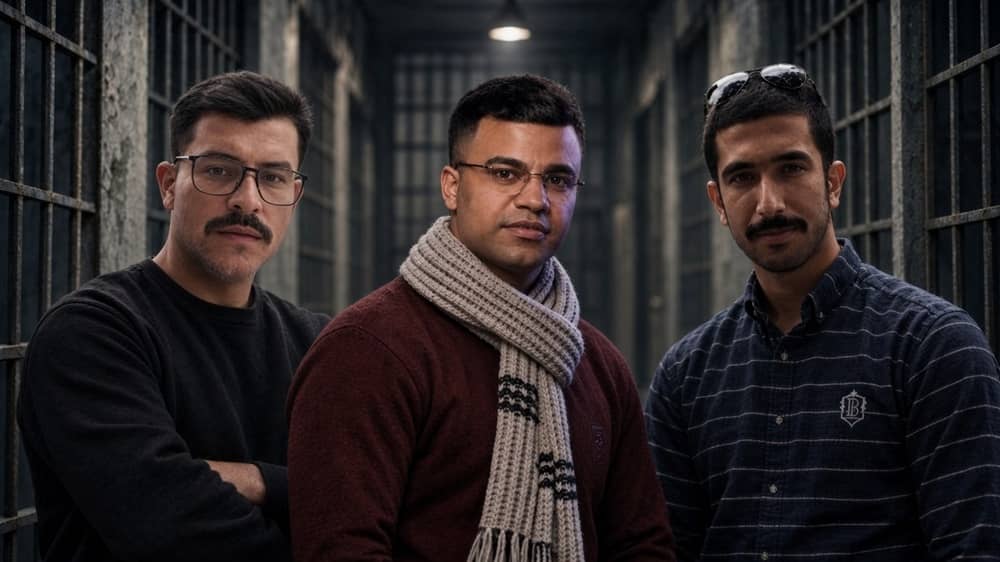
There are moments when a prison ceases to be merely a place of confinement and becomes a contest over who possesses the future.
From Vakilabad Prison in Mashhad, Ghezel Hesar, and Karaj Central Prison, Iranian political prisoners have written to mark the 61st anniversary of the founding of the People’s Mojahedin Organization of Iran (PMOI/MEK)—the organized Resistance movement to which they explicitly attach their own struggle, memory, and hopes for Iran.
Their messages come from men whom the state has attempted to isolate from society. Yet almost every sentence reaches beyond the cell.
National boxing champion Mohammad Javad Vafaei Sani begins with the simplest refusal: repression will not produce silence.
“These are difficult and harsh conditions for us in prison, as they are for all the people of this land, but this is no reason for us to remain silent,” he writes. “We have a duty, under all circumstances, to be the voice of our oppressed people and to cry out their pain and suffering.”
That may be the central sentence of all these letters.
For dictatorship, prison is supposed to reverse the relationship between citizen and state. The prisoner is reduced to someone upon whom power acts. He is watched, moved, interrogated, sentenced. His world contracts.
Vafaei Sani rejects that reduction. He still assigns himself a public duty: to speak, to cry out, to call beyond the walls.
And the Iran to which he speaks is exhausted—an Iran of shrinking household budgets and shrinking horizons, of young people confronting repression and economic insecurity, of families who have learned the geography of prisons, courtrooms, and cemeteries.
Against such exhaustion, he offers an extraordinary image.
‘Prison and the gallows cannot silence us’: Political prisoners mark PMOI’s 61st anniversary https://t.co/LiqsX1fuIO
— People's Mojahedin Organization of Iran (PMOI/MEK) (@Mojahedineng) September 3, 2026
Looking back to the founding of the MEK by Mohammad Hanifnejad and his companions, he writes: “This tree has taken root, and we have become a forest that no winter and no axe can destroy or silence. Every time they cut off our heads, we grew again—many times over.”
The tree he invokes is not an abstraction. It is the MEK itself; the forest is what he believes six decades of organized resistance have become.
The metaphor is an answer to terror.
A dictatorship understands the human body very well. It can imprison it. It can injure it. It can execute it.
What it fears is multiplication.
One prisoner can be removed. A memory reproduced in thousands of minds cannot.
That same idea runs through Ali Moezzi’s message from Ghezel Hesar. His appeal is not directed toward spectators but toward a society he sees as angry, impoverished, and trapped. And when he speaks of “organized resistance,” he is speaking of the MEK and the resistance movement built around it.
“Let us not allow others to write our destiny,” he says.
Then comes the political heart of his argument: “Organized resistance needs the masses, and the unorganized masses need this organized resistance.”
The insight reaches beyond one prison. Suffering alone does not produce liberation. Anger alone does not create a future. A population can be furious yet fragmented; courageous yet isolated.
Authoritarianism survives precisely by maintaining that isolation.
It tells the worker he stands alone.
The student that she stands alone.
The grieving mother that she stands alone.
The prisoner that nobody remembers him.
These letters answer: You are not alone in history.
🚨 EXCLUSIVE | Message From Political Prisoner Parisa Kamali in Yazd Prison
In an exclusive message from Yazd Central Prison, political prisoner Parisa Kamali marks the 61st anniversary of the founding of the PMOI:“If today I stand on the right side of history, I owe it to the… pic.twitter.com/VQzWbLxbBL
— SIMAY AZADI TV (@en_simayazadi) September 3, 2026
Meysam Dehban-Zadeh’s message reads almost like a liturgy of resistance. Again and again comes the word salaam—a salute to the MEK’s founders, its dead, its uprisings, its endurance, the generations that came before.
Then, amid memories of blood and repression, comes an unforgettable question:
“Can the sun be killed?”
It is the kind of sentence that acquires a different weight inside a prison.
The state can extinguish a life. The prisoner asks whether it can extinguish what that life represented.
Mohammad Hassani reaches deeper still into Iranian memory. In his poem, Zahhak—the monstrous tyrant of Persian mythology—returns, while Kaveh the blacksmith rises against him. Tyranny changes its costume; the ancient crown becomes the turban. But Kaveh, too, multiplies:
“Kaveh became thousands.”
And then:
“The plain of Iran has become filled with the springtime of cypresses.”
These are not the words of men describing themselves as defeated.
Every dictatorship attempts to monopolize not only the present but the imagination of the future. Its most effective sentence is not Obey me. It is something colder:
Nothing can change.
Against that sentence, these prisoners offer another vocabulary—one rooted explicitly in the history of the MEK.
The tree becomes a forest.
Kaveh becomes thousands.
Winter carries the possibility of spring.
The executed become stars.
Vafaei Sani writes of those who were hanged as “stars who went to the sky before us,” still shining “in the hearts of the people of Iran.”
‘This beginning has no end’: Mehdi Vafaei Sani marks 61 years of PMOI resistance from prison https://t.co/pjF33hpzi4
— People's Mojahedin Organization of Iran (PMOI/MEK) (@Mojahedineng) September 4, 2026
That is why these prison letters matter.
They do not merely praise endurance. They place suffering inside a lineage: the MEK as an organized resistance that, in their telling, has survived executions, prisons, and generations of repression.
They do not pretend that suffering is victory.
They do something more difficult: they deny suffering the right to determine the ending.
The jailer may possess the keys.
But the prisoner is still fighting for possession of the final sentence.