

An expansive wave of coordinated kinetic strikes and regime-directed subversion swept across Iran during the week of August 30 – September 5, 2026. Spearheaded by Resistance Units, the operations coincided with the 61st anniversary of the main Iranian opposition movement’s founding and the 40th-day memorial of executed political dissidents. From heavy incendiary attacks on Islamic Revolutionary Guard Corps (IRGC) outposts and judiciary headquarters to synchronized light projections and street demonstrations in over thirty cities, the week’s developments underscore an underground resistance capable of sustained, high-intensity operations despite elevated state readiness and security lockdowns.
September 5, 2026
Marking a major operational offensive, Resistance Units executed 61 coordinated kinetic strikes and incendiary operations targeting state security, judicial, and municipal centers while regime forces remained on heightened alert. In Tehran, operatives ignited a municipal complex in Robat Karim used as a gathering hub for suppressive forces, while also torching Ministry of Intelligence and Security (MOIS) espionage signage and leadership banners in multiple locations. In Mashhad, a state seminary was set ablaze with Molotov cocktails alongside the systematic burning of propaganda imagery depicting supreme leadership figures. Judicial infrastructure faced direct strikes in Gorgan and in Kaki, a district of Bushehr, where operatives targeted the local courthouse. Additional incendiary operations destroyed IRGC Basij facilities and command posts in Ja’vardeh within Kohgiluyeh, as well as in Chabahar, Iranshahr, Kermanshah, Bam, Sarbaz, and Farsan, where a security checkpoint was set on fire.
Concurrently, a broad campaign focused on destroying state propaganda and surveillance infrastructure across regional hubs. In Iranshahr, units set fire to the Ministry of Islamic Culture and Guidance building alongside two anti-student Basij bases and three IRGC posts. In Chabahar, directional signboards for IRGC and MOIS intelligence networks were destroyed alongside a public monument dedicated to Qassem Soleimani. Operational teams in Pishin and Rask torched state police and IRGC highway directional signage. Fire strikes against imagery of Ruhollah Khomeini, Ali Khamenei, and Mojtaba Khamenei were successfully conducted across Zahedan, Torbat-e Jam, Karaj, Shiraz, Qazvin, Birjand, Arak, Kashan, Maragheh, and Borazjan, with activists chanting slogans affirming their commitment to armed resistance and the overthrow of the clerical state.
On August 27, PMOI/MEK Resistance Units carried out 60 operations across Iran in response to the regime’s plans to raise gasoline prices, targeting institutions and symbols of repression and corruption. pic.twitter.com/X8DErvFgOG
— People's Mojahedin Organization of Iran (PMOI/MEK) (@Mojahedineng) September 2, 2026
September 4, 2026
On the eve of the 61st anniversary of the founding of the People’s Mojahedin Organization of Iran (PMOI/MEK), resistance networks organized over 150 coordinated public actions across urban centers to broadcast messages of regime change and reject both theocratic and monarchical governance. In Tehran, large banners depicting opposition leaders and organizational emblems were displayed on prominent overpasses and near landmarks like Milad Tower, accompanied by collective public pledges by Resistance Units. Parallel banner displays and group actions emphasizing a democratic republic based on the separation of religion and state were executed in Tabriz, Urmia, Mashhad, Karaj, Isfahan, Shiraz, Qom, Ahvaz, Sari, Kermanshah, Kerman, Hamadan, Arak, Khorramabad, Sanandaj, Zabol, Kashan, Saveh, Iranshahr, Marvdasht, Qaemshahr, Behshahr, Fasa, Malayer, Baneh, Shirvan, and Tabas.
In Zahedan, Resistance Units conducted field campaigns featuring posters and banners from resistance leadership. Public messaging explicitly rejected both current religious rule and any restoration of the former monarchy, featuring slogans such as “Neither Shah nor mullah” and calls for a secular republic. Street actions highlighted historical grievances, emphasizing that decades of state torture and executions have only reinforced the domestic imperative for fundamental political revolution.
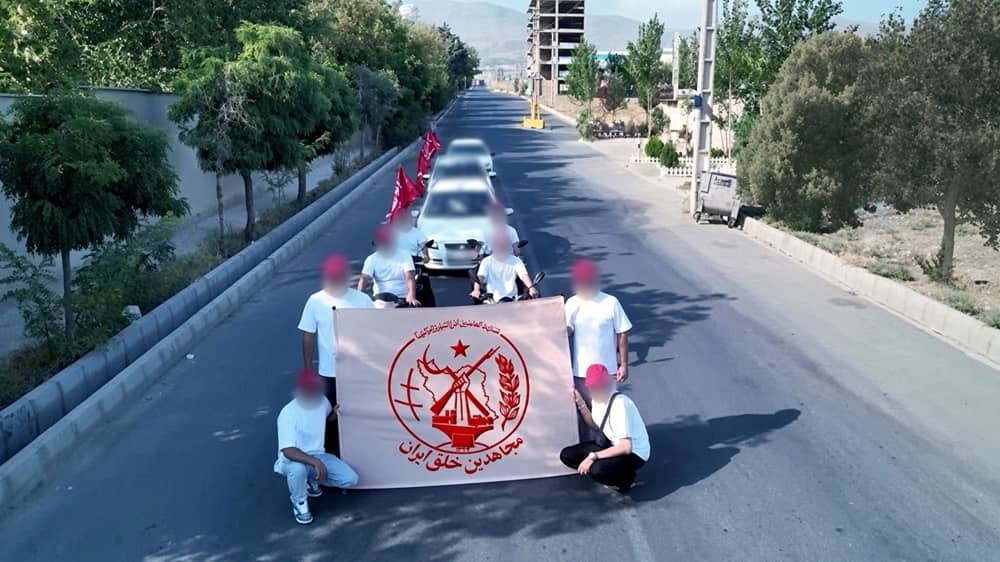
🚨 EXCLUSIVE | PMOI Resistance Unit Holds Parade in Karaj
Exclusive footage received by Simay Azadi shows a unit of the PMOI Resistance Units holding a parade in Karaj on September 3, 2026, marking the 61st anniversary of the founding of the People’s Mojahedin Organization of… pic.twitter.com/7Y4RUDIx5y— SIMAY AZADI TV (@en_simayazadi) September 4, 2026
September 3, 2026
In an advanced display of urban psychological warfare, resistance teams executed 30 synchronized nighttime photo projections featuring opposition symbols and leadership portraits across major public buildings and high-visibility structures. The coordinated projections illuminated cityscapes in Tehran, Karaj, Mashhad, Qom, Shiraz, Rasht, Ahvaz, Kermanshah, Bandar Abbas, Hamadan, Zanjan, Ilam, Sanandaj, Sabzevar, Saveh, Eyvan-e Sarab, Bukan, Minab, and Islamabad-e Gharb. In Karaj, a Resistance Unit conducted a tactical formation march through urban streets, signaling growing organizational coordination in key provincial capitals.
PMOI Resistance Units challenge regime as looming fuel price hike raises fears of unrest https://t.co/rZ6pAKoA8Q
— People's Mojahedin Organization of Iran (PMOI/MEK) (@Mojahedineng) August 30, 2026
September 1, 2026
Resistance Units marked two major memorial observances through nationwide street actions and public installations. Marking the 13th anniversary of the 2013 Camp Ashraf massacre, activists in Tehran, Tabriz, Karaj, Shiraz, Mashhad, Kermanshah, Kerman, Kazarun, Kamyaran, Masal, and Bojnourd established memorial sites and mounted posters commemorating the 52 victims, framing the historical event as an enduring symbol of resistance.
Simultaneously, activists joined the weekly “No to Executions Tuesdays” initiative, incorporating memorial actions for the 40th day following the execution of political prisoner Mehdi Khanki. Memorial tables, floral wreaths, and placards demanding the immediate cancellation of death sentences were displayed in Tehran, Karaj, Kerman, Soume’eh Sara, Varamin, Shiraz, Isfahan, Mashhad, Golpayegan, Yazd, Rasht, Lahijan, Eslamshahr, Abadan, and Bandar Abbas. Public messaging specifically condemned death sentences issued against political detainees, including Arghavan Fallahi, Manouchehr Fallah, and Issa Chari, calling for widespread civil uprisings against the judiciary’s use of capital punishment.
August 27—Iran
PMOI/MEK Resistance respond to the regime's plans for hiking the price of fuel by carrying out 60 daring operations across Iran, targeting institutions tasked with repression and corruption. pic.twitter.com/qXjnLdAU2j— People's Mojahedin Organization of Iran (PMOI/MEK) (@Mojahedineng) August 30, 2026
August 31, 2026
In response to the execution of dissident Mehdi Khanaki, youth groups and resistance units initiated solemn tribute actions across multiple municipalities. Memorial floral arrangements bearing photographs of Khanki were placed in public spaces and designated gathering points, accompanied by declarations pledging to continue resistance against state violence and capital punishment.
September 4—Zahedan
Resistance Units celebrate the 61st anniversary of the founding of PMOI/MEK, defying the regime's repressive measures and wave of executions and arrests. pic.twitter.com/aGZsoDP5sF— People's Mojahedin Organization of Iran (PMOI/MEK) (@Mojahedineng) September 5, 2026
The operations conducted between August 30 and September 5 demonstrate that the Iranian state’s intense security posture has failed to neutralize domestic opposition. By combining kinetic sabotage against IRGC infrastructure with sophisticated visual projection and synchronized memorial campaigns, underground Resistance Units continue to prove their operational agility across geographically diverse regions. The explicit public rejection of both the current theocracy and any monarchical restoration highlights an opposition movement anchored in a clear vision for a democratic republic. Rather than projecting authority, the regime’s reliance on mass executions and heightened militarization reveals an unsustainable reliance on force, leaving its internal security apparatus vulnerable to persistent, decentralized pressure from within.