

Three-minute read
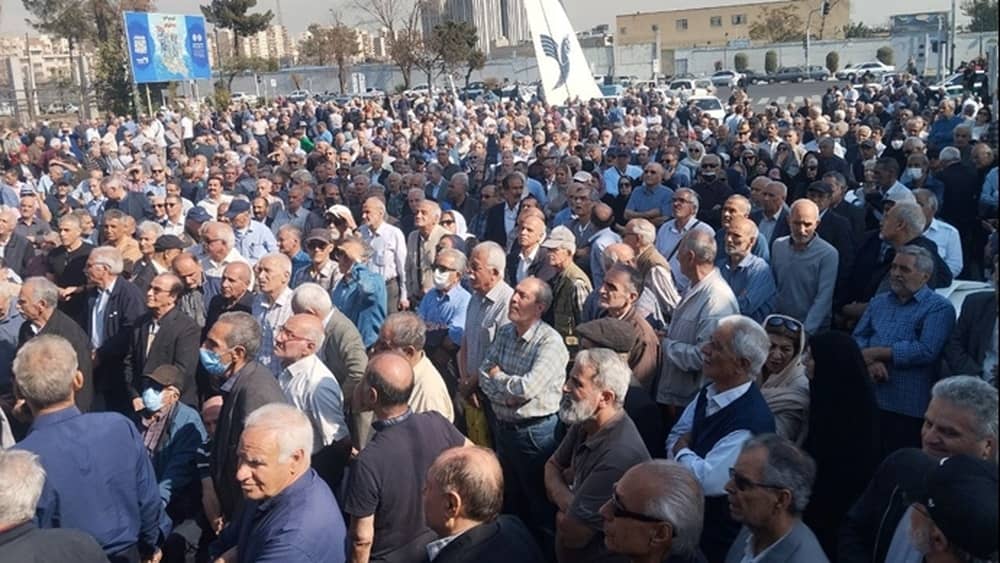
Retirees took to the streets across Iran on November 8, with demonstrations extending beyond economic demands to calls against executions and political repression. In Rasht, protesters vowed to continue until death sentences were abolished, while those in Ahvaz appealed for broader public participation. Their protests coincided with a prolonged transport strike, devastating floods and new official figures exposing the scale of Iran’s road-safety crisis.
Retirees Challenge Poverty, Corruption and Repression
Retirees demonstrated in Rasht, Tehran, Ahvaz, Shush and Haft Tappeh, demanding adequate pensions, affordable healthcare and accountability for mismanaged retirement funds.
In Rasht, protesters reportedly chanted, “We swear by our comrades’ blood, we will stand until executions are abolished.” In Ahvaz, demonstrators appealed for solidarity: “Our pain is your pain; people, join us.” Shush retirees denounced government failures over water, electricity, pensions and corruption, chanting, “How long poverty and misery? How long stealing from the people?”
Bank Saderat retirees also protested in Tehran despite heavy rainfall, demanding answers over their pension fund’s deteriorating condition. Participants called out the authorities because of their severe mismanagement while their purchasing power continues to collapse.
Iran’s regime is struggling with factional infighting, student and worker #protests, medicine shortages and mounting economic hardship. Yet it continues trying to project military strength against regional and international adversaries. Its inability to manage these simultaneous…
— NCRI-FAC (@iran_policy) November 3, 2026
In Yazd, a strike affecting part of the municipal bus fleet entered its ninth consecutive day, adding to recurring labor disputes over deteriorating working conditions and economic grievances.
The demonstrations coincided with the execution of three men arrested during January’s anti-regime protests. The judiciary accused them of attacking security personnel and state institutions, presenting the executions as punishment for violence against the state. By emphasizing these allegations, the authorities sought to justify the executions and counter public outrage over their crackdown. The anti-execution slogans voiced by retirees reflect continuing opposition to the regime’s use of capital punishment against protesters.
Road Deaths Expose a Public-Safety Crisis
Newly reported figures from Iran’s Forensic Medicine Organization show that more than 10,000 people died and 224,000 were injured in road accidents during the first six months of 2026. Approximately 18% of those killed were aged 18–24, while the number of injuries increased 11% over the corresponding period last year.
More than 100,000 people have died on Iranian roads since 2021. Officials and road-safety specialists have identified inadequate road infrastructure and poor safety standards in domestically manufactured vehicles as major contributors.
Iran’s Majlis Moves to Tighten Repression as Factional Infighting and Mounting Domestic Crises Expose Regime Vulnerabilities https://t.co/LR7ggvzXxG
— NCRI-FAC (@iran_policy) November 4, 2026
Police estimates put the annual economic cost of road accidents at approximately 7–8% of GDP. The continuing death toll exposes the consequences of longstanding failures in vehicle regulation, infrastructure investment and public safety.
Floods Disrupt Services Across 19 Provinces
Heavy rainfall and flooding affected at least 19 provinces, leaving four people dead and 11 injured, according to November 8 emergency-service figures.
In Lorestan, authorities reported extensive disruption to roads, electricity and gas supplies. Earlier assessments placed the number of villages with blocked roads at more than 200; subsequent updates reported continuing isolation of numerous communities. Landslides damaged railway lines, forcing more than 1,200 passengers to complete their journeys by road.
Flooding also damaged homes and infrastructure elsewhere, with schools and universities switching to remote instruction in several provinces. Emergency crews struggled to reach isolated communities because of blocked roads and damaged bridges.
Iran’s economic breakdown is turning into an internal security crisis for the clerical regime.
Regime data shows industrial producer prices up 147% year-on-year, food #inflation at 113% (fats/oils +250%), $34 billion lost to disruptions, and 1.15 million people exiting the formal…— NCRI-FAC (@iran_policy) November 6, 2026
Proposed Salary Increase Trails Inflation
The government’s draft 2027 budget guidelines envisage an average 35% increase in public-sector salaries. Official statistics, however, put annual inflation at 76.8% and year-on-year inflation at 88.7% in October.
The proposed increase remains far below recent price growth, threatening further losses in purchasing power for government employees. It is a preliminary budget provision rather than an approved wage adjustment.
Meanwhile, medical equipment shortages are adding pressure to healthcare services. The head of Iran’s radiology association acknowledged that hospitals cannot afford replacement imaging-equipment components at market exchange rates. Regulated treatment fees, he said, have left public facilities unable to maintain or replace essential equipment.
Armed Attack Kills Cleric in Sistan and Baluchestan
In a November 7 incident, armed assailants killed Sunni cleric Shamsolhaq Yousef Ghazi while he was traveling near Fanouj. Local accounts described his cooperation with state institutions. Police confirmed the shooting but had not identified the perpetrators or established their motive.
Iran’s ruling factions are openly warring over U.S. negotiations and #nuclear policy.
Hardliners accuse Foreign Minister Araqchi of “capitulation,” demand his removal, call for #NPT withdrawal, and push for nuclear weapons as deterrence—while Pezeshkian’s government signals…— NCRI-FAC (@iran_policy) November 6, 2026
The incident adds to continuing insecurity in southeastern Iran, where repeated armed attacks have challenged the authorities’ ability to protect security-linked personnel and local officials.
The November 8 protests highlight a political challenge that economic concessions and security measures have struggled to contain: pensioners are increasingly connecting their deteriorating living standards with corruption, repression and demands for broader solidarity. At the same time, the road-death figures, damaged infrastructure, inadequate wages and hospital equipment shortages expose failures affecting millions of people in everyday life.
For the ruling establishment, these pressures are mutually reinforcing. Declining purchasing power and unreliable public services generate fresh grievances, while severe repression can turn economic protests into wider political confrontation. The authorities face growing difficulty maintaining public compliance as the institutions responsible for essential services struggle to meet basic needs.