

THIS PAGE WILL BE UPDATED WITH THE LATEST NEWS
UPDATE: 7:00 AM CET
Retirees Across Iran Rally to Protest State Plunder and Collapsing Public Services
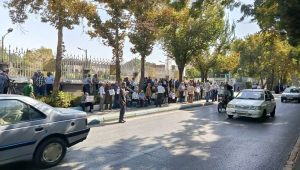
On Sunday, November 8, 2026, several Iranian cities witnessed a wave of protest rallies and labor strikes involving Social Security retirees and retired workers in Ahvaz, Shush, and Haft Tappeh, retirees of Bank Saderat, and municipal bus drivers in Yazd, whose strike entered its ninth consecutive day. The demonstrations and slogans underscored a deepening livelihood crisis that now directly threatens household food and medicine security, alongside a gradual paralysis of public transit and basic utilities driven by runaway inflation and the systemic draining of national resources.
In Khuzestan province, Social Security retirees in Ahvaz gathered outside the provincial General Directorate of Social Security to protest deteriorating living conditions and the authorities’ persistent refusal to address their long-standing legal demands. Simultaneously, retired workers from Shush and Haft Tappeh rallied outside the Social Security Organization headquarters to demand their misappropriated rights.
Protesters in Shush and Haft Tappeh raised slogans that delivered a comprehensive indictment of the executive branch’s record, linking the looting of public wealth directly to the collapse of basic infrastructure and utilities: “The result of the government’s work is water and power outages!”
Reza Pahlavi Does Not Speak for the Iranian People
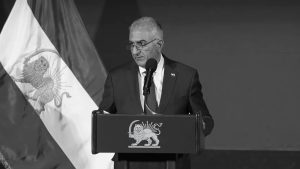
On November 7, 2026, the Friedrich Naumann Foundation presented its Freedom Prize to the Iranian people at Frankfurt’s Paulskirche, and designated Reza Pahlavi, son of Iran’s deposed Shah, as the trustee to receive the award.
But his selection raises a fundamental question: Who gave the heir to Iran’s former dictator the authority to represent a nation whose political activists and prisoners have repeatedly rejected a return to the dictatorship of his father and grandfather?
In Frankfurt, Pahlavi presented himself as a champion of freedom and democratic elections, invoking Iran’s long parliamentary tradition. Yet this history exposes a contradiction in his political narrative.
Iran’s Constitutional Revolution of 1905–1906 established parliamentary institutions nearly two decades before his grandfather, Reza Shah, founded the Pahlavi dynasty in 1925.
Rather than advancing constitutional government, Reza Shah progressively dismantled parliamentary independence. Elections were manipulated, opposition politicians were excluded and murdered, and the legislature became subordinate to royal authority.
Iran’s Regime Executes Four Political Prisoners and Seven More Inmates in Escalating Wave of Executions

Iran’s regime executed three prisoners arrested during the January uprising and a 27-year-old political prisoner in separate cases, while at least seven other inmates were hanged on November 4. The executions have intensified concerns over the regime’s escalating use of capital punishment to suppress dissent.
On Sunday, November 8, 2026, the regime executed Hossein Deyvaband, Hamid Kazemi, and Reza Zanganeh, three prisoners arrested in connection with the January uprising. The regime’s judiciary accused them of attacking government facilities, setting buildings on fire, carrying knives and hunting weapons, damaging street surveillance cameras, and assaulting security personnel. The authorities also announced the confiscation of their property.
Eight other defendants in the same case received prison sentences ranging from five to ten years.
In a separate execution, the regime hanged political prisoner Mohammad Aref Shahbakhsh, 27, from Qaleh Bid village in Taftan County, at Zahedan Central Prison. According to the judiciary, he was accused of links to Jaish al-Adl and sentenced to death on charges of armed attacks against a police station in Qaleh Bid, which the regime classified as baghi (armed rebellion) and moharebeh (enmity against God).
Jean-Pierre Spitzer: Western Governments Must Recognize the Iranian People’s Right to Resist Dictatorship
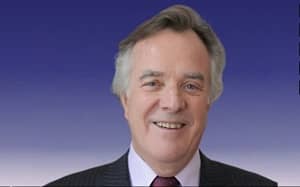
European governments must acknowledge the right of the Iranian people to resist dictatorship and reconsider the political decisions that once undermined their organized opposition. This is the central argument of Jean-Pierre Spitzer, a European law specialist who has revisited the controversial designation of the People’s Mojahedin Organization of Iran (PMOI/MEK) as a terrorist organization and its eventual removal from European terrorist lists.
In an opinion article published on November 4, 2026, by the French newspaper La Tribune Dimanche, Spitzer draws on recent remarks by Marc Trévidic, a prominent French anti-terrorism judge, who discussed the political considerations surrounding the legal treatment of the Iranian opposition movement.
Trévidic’s observations raise a fundamental question: when does the designation of an organization as terrorist cease to reflect a consistent legal assessment and instead become an instrument serving the interests of the dictatorship it opposes?
Spitzer, who spent nearly a decade working with the legal team challenging the PMOI’s inclusion on European terrorist lists, argues that the case exposed the vulnerability of judicial decisions to political pressure.
Argentine Congress Condemns Iran’s Regime Over Wave of Political Executions

Argentina’s Chamber of Deputies has taken a stand against the escalating wave of political executions in Iran, with a resolution presented to its Foreign Affairs Committee condemning the regime’s use of capital punishment to intimidate the population and eliminate political opposition.
On Wednesday, November 4, 2026, Sabrina Ajmechet, vice-chair of the committee, presented a resolution titled Strong Condemnation and Deep Concern Over the Recent Wave of Executions of Political Opponents by the Authoritarian and Terrorist Regime in Iran.
Ajmechet called on fellow lawmakers to support the initiative, stressing the importance of international solidarity with the Iranian people in their struggle for freedom and democracy.
She recalled how Iranians took to the streets at the beginning of 2026 in opposition to the regime’s dictatorship, only to face an unprecedented wave of executions targeting those who challenged its rule. She argued that Argentina, having suffered the consequences of terrorism attributed to the Iranian regime, had a particular responsibility to stand with the Iranian people.
Ajmechet emphasized that solidarity with Iranians seeking democracy and freedom was essential, adding that countries affected by the regime’s terrorism must work together against both political repression and terrorism.
Of 9.8 million Iranians Living with Disabilities, Only 1.6 million Covered by State Welfare Organization

Disability in Iran is not merely a medical or family issue; it has become one of the indicators for assessing the effectiveness of the country’s social welfare system. Fariba Boroumani, head of the secretariat of the Committee for Coordination and Oversight of the Implementation of the Law on the Protection of the Rights of Persons with Disabilities, has announced the latest estimate. According to her, approximately 9.8 million Iranians, equivalent to 11.5% of the country’s population, live with disabilities. Yet only about 1.6 million of them receive coverage from Iran’s State Welfare Organization.
If Boroumani’s estimate is used as the basis, only about 16% of people with disabilities are listed as beneficiaries of the State Welfare Organization. More than eight million people remain outside its coverage. This calculation is based on the two figures announced by the head of the law’s secretariat. According to her, the law’s permanent commission will convene next week to review issues requiring budget allocations.
Recent news reports offer no clear explanation of the criteria behind leaving more than eight million people outside the State Welfare Organization’s coverage. The organization’s deputy for rehabilitation previously cited limited resources and low reimbursement rates. The head of the State Welfare Organization has also announced that the 2026 budget, which she said was drafted under wartime conditions, provides for only 24% of the funding required to fully implement the Law on the Protection of the Rights of Persons with Disabilities.
Iran’s Regime Executes Three Detained Protesters in Karaj Following Torture, Forced Confessions

Iran’s judiciary carried out the death sentences of Reza Zanganeh, Hassan Divband, and Hamid Kazemi early on Sunday, November 8, executing the three men detained during the January 8 and 9, 2026, protests in Karaj. Before their executions, multiple reports had emerged concerning their torture, mock executions, forced confessions, and denial of access to legal counsel. The three prisoners were executed on security-related charges after their sentences were upheld by the Supreme Court. According to the judiciary, the confiscation of their assets is also underway, while other defendants in the case have been sentenced to between five and 10 years in prison.
Reza Zanganeh, 27, Hassan Divband, and Hamid Kazemi were among the defendants in the case concerning the January protests in Karaj. Iran’s regime judiciary had accused them of participating in the destruction of public facilities and electricity infrastructure. The case also included allegations of cooperation with foreign intelligence services, a charge that Reza Zanganeh’s family and relatives had rejected.
One of the most shocking aspects of this case was the reports published before the executions about the torture and mock executions of the defendants. According to information received from the prisoners’ families, several defendants had repeatedly been taken to the gallows and returned to their detention facilities after staged executions. The purpose of these measures was to inflict severe psychological pressure, break the prisoners’ resistance, and force them to accept the charges brought against them. Reports had also emerged that the defendants were denied access to lawyers and that efforts were being made to produce forced television interviews. These reports raise serious questions about the credibility of any confessions obtained and whether the defendants’ most basic defense rights were respected.
Isfahan’s Carpet Market Enters Recession as People Sell Their Household Carpets to Pay Rent and Loan Installments
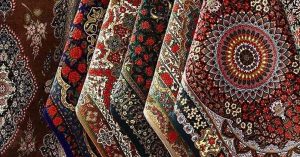
For centuries, Isfahan’s carpet bazaar, one of Iran’s historic centers of carpet trading and craftsmanship, symbolized art, wealth, and economic prosperity. Today, however, it is experiencing an unprecedented period of recession and an erosion of its traditional identity. The bazaar, which once welcomed major merchants, foreign tourists, and Iranian families, is now facing a very different atmosphere, reflecting a fundamental shift in the nature of transactions and the behavior of its visitors.
One longtime carpet dealer in Isfahan’s bazaar describes his recent experience: “I have been working in this market for more than 30 years. Over the years, I have dealt with people from every social class, from low-income families to the wealthy. But I have rarely seen a situation like this.”
Looking back at previous years, he emphasizes that people once visited the bazaar to renovate their homes or buy new carpets. Today, however, the situation has completely reversed.
He adds: “Nowadays, many visitors don’t come to buy anything; they come to sell the carpets covering the floors of their homes. Almost every day, someone walks into the shop and says, ‘I have loan installments to pay, I have rent to pay, I have living expenses. Buy this carpet from me because I need the money.’”
Iran: University Transformation from Academia to a tool of Repression & Ideological Control
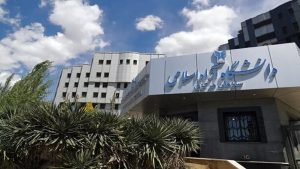
This report examines the escalating ideologization and security governance of higher education in the Islamic Republic of Iran—a process through which the university has been transformed from an independent academic and educational institution into an instrument for the government’s political, ideological, and security objectives.
An analysis of official government statements, institutional documents, student expulsions and suspensions, intelligence interventions in academic environments, and documented human rights reports reveals that the crackdown on critical students and faculty members cannot be viewed as isolated or sporadic incidents. Rather, these actions form part of a structural policy whose broader and fundamental objective is to establish an authoritarian model of governance for the complete subjugation of the academic sphere, the imposition of ideological monopoly, the eradication of critical thought, and the systemic suppression of the independence of educational institutions.
The available evidence demonstrates that the Iranian government views the university not as a space for independent research, the free exchange of ideas, and scientific critique, but as a “bastion,” the “frontline of cognitive warfare,” a “center for clarifying propaganda (Jihad-e Tabyin),” and part of the ideological defense mechanism of the state. Within this framework, faculty members are designated as “commanders” and students as “officers,” and the university is expected to actively participate in reproducing the official state narrative and countering critical viewpoints.
Concurrently, to confront any independent voice, the ruling authorities go beyond administrative pressures—resorting to systematic repression, intimidating intelligence summons, judicial case-building, arbitrary detentions, severe educational deprivations, chain expulsions, and even the deprivation of the right to life (such as the execution of student protesters)—to raise the cost of free thought and independent activity to the highest possible level. Recent reports from the University of Sistan and Baluchestan, the University of Tehran, and other higher education institutions across the country document examples of this trend.
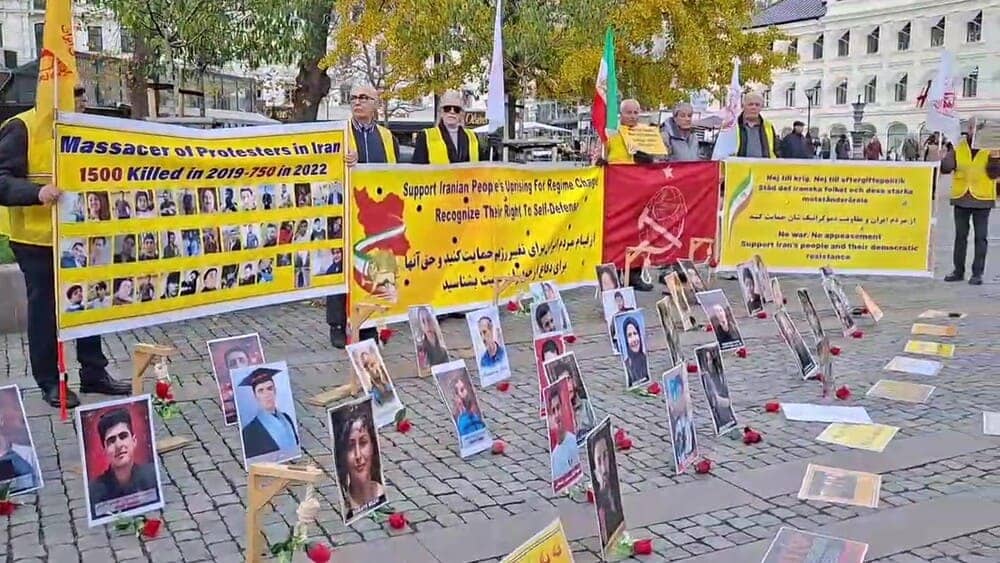
Malmö Rally Marks November 2019 Uprising Anniversary, Demands End to Executions in Iran
Malmö, Sweden – November 7, 2026 – Supporters of the Iranian Resistance, including the PMOI/MEK and the National Council of Resistance of Iran (NCRI), held a rally and photo exhibition in Malmö to mark the seventh anniversary of the nationwide November 2019 uprising and honor its martyrs. The event also protested the Iranian regime’s continued use of the death penalty and called attention to political prisoners and protesters facing execution.

Demonstrators condemned the threatened executions of political prisoners and protesters arrested during recent nationwide uprisings, as well as the use of the death penalty in all its forms. They called for an immediate halt to all executions in Iran.
Participants denounced the actions of Iran’s ruling clerical regime, describing executions as clear violations of fundamental human rights. They also paid tribute to the victims by displaying their photographs.
PMOI Supporters in Heidelberg Condemn Iran’s Death Penalty, Demand International Action
Heidelberg, Germany – November 7, 2026 – Supporters of the People’s Mojahedin Organization of Iran (PMOI/MEK) held a book table and photo exhibition in Heidelberg, condemning the Iranian regime’s ongoing use of the death penalty, including the recent execution of two young protesters, Amirhossein Maleki and Amirhossein Ebrahimi, in Isfahan, and highlighting the situation of political prisoners and protesters at risk of execution.

Participants urged the international community to take immediate and decisive action to save political prisoners and protesters arrested during recent protests who face execution. They called for swift measures to prevent further executions and for effective international pressure on the Iranian regime to end its use of capital punishment as a tool of repression.
Sydney Exhibition Condemns Executions and Human Rights Violations in Iran
Sydney, Australia – November 6, 2026 – Supporters of the People’s Mojahedin Organization of Iran (PMOI/MEK) held a book table and photo exhibition to draw attention to Iran’s deteriorating human rights situation, particularly the regime’s systematic execution of political prisoners and protesters arrested during nationwide uprisings.

The event also called for the immediate and unconditional release of all political prisoners in Iran. Participants condemned the death penalty, political repression, and the regime’s impunity, demanding justice and accountability for human rights violations.