
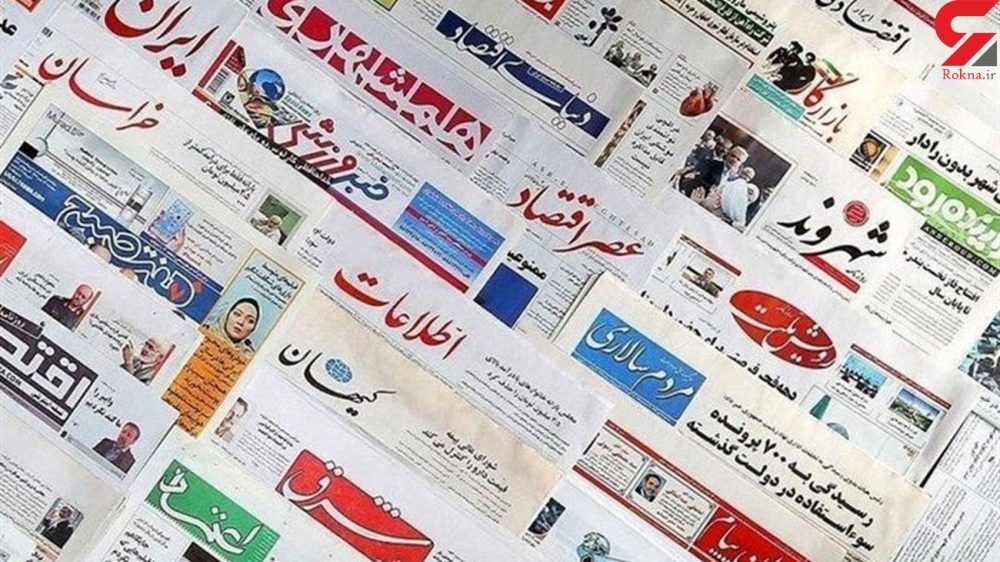
Iran’s newspapers on Monday offer an unusually revealing picture of a country under simultaneous economic, social and institutional strain.
Read separately, the stories concern unemployment, budgets, floods, workers’ wages, sanctions, corruption or women’s dress. Read together, they describe something larger: a state trying to preserve economic activity under wartime conditions while its own officials and newspapers increasingly acknowledge weakened social cohesion, deteriorating purchasing power, shrinking financial options and a widening gulf between official policy and everyday Iranian life.
A Government Preparing for Zero Oil Revenue
Perhaps the starkest admission comes from Donya-e Eqtesad on November 9.
Discussing preparation of the 2027 budget, Mohammad Ghasemi, a senior official at the Planning and Budget Organization, said the government must prepare for a scenario in which oil revenues fall to zero. The budget framework is built around “stability, resilience and reconstruction,” with restrictions on new hiring, new government projects and administrative spending.
The language itself is revealing. The regime is not presenting a credible development strategy; it is trying to contain the damage. Its budget framework is built around preserving what remains of production and employment, rationing scarce resources, and patching infrastructure already weakened by war and chronic underinvestment. The paper says the baseline scenario assumes sanctions, the maritime blockade and current regional conditions continue—meaning the regime is effectively planning for prolonged economic attrition rather than recovery.
Iran’s retirees protest across multiple cities, denouncing #corruption, poverty and executions. Yazd’s bus strike enters its ninth day, floods disrupt 19 provinces, and new figures reveal over 10,000 road deaths in six months. With wages trailing #inflation and hospitals…
— NCRI-FAC (@iran_policy) November 8, 2026
The Economic Squeeze Is Reaching Ordinary Life
Another Donya-e Eqtesad edition reports that businesses face effective financing costs of 45 to 47 percent, while a new government credit scheme cannot solve a basic problem: companies may receive paper credit but still lack cash to pay wages, taxes, energy and operating expenses.
Khorasan Daily, on November 9, highlights another symptom. More than one-third of Iran’s unemployed are university graduates. An Education Ministry official quoted in the report concedes that the central problem is not simply inadequate skills: “there are fundamentally not enough job opportunities.” Women graduates face a particularly severe disadvantage.
Meanwhile, Ebtekar reports a dispute between the government, parliament and the Audit Court over food subsidies. Inflation has eroded the real value of the electronic food allowance so severely that lawmakers are arguing over who should remain eligible and whether the government even has legal authority to remove recipients.
Even the Kayhan Daily, the newspaper closely associated with the Supreme Leader’s camp, attacks Vice President Mohammad Reza Aref for saying wage increases feed inflation. Its November 9 article argues that workers are being turned “from victims of inflation into its cause,” and warns against making wage demands appear a threat to economic stability.
Iran faces deepening factional infighting over intelligence appointments and political prosecutions, reported killings of Baluch civilians, #protests in Shahroud and flood damage cutting off villages. Meanwhile, food prices and water shortages strain households as the regime…
— NCRI-FAC (@iran_policy) November 7, 2026
The More Revealing Warning Is Social
Yet today’s most politically significant article may be in Ham-Mihan.
Ali Rabiei, Masoud Pezeshkian’s social affairs adviser and a former intelligence official, writes that Iranian society is living with “suspension, expectation and anxiety” and warns that military hardware cannot by itself protect a country whose institutional trust and hope have eroded.
That anxiety is visible even in the hardline press. Javan, published late November 8, complains about women appearing in Tehran’s streets in ways it describes as openly violating official standards of modesty. But the article also admits that police action, administrative orders and text-message warnings have failed, and that the gap between official cultural policy and social reality has grown deeper since the death of Mahsa Amini.
As the #IranWar fails to deliver the foreign-backed regime change Pahlavi had hoped for, his carefully orchestrated European tour backfires, encountering resistance from politicians, Iranian communities and former political prisoners. By @MasumehBolurchi https://t.co/f99rMgx5Nj
— NCRI-FAC (@iran_policy) November 7, 2026
Even Rain Becomes an Indictment of Governance
Shargh’s November 9 report on heavy rainfall completes the picture. Flooding affected at least 15 provinces; roads were closed, electricity was cut to villages and deaths and injuries were reported. In Tehran, a flood-prevention plan approved nearly 20 years ago remains incomplete: only around 450 kilometers of a planned 700-kilometer surface-water network have been built, while the integrated early-warning system has still not been completed.
Another Shargh report describes Washington’s expanding economic pressure and says Iran’s remaining floating oil stocks outside the maritime blockade have now been exhausted, while northern and overland routes lack the capacity to substitute for southern ports.
Taken together, today’s Iranian press does not depict a society merely enduring another difficult economic cycle. It depicts an establishment simultaneously worried about revenue, production, employment, welfare, corruption, infrastructure, cultural authority and—most importantly—the relationship between the state and society.
The most revealing words are therefore not “sanctions” or “war.” They are the ones appearing increasingly inside the system itself: trust, cohesion, hope, resilience and social fracture.
Those are the vocabulary of a state worried not only about what is happening to the country, but about how much more pressure its relationship with Iranian society can absorb.