

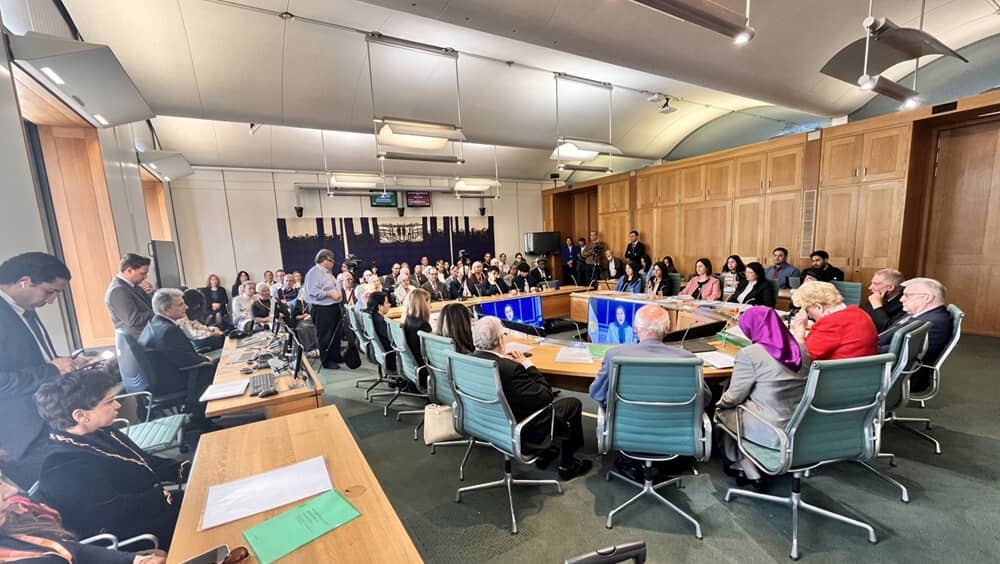
British parliamentarians, legal experts, academics and Iranian community representatives gathered at Portcullis House in Westminster on September 9, 2026, for a conference titled The Road to a Free Iran: Human Rights, Accountability and Democratic Change, focusing on executions, political repression and prospects for an Iranian-led democratic transition. The meeting examined the growing role of the organized Resistance and Resistance Units inside Iran, the NCRI’s proposed transition framework and Maryam Rajavi’s Ten-Point Plan, while speakers repeatedly argued that neither military intervention nor continued appeasement offers a solution to the Iran crisis. Several participants also rejected a return to monarchical rule and called for stronger accountability for the IRGC and other officials implicated in repression. Mrs. Maryam Rajavi, President-elect of the National Council of Resistance of Iran, sent a video message to the conference, calling on Britain to adopt a policy centered on human rights, support for a democratic republic and recognition of the Iranian Resistance.
In her message to the conference, Mrs. Rajavi said the central issue linking human rights to political change was the determination of Iran’s younger generation to end religious dictatorship and establish “a free and democratic republic.” She cited imprisoned and executed young PMOI supporters to argue that repression had failed to extinguish organized opposition, including two women prisoners who wrote: “We are Generation Z. We are anti-dictatorship and anti-dependency. We are against Shah and the mullahs.” Mrs. Rajavi sharply rejected both the clerical system and restoration of the previous monarchy, saying the Shah had ruled through torture and that his son remained proud of the dynasty’s record.
“In Iran, only the regime and the remnants of the old dictatorship want war,” the NCRI President-elect said. “They see war as their only chance. They want to bring back the old dictatorship and its brutal secret police, the SAVAK.”
She called on London to abandon both war and appeasement: “Now, it is time for the world to stand with the people of Iran.” Britain, she said, should support the demand for a republic based on separation of religion and state, gender equality and abolition of torture and executions.
Mrs. Rajavi also set out three concrete demands for international policy. She urged governments to make diplomatic and commercial relations with Tehran conditional on an end to executions, use international jurisdiction against those responsible for the 1988 massacre and more recent killings, and require a “real, verified stop to executions” in any agreement with the authorities. “Long years of experience prove that ignoring executions and ignoring the Iranian people’s Resistance lie in the heart of a policy that has helped the regime over several decades,” she said. Mrs. Rajavi also referred to the successful British campaign to blacklist the IRGC and expressed hope that the same political effort would now be directed toward stopping executions and securing a policy supportive of the Iranian Resistance. Her message presented human-rights accountability not as separate from political change but as integral to the struggle over Iran’s future.
Jim Shannon, Democratic Unionist Party MP for Strangford, said political change ultimately had to be achieved by Iranians themselves, but argued that Britain should openly support the organized democratic alternative. “Despite the regime’s propaganda, repression, and threats, we know there is an organized democratic alternative led by Madam Maryam Rajavi and the National Council of Resistance of Iran,” he said, reaffirming his support for Mrs. Rajavi’s Ten-Point Plan. Shannon highlighted the expansion of Resistance Units alongside executions of PMOI members, political prisoners and detained protesters, saying this demonstrated both the strength of the opposition and Tehran’s fear of it. He urged Britain to go beyond expressions of sympathy: “Stand with the Iranian people and their popular resistance. Reject the murderous regime. Recognize the NCRI’s provisional government as a democratic alternative to this regime.” Shannon also praised the prominent role of women in the Resistance and congratulated Mahnaz Meimanat on her election as the PMOI’s new Secretary-General.
Conservative MP Bob Blackman, who was unable to attend, sent remarks that were read to the conference by Matthew Goodwin-Freeman. Blackman’s message argued that neither “war nor appeasement offers a sustainable solution to the Iran crisis” and identified the Iranian people and their organized resistance as the principal force for democratic change. He cited recent activities by Resistance Units, including public actions connected with the PMOI’s 61st anniversary, as evidence that the movement remained “alive, organized, and resilient across Iran.” Blackman called on the British government to recognize the NCRI as a provisional authority for democratic transition and endorse Rajavi’s Ten-Point Plan. He also rejected “a restorationist project” as a democratic alternative, arguing that Reza Pahlavi’s support for foreign military strikes, questions surrounding some supporters and the absence of a clear reckoning with abuses under the monarchy raised doubts about his democratic credentials. Iran’s future, he said, must rest on popular sovereignty rather than dynastic restoration.
Message to the conference at UK Parliament: #HumanRights and democratic change in Iran
Ignoring executions lies in the heart of a policy that helps the clerical regimehttps://t.co/SBtZ5K0K94 pic.twitter.com/gjIXmhQ5rO— Maryam Rajavi (@Maryam_Rajavi) September 9, 2026
Lord McCabe made human rights the central test of British policy. “It’s a moral mission to protect the human rights of ordinary Iranians,” he argued, describing the death penalty as a weapon used by the regime to suppress dissent. He welcomed what he described as the government’s banning of the IRGC but said implementation had to go beyond a parliamentary decision. McCabe rejected both foreign military intervention and appeasement, insisting that “only the Iranian people can determine their own destiny.” Turning to Reza Pahlavi, he was dismissive: “For me, Reza Pahlavi has a bit of the Johnny-come-latelys about him, and there are some very questionable aspects to his claims and his associates.” He also questioned possible links between Pahlavi’s circle and SAVAK, the Shah’s former secret police. McCabe concluded that Britain should give proper recognition to Iran’s “organised democratic opposition” and support Maryam Rajavi’s Ten-Point Plan.
Sammy Wilson, DUP MP for East Antrim, said mounting domestic pressure and the regime’s multiple crises had created a moment in which democratic change could accelerate. He praised Iranians who resist despite the risks of imprisonment, torture, lost employment and retaliation against their families. Wilson argued that the regime survives through repression and through a mistaken Western perception that it represents Iranian interests. “This is a dangerous illusion. The regime does not represent the Iranian people. It is their oppressor,” he said. He described the NCRI as representing Iran’s democratic aspirations through “a democratic vision for the future, a framework for the peaceful transition, a network of Resistance Units” and continued mobilization for change. Wilson urged the British government to recognize the NCRI as a credible democratic alternative and said Britain should not repeat what he characterized as its earlier failure to recognize the danger posed by the IRGC.
Baggy Shanker, Labour MP for Derby South, stressed that democratic legitimacy could only come from Iranians themselves. Referring to his contacts with Iranian constituents, Shanker said the situation “needs to change and it must change,” but added that it was “the Iranian people who decide what’s right for Iran and what’s best for Iran.” Any political transition, he said, should not merely appear democratic but actually provide people with a free choice over their country’s future. Shanker praised the work of the British Committee for Iran Freedom and Iranian advocates who regularly engage parliamentarians at Westminster, describing their campaigning as effective, persistent and legitimate. He reinforced a recurring principle of the conference: foreign governments should not appoint Iran’s future rulers, but should support conditions in which Iranians can exercise genuine democratic choice themselves.
Message to the conference at UK Parliament: Human rights and democratic change in Iran
Long years of experience prove that ignoring executions and ignoring the Iranian people’s Resistance lie in the heart of a policy that has helped the regime over several decades.
Now, it is… pic.twitter.com/EHveqXnbsf— Maryam Rajavi (@Maryam_Rajavi) September 9, 2026
Robert Ward, a Conservative councilor in Croydon, said Iran’s democratic future had to be determined “by the Iranian people from start to finish,” without a leader being selected or imposed by foreign governments. Ward described the NCRI under Rajavi as standing “at the forefront” of resistance to the regime and said organized movements affiliated with it remained active inside Iran. He emphasized the NCRI’s proposal for a provisional government lasting no more than six months, tasked primarily with organizing elections for a constituent and legislative assembly. “Decades of appeasement have achieved nothing. Concessions do not moderate this regime,” Ward said. He urged Britain to recognize the NCRI and its program, put human rights at the center of its Iran policy and take stronger action against the IRGC. Any relationship with Tehran, he concluded, should be conditional on a verifiable end to executions and the release of all political prisoners.
Matthew Goodwin-Freeman, a Harrow councilor and senior parliamentary assistant to Bob Blackman, focused on misinformation, younger audiences and the responsibility of individuals in democratic societies to amplify realities that Iranians themselves cannot freely discuss. He said social-media platforms were saturated with propaganda promoted by foreign states and contrasted the freedom of those meeting in Westminster with the impossibility of holding a comparable political gathering in Iran. Goodwin-Freeman welcomed what he described as the long-delayed proscription of the IRGC “in its entirety” and said the organization should be called “the terrorists that they are.” He argued that political pressure could grow cumulatively through parliamentarians, councilors, activists and citizens using whatever influence they possessed. “We’re not going to give up,” he said, adding that regardless of age or personal connection to Iran, supporters were united by “freedom, fairness, democracy” and would continue until Iranians enjoyed those rights themselves.
Dr. Jocelyn Scott, a former judge, argued that executions were being used systematically to suppress political dissent and intimidate wider society. “When the people rise, executions rise exponentially,” she said, describing arrest, torture and capital punishment as instruments for extinguishing demands for democracy. Scott placed the current conflict in a longer historical frame, saying that in 1979 “a monarchical dictatorship, the Shah’s dictatorship, was replaced by a dictatorship of a theocracy. Democracy must now prevail.” She rejected the two policy options that dominated much of the discussion: “Neither war nor appeasement is the answer. Concessions to the Iranian regime do not work. Military intervention does not work.” Scott instead called for recognition of the Iranian people’s right to resist repression and defend themselves against the IRGC. She said a viable alternative already existed inside the country through organized resistance and must be founded on popular sovereignty, equality, free elections, transparency and accountability.
Professor Sara Chandler KC, speaking in her capacity as Secretary of the Human Rights Committee of the Federation of European Bar Associations, focused on executions, torture, judicial independence and the treatment of lawyers and political prisoners. She said the federation condemned recent executions and expressed particular concern about PMOI supporters and participants in the January uprising facing death sentences. Prof. Chandler then linked rights protection directly to the question of political transition. “We are clear and have known for many years that the organized resistance of the PMOI aims to establish a democratic republic based on elections,” she said. She described the NCRI transition framework as designed to prevent a political vacuum by maintaining public order and state functions while organizing free constituent-assembly elections within six months. Prof. Chandler also emphasized women’s central role in the NCRI and its respect for ethnic, linguistic and cultural diversity, adding directly to Rajavi: “You have our support as the resistance gets closer to overcoming the regime at last.”
Dr. Leyla Hannbeck, chief executive of the Independent Pharmacies Association, drew on her own childhood experience of repression in Iran and said the state’s weapons, prisons and security apparatus had still failed to destroy the population’s desire for freedom. She argued that four decades of international tolerance for impunity had strengthened a government that now threatened regional and international security. Dr. Hannbeck contrasted the existing system with the NCRI’s commitments to abolish the death penalty, establish an independent judiciary and repeal discriminatory religious laws. She also referred to the proposed dissolution of the IRGC and described the NCRI’s transition plan as ensuring “a peaceful, orderly, and democratic transfer of power to the Iranian people.” The regime, she argued, feared the interaction between this political alternative and the protest movement inside Iran. Dr. Hannbeck urged the British government to recognize and engage the NCRI “officially and publicly,” saying such recognition would isolate Tehran and shift momentum toward democratic forces.
Message to the conference at UK Parliament: Human rights and democratic change in Iran
To stop the uprising, the regime relies on war. Despite the concessions made to the regime in the Memorandum of Understanding, it attacked ships in the Strait of Hormuz and discredited the… pic.twitter.com/CGXBqyEvlO
— Maryam Rajavi (@Maryam_Rajavi) September 9, 2026
Dr. Caroline Bennett, an academic specializing in anthropology, human rights, genocide and atrocity crimes, argued that Western policy bore part of the responsibility for the culture of impunity surrounding Iran. “We cannot appease Iran’s leaders anymore,” she said, while also insisting that an Iranian-led democratic transition did not absolve the wider international community of its responsibilities. Dr. Bennett said the postwar human-rights system was founded precisely on the idea that states should act collectively when atrocity crimes occur. Appeasement of both the present and previous regimes, she argued, had not simply failed but “is part of what has enabled the impunity that is rife in Iran to happen.” She criticized an international order more concerned with protecting trade routes than individuals and called for accountability alongside solidarity. Addressing Iranians directly, including victims of arbitrary detention, torture and killing, Dr. Bennett said: “We haven’t forgotten you. We won’t forget you,” promising continued advocacy in Parliament, government and wider society.
Dolat Nowrouzi, the NCRI’s representative in the United Kingdom, said Iran’s internal crisis had become a major international issue because Tehran’s policies affected not only Iranians but the wider region and Europe. She argued that expecting the regime to moderate its domestic or foreign conduct was “absolutely an illusion,” pointing to executions, repression, war-making and support for proxy networks. Nowrouzi said the authorities’ greatest fear was the Iranian population, particularly an organized opposition capable of channeling public anger toward political change. She described the economic and social situation as increasingly explosive and argued that renewed protests showed repression had failed to quell society. “The war is not an option,” she said. “It may weaken, but it can’t change the regime. It needs to be changed by Iranian people.” Norouzi urged Britain and Europe to stop appeasement, support Mrs. Rajavi’s Ten-Point Plan, isolate Tehran politically and economically and back Iran’s organized opposition.
Dr. Elaheh Zabihi, a University of London lecturer speaking on behalf of an international community of academics, said Iranian intellectuals had repeatedly been driven from their country by repression—first under the Pahlavi monarchy and later under the clerical state—but continued contributing internationally while remaining engaged with Iran’s future. She highlighted prison protests against executions and called on the international community not to remain silent. Dr. Zabihi said her academic colleagues supported Mrs. Rajavi’s Ten-Point Plan and the “organized resistance of the Iranian people, which has fought dictatorship over decades.” She urged Parliament to recognize the NCRI as a democratic representative and argued that such a move would affirm the right of Iranians to determine their own political future. She also called for international inspections of prisons and detention centers, an end to what she described as sham trials and the unconditional release of prisoners detained solely for exercising fundamental rights.
Rosa Zare, a 24-year-old doctoral student in international politics, gave the conference a personal account of the unresolved impact of the 1988 massacre. Her aunt, she said, was executed at 21, making human rights “not simply an academic responsibility” but a personal one. Zare connected that history with the continuing “No to Executions Tuesdays” campaign, saying prisoners in 62 prisons had maintained hunger strikes for 137 consecutive weeks despite the risks. “We cannot allow executions to become statistics,” she said. “Behind every number is a person, a family, a mother, a father, a sister, a brother, a friend.” Reflecting on the small age difference between herself and her aunt at the time of her execution, Zare said it demonstrated how narrow the distance was between Iran’s history and its present. She urged participants to move beyond declarations of concern because, for prisoners facing persecution and execution, “international solidarity cannot just be words. It has to mean something.”
Amir-Hossein Olyaee, a 22-year-old biomedical engineering master’s student, said the regime’s repression was deeply personal to him because his uncle had been executed after agents came to his home and hanged him in his basement. “His story is one of countless Iranian lives destroyed by a regime that uses execution, torture, and fear to suppress opposition,” he said. Olyaee argued that the increase in executions reflected fear rather than strength and joined other speakers in rejecting both external war and accommodation with Tehran. “Neither war nor appeasement offers a solution. Iran’s future must be determined by the Iranian people themselves,” he said. He called on the British government to place executions and human rights at the center of its Iran policy, support accountability for perpetrators, stand behind the public demand for a democratic republic and recognize Iran’s organized democratic opposition. His remarks linked the conference’s institutional arguments to the experiences of younger Iranians whose families have directly suffered political violence.