

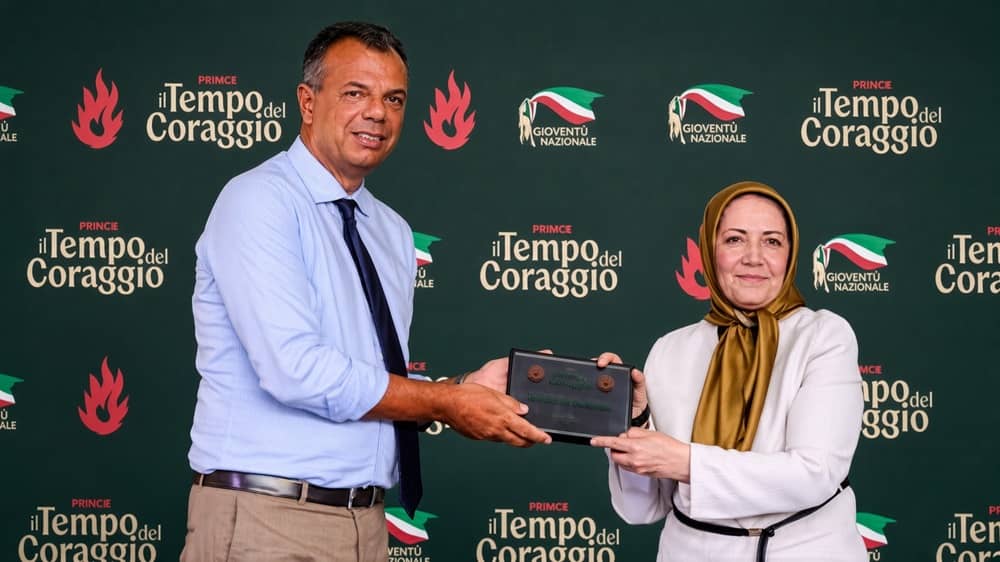
Sarvnaz Chitsaz, Chair of the Women’s Committee of the National Council of Resistance of Iran (NCRI), received the Courage Award on Friday at Fenix 2026, a major national gathering organized by Gioventù Nazionale, the youth organization of Prime Minister Giorgia Meloni’s Brothers of Italy party.
The official Fenix program listed Chitsaz as the recipient of the “Premio Coraggio” during a September 18 session titled Giovani in Rivolta — “Youth in Revolt” — with Senator Marco Scurria, deputy leader of Brothers of Italy in the Italian Senate, presenting the award. The five-day gathering has featured ministers, lawmakers and other senior Italian political figures and is scheduled to conclude Sunday with an address by Prime Minister Meloni.
Chitsaz attended as head of an NCRI delegation invited to the conference and addressed participants on Iran’s political situation, the role of women and young people in opposition to the ruling theocracy, and the NCRI’s vision for a post-theocratic Iran.
Accepting the award, Chitsaz said she regarded it not as a personal distinction but as recognition of Iranians confronting repression inside the country.
“It is a tremendous honor for me to have been chosen as the recipient of the Courage Award on behalf of the courageous women and young people of Iran who are resisting religious oppression,” she said. “So, this award belongs to them.”
The “Courage Award” was presented to .@s_chitsaz, Chair of the Women’s Committee of the National Council of Resistance of Iran (NCRI), at the Fenix Festival in Rome today.
Fenix is the annual festival organised by Gioventù Nazionale, the youth organisation of Fratelli d’Italia.… pic.twitter.com/nEDq2vsKvF
— Women's Committee NCRI (@womenncri) September 18, 2026
Award Dedicated to Iran’s Political Prisoners
Chitsaz dedicated the award in particular to young Iranians imprisoned or executed in connection with opposition activities.
She cited the cases of Mehdi Khanaki, a 26-year-old law graduate and a member of Resistance Units and was recently executed, and Arghavan Falahi, a 25-year-old political prisoner and supporter of the People’s Mojahedin Organization of Iran (PMOI/MEK) who has been sentenced to death.
Chitsaz also quoted a message attributed to Falahi and fellow political prisoner Forough Pourtaghi, presenting it as representative of the outlook of a younger generation rejecting both Iran’s current theocracy and a return to monarchical rule.
“We are Generation Z of Iran. We oppose dictatorship and seek independence. We reject both the Shah and the mullahs,” the message said.
Much of Chitsaz’s address focused on the role of young people and women in successive anti-government protests. Referring to the 2022 nationwide uprising and subsequent unrest, she said women had emerged not merely as victims of state repression but as active participants and leaders in demands for political change.
“The women and young girls of Iran demonstrated that they are not powerless victims but the driving force for change,” she said.
She also pointed to what she described as a new wave of political executions since mid-March, saying many of those targeted had been young protesters arrested during the uprisings.
Message to the freedom-loving Iranians commemorating the 2022 uprising
The footsteps of uprising echo once again in Iran’s citieshttps://t.co/Dl4l2owZXr pic.twitter.com/tWThpGCQRp— Maryam Rajavi (@Maryam_Rajavi) September 12, 2026
Chitsaz Presents NCRI’s Political Alternative
Chitsaz used the appearance to outline the NCRI’s proposed political framework for Iran, arguing that political change should come through the Iranian people rather than foreign military intervention.
“The path to change is neither appeasement of the regime nor foreign war,” she said. “It is change brought about by the Iranian people themselves and their organized Resistance.”
She placed particular emphasis on women’s leadership within the Iranian Resistance. According to Chitsaz, women constitute 52 percent of the NCRI, while the PMOI/MEK recently elected a woman as its secretary-general for the ninth consecutive term. Maryam Rajavi, the NCRI’s President-elect, is also a woman.
“The clearest difference between our vision and the ruling theocracy can be seen in the role of women,” Chitsaz said.
She then outlined Rajavi’s Ten-Point Plan, which advocates universal suffrage and free elections, political and press freedoms, separation of religion and state, gender equality, an independent judiciary, abolition of the death penalty, minority rights and a non-nuclear Iran.
Under the NCRI’s proposed transition process, Chitsaz said, a provisional government would serve for no more than six months, restore basic freedoms and organize elections for a Constituent Assembly.
“Its goal is to transfer power to the people of Iran,” she said.

Appeal to Italy’s Youth
Concluding her remarks, Chitsaz urged young Italians to draw attention to political prisoners and Iranians facing execution.
“The Iranian people are not asking the international community to liberate their country for them,” she said, calling instead for international pressure over executions and accountability for human rights violations.
She asked participants to “be the voice of Iran’s political prisoners” and of young people involved in the MEK’s Resistance Units.