

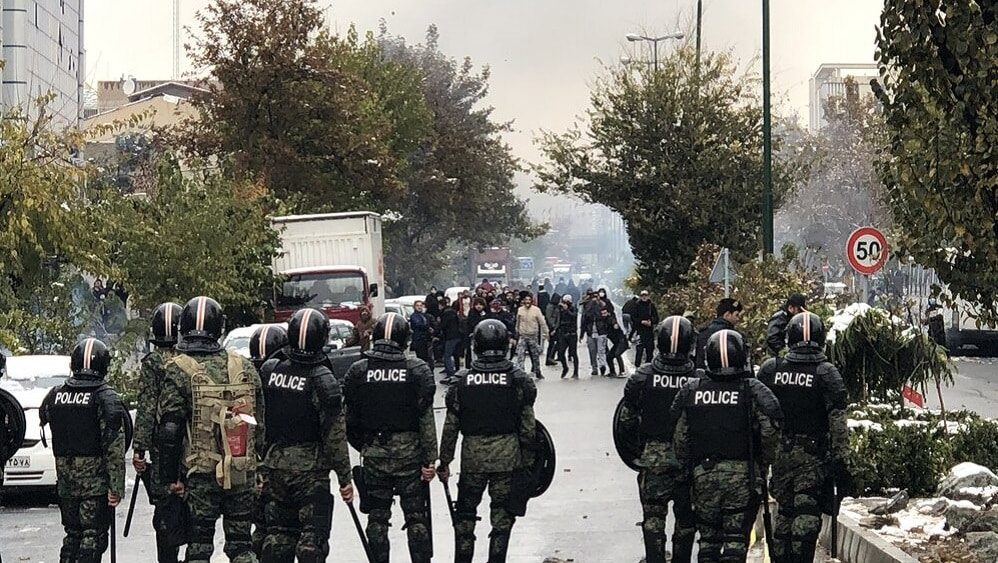
Amnesty International’s 2026 investigation into Iran’s 2022 uprising reaches a conclusion that goes beyond documenting hundreds of killings, mass arrests and torture: the violence was not a collection of spontaneous acts by individual security officers. Amnesty says it formed a nationwide, systematic attack carried out pursuant to state policy.
The organization reached that conclusion after examining patterns of repression across the country alongside leaked government documents, security meetings, written orders, chains of command, deployment of forces, financial support and public statements by senior officials. Amnesty’s Architects of Atrocities investigation reconstructs how decisions made within state institutions translated into violence on the streets.
Its Executive Summary states: “Official statements and leaked official documents analysed by Amnesty International show that senior political and security authorities planned, directed, funded and celebrated the repression while demonizing protesters and issuing threats.”
Amnesty International is calling for urgent international criminal justice to end impunity for repeated mass protest killings in Iran. https://t.co/mEyq7WUcNV
— Amnesty Iran (@AmnestyIran) September 16, 2026
A Nationwide Pattern
The geographical scale was one of Amnesty’s starting points. Its investigation gathered information on 377 protesters and bystanders who died in connection with the uprising across 26 of Iran’s 31 provinces. Of them, 326 were killed during protest dispersals or in militarized areas, 18 died in state custody, 10 died after release in circumstances linked to detention, and 23 were classified as suspicious deaths.
The concentration of killings during the uprising’s first days was striking. Amnesty found that 178 people—55% of the 326 killed during protest dispersals or in militarized areas—died between September 19 and 30, 2022. On September 21 alone, at least 60 protesters and bystanders were killed across 30 counties in 12 provinces. Nine days later, at least 87 people were killed in Zahedan in a single day.
But geography alone did not make the attack systematic. Amnesty found similar methods repeatedly appearing across the country: firing into gatherings, pursuing and shooting people as they fled, using firearms in militarized areas, mass arrests, transferring detainees to undisclosed locations, torture, rape and other sexual violence, and forced “confessions.” The report concluded: “The recurrent patterns of violence demonstrate that the attack — that is, the course of conduct involving the commission of multiple prohibited acts — was carried out pursuant to a policy developed by the authorities.”
After my mother was killed, the authorities tried to silence us. They wanted us to say that she was simply a bystander [….] They also refused to give our family an autopsy report. They wanted to hide the truth. But they did not succeed.
— Amnesty Iran (@AmnestyIran) September 16, 2026
Orders From Above
Amnesty says the evidence leads upward through formal state structures. The IRGC and FARAJA led lethal protest operations while operating within hierarchical systems extending from local and provincial commands to national leadership. Security policy was also formulated through the Supreme National Security Council, State Security Council and provincial and county security councils.
One leaked document examined by Amnesty concerned a meeting of the State Security Council’s Intelligence Committee on September 18, 2022, at the uprising’s outset. Decisions from the meeting were transmitted through the Interior Ministry to bodies including the Ministry of Intelligence, IRGC, FARAJA and judiciary. Relevant authorities were instructed to pass orders down to subordinates and report on their implementation.
Amnesty also examined six leaked orders issued from different levels of the security apparatus. They included orders from the General Staff of the Armed Forces, the Interior Minister in his capacity as head of the State Security Council, provincial FARAJA leadership and IRGC commanders. A September 21 order from the General Staff called for a “firm and severe” response, dispersal of gatherings and arrests, and was transmitted through FARAJA’s command system from the national level down to counties.
Protesters in Iran have been killed, tortured or imprisoned in the thousands for demanding human rights & fundamental political change. Sign the petition to call for creating an international criminal justice mechanism for crimes against humanity in Iran. https://t.co/ddbWITeTzT
— Amnesty Iran (@AmnestyIran) September 17, 2026
State Policy
The report does not base its conclusion on orders alone. Amnesty identifies planning meetings involving political, security and judicial authorities; leaked documents from national security bodies; written instructions through military and police chains of command; mobilization and financing of thousands of personnel; official rhetoric encouraging repression; and subsequent efforts to obstruct accountability.
The organization summarized its finding in Chapter 12: “Leaked official documents analyzed by Amnesty International further reveal that the attack was carried out pursuant to a state policy developed and implemented under the close control of senior officials and institutions, including ones at the highest levels of the state, and with their full authorization and financial support.”
Amnesty says the immediate purpose was to crush the protests and restore control over areas where people had taken to the streets. But it found a broader objective as well: the repeated commission of prohibited acts was intended not only to stop existing protests but to traumatize the wider population and create a climate of fear capable of deterring future uprisings.
The significance of the evidence is straightforward. The same methods appeared across numerous provinces; security forces operated within formal hierarchies; central and local security councils formulated strategy; orders travelled through established command channels; state resources financed and equipped the forces; and senior authorities publicly supported the crackdown.
Read @amnesty's groundbreaking 1000+ page report, Architects of Atrocities: State Machinery Orchestrating Crimes Against Humanity in Iran’s 2022 Woman Life Freedom Uprising, published today, here https://t.co/mEyq7WUcNV pic.twitter.com/7Jeis5TVE7
— Amnesty Iran (@AmnestyIran) September 16, 2026
Amnesty’s conclusion leaves little room for the explanation of uncontrolled local excesses. “This confirms that the crimes committed by the security forces were not spontaneous, but part of a systematic attack waged pursuant to and in furtherance of a state policy to crush protests,” the report concluded.
What happened on Iran’s streets in 2022, according to Amnesty’s evidence, was therefore not a case of the state losing control over its security forces. It was the security machinery carrying out the policy for which it had been mobilized.