

Three-minute read
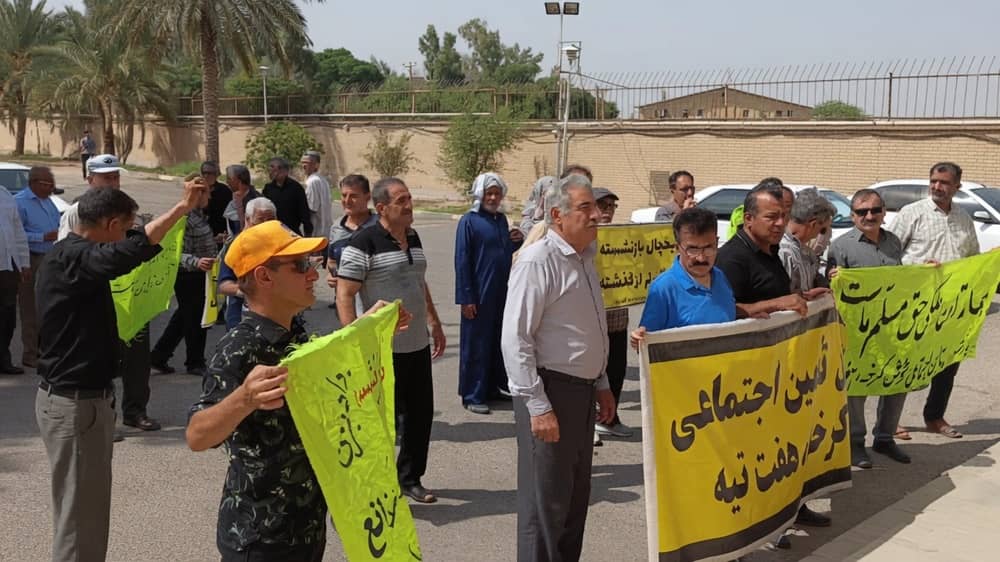
Iran’s economic crisis continued spilling into the streets on September 21, 2026, with retirees demonstrating across at least six cities while the rial remained near historic lows. At the same time, state-aligned media issued increasingly explicit warnings about restrictions on Iran’s remaining trade and financial channels, while the authorities expanded a nationwide Basij mobilization beyond Tehran and into the provinces.
Social Security retirees gathered in Rasht, Isfahan, Kermanshah, Tabriz, Sanandaj and Bijar, according to footage published by Simaye Azadi. Protesters chanted “Our wages are in rials, our expenses are in dollars” and demanded the release of imprisoned workers and teachers. Some demonstrations also included opposition to executions, indicating that economic grievances were again intersecting with broader political demands.
The currency provides the immediate economic backdrop. Iran’s domestic market tracker TGJU put the free-market dollar at roughly 231,000 tomans on September 21, around 20 percent higher than one month earlier. The pressure comes as families enter the new school year facing sharply higher costs. Reporting based on Shargh estimated that even basic supplies and one school uniform for a first-grade pupil cost at least 4.5 million tomans, while the number of children outside formal education has approached one million.
"Iran’s accumulating #economic pressures moved visibly into the streets on September 20, 2026, as retirees demonstrated in several cities while the rial again weakened sharply," writes @shahriarkia.https://t.co/scTS9SL15B
— NCRI-FAC (@iran_policy) September 20, 2026
State Media Sounds the Alarm
More revealing than the exchange rate itself is the increasingly alarmed language coming from within the establishment. On September 21, Hamshahri republished a Kayhan article warning that the revocation of Bank Mellat’s Istanbul license, restrictions on Iran’s access to gas revenues, delays facing Iranian trucks at the Turkish border and competing regional transit routes were “no longer a collection of scattered events.”
Kayhan said Turkey was not transferring Iranian gas revenues directly to Tehran but holding the money in supervised accounts that Iran could use only for permitted purchases such as food and medicine. It warned that restrictions affecting banking, energy payments and land transportation were increasingly aligning with Washington’s economic-pressure policy. The significance is not Turkey itself, but that a newspaper closely aligned with the supreme leader is openly describing Iran’s shrinking financial and commercial room for maneuver as a coordinated economic danger.
Another state-media report exposed pressure on trade from a different direction. Tasnim reported that around 400 20-ton containers of Iranian fruit, vegetables and agricultural products sent toward the United Arab Emirates had been returned, with exporters demanding urgent government action. The report did not establish an official Emirati reason for the returns, but it adds to a wider picture of costly disruptions at precisely the moment the regime is increasingly dependent on alternative commercial routes.
"Iran is entering the final days of September under simultaneous pressure from soaring living costs, a weakened #currency, fuel shortages and problems across industrial supply chains," @MansoreGolestan writes.https://t.co/N7NEb86C1o
— NCRI-FAC (@iran_policy) September 19, 2026
Mobilization Moves into the Provinces
Alongside the economic strain, the security apparatus is extending the “Jan-Fada” Basij mobilization across the country. On September 21, IRNA reported that authorities in Sistan and Baluchestan were planning a mass assembly of Basij battalions. Similar exercises have been announced in Kermanshah, Kerman, Semnan and other provinces. The expanding mobilization underscores the regime’s growing concern that economic hardship and wartime pressures could spill over into broader social unrest.
The geographical expansion matters more than those numbers. What began with a highly publicized Tehran event is becoming a province-by-province organizational campaign involving Basij formations and different sectors of society. This comes alongside the government’s intensified focus on schools and universities as the academic year begins—areas that officials have repeatedly warned could become channels for dissent.
Zahedan Gunfire Shadows Basij-#IRGC Parade Amid Sanctions, Police Abuse and Division
by Amir Taghatihttps://t.co/R9vljTNE3I— NCRI-FAC (@iran_policy) September 18, 2026
The Pressure Converges
The latest developments sharpen the pattern visible over the past several days. Retirees are demonstrating across a widening geography; wages and pensions are being eroded by a currency trading above 230,000 tomans to the dollar; families face sharply rising education and living costs; and state media itself is warning that Iran’s banking, energy-payment and trade channels are narrowing.
At the same time, the authorities are not treating these developments solely as economic problems. They are expanding organized Basij mobilization, intensifying attention to schools and universities and repeatedly framing public “resilience” and internal cohesion as security necessities.
Iran’s recent history gives the leadership ample reason for concern. Repeated protest waves, from 2017–18 and 2019 to 2022 and 2025–26, have shown how quickly economic grievances can turn into broader challenges to the political order.
Today, that pattern is again visible: worsening livelihoods are driving street protests, state media is acknowledging a tightening economic squeeze, and the authorities are expanding security mobilization across the provinces. The regime’s response reflects a deeper fear that economic misery could once again become nationwide political unrest.