

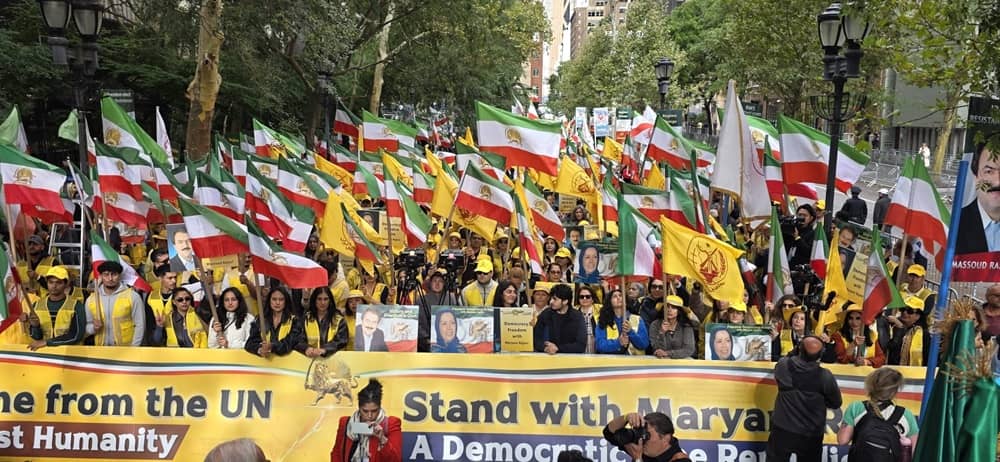
From September 20 to 26, supporters of the National Council of Resistance of Iran (NCRI) and the People’s Mojahedin Organization of Iran (PMOI/MEK), together with Iranian diaspora communities, carried out a succession of rallies, vigils, sit-ins, marches, public exhibitions, and advocacy campaigns across Europe and the United States. The mobilization culminated on September 22 and 23 with two major demonstrations across from United Nations headquarters during the 81st UN General Assembly, following a week of street outreach and candlelight vigils in Manhattan. Across Europe, activists protested executions and political imprisonment, commemorated victims of the 1988 massacre and the 2022 and January 2026 uprisings, marked the continuing “No to Execution Tuesdays” campaign, challenged Tehran’s diplomatic presence, and promoted a secular democratic republic while rejecting both monarchical and theocratic dictatorship.
September 26, 2026
In Stockholm, NCRI supporters rallied outside Sweden’s Ministry for Foreign Affairs to condemn the regime’s execution of political prisoners and to commemorate the September 27, 1981, uprising in Tehran. Participants urged the Swedish government to take decisive action, demanding the immediate release of all political prisoners and the closure of the Iranian embassy, which they characterized as a hub for espionage and terrorism. The gathering reinforced a unified rejection of both monarchical and theocratic dictatorships, expressing support for the NCRI as a democratic alternative. Concurrently, in Lyon, France, the Committee in Support of Human Rights in Iran (CSDHI) and Resistance supporters hosted a photo exhibition outside City Hall. The public display featured a detailed timeline of the regime’s widespread 2026 executions, drawing significant engagement from local residents and raising awareness of the ongoing human rights crisis in Iran.
🚨 FREE IRAN ACTIVIST OUTSIDE UN: “WE DON’T WANT ANY DICTATORSHIP” 🚨
LindellTV’s @CaraCastronuova spoke with Nasser Sharif at the Free Iran demonstration outside the United Nations, where Iranian-American activists are calling for an end to executions and a democratic future… pic.twitter.com/AzKhCl48Vx
— LindellTV (@RealLindellTV) September 23, 2026
September 25, 2026
In Berlin, NCRI supporters marked the 210th consecutive day of a sit-in outside the Iranian embassy. Participants demanded the immediate closure of the diplomatic mission, identifying it as a central node for regime espionage and terrorism in Germany. The gathering reinforced opposition to both clerical rule and a return to the former monarchical system, advocating for a free, democratic republic as Iran’s definitive future.
More pics
2-#Lyon – Sept 26, 2026: A photo exhibition honoring the martyrs of Iran’s uprisings & political prisoners was held in front of Lyon City Hall to condemn the widespread executions carried out by the mullahs’ regime in Iran, particularly in 2026.#StopExecutionsInIran pic.twitter.com/tkm6ZqEQDx— Iran Freedom (@4FreedominIran) September 27, 2026
September 24, 2026
Supporters organized a public book stand and photo exhibition at Place de la République in Paris, aiming to expose the deteriorating human rights conditions in Iran. The event specifically highlighted the regime’s reliance on the death penalty targeting political prisoners and individuals detained during nationwide uprisings. Organizers urged the French public and the broader international community to acknowledge the Iranian people’s unequivocal rejection of both monarchical and theocratic dictatorships, calling for concrete actions against ongoing rights abuses.
Thousands of people gathered outside the United Nations in New York to protest Iran’s government as President Masoud Pezeshkian addressed the General Assembly. Demonstrators called for an end to the current regime, while some American Iranian protesters with personal ties to Iran… pic.twitter.com/DxEn4WO1ES
— CBS News (@CBSNews) September 23, 2026
September 23, 2026
In New York, Iranian Americans and NCRI supporters returned to Dag Hammarskjöld Plaza for a second consecutive day as the Iranian regime president Masoud Pezeshkian addressed the UN General Assembly. Demonstrators protested executions and political repression in Iran, challenged Tehran’s claim to represent the Iranian people, and expressed support for an Iranian-led transition toward a democratic republic. Former New Jersey Senator Robert Torricelli, former New York Mayor Rudy Giuliani, former U.S. Ambassador Marc Ginsberg, and Iranian opposition representatives addressed the gathering, while NCRI President-elect Mrs. Maryam Rajavi delivered a message asserting that Iranians should determine their political future themselves.
Reuters documented Iranian-American demonstrators on both September 22 and 23 and identified the events as rallies organized by supporters of Maryam Rajavi and the MEK at Dag Hammarskjöld Plaza.
Fox News reported that protesters demonstrated as Pezeshkian addressed the UN and repeatedly chanted, “They are terrorists. They must go!”
EFE reported that Iranians carrying “Free Iran” signs demonstrated outside UN headquarters on September 23.
Iranian opposition protesters rally for regime change outside UN https://t.co/qFSaddRtzn #FoxNews @iran_policy @Maryam_Rajavi @A_Jafarzadeh @AlinejadMasih #iran @FDD_Iran @FDD @NUFDIran @iran
— Eric Shawn (@EricShawnTV) September 23, 2026
September 22, 2026
Thousands of Iranian Americans and NCRI supporters, according to organizers, gathered across from UN headquarters as the General Assembly’s high-level meetings began, calling for an end to political executions and repression and backing democratic change led by Iranians themselves. Participants displayed photographs of victims, opposition banners, and slogans rejecting both the current clerical system and restoration of the ousted monarchy, while speakers emphasized Maryam Rajavi’s Ten-Point Plan and the activities of Resistance Units inside Iran.
CBS News New York reported that Iranian Americans gathered outside the UN and called for the international community to hold Iran’s government accountable.
The New York Post reported that thousands gathered outside the UN demanding an end to political executions and calling for a free democratic system in Iran.
Protesters outside UN demand end to Iranian regime, political executions https://t.co/XUv1qZJIW1 pic.twitter.com/FPDAupKasp
— New York Post (@nypost) September 23, 2026
September 21, 2026
A photo exhibition took place outside the European headquarters of the United Nations in Geneva. Coinciding with the 63rd session of the UN Human Rights Council, the display confronted international delegates with visual documentation of executed political prisoners and victims of recent uprisings. The event aimed to force international institutional attention onto the urgent human rights crisis and the continuing use of capital punishment against dissidents.
WATCH: Iranian-Americans gather outside the UN headquarters in New York to protest the current Iranian government, as the High-Level Week of the 81st UNGA gets underway. https://t.co/bGyL05K0RB pic.twitter.com/msUCWwvybG
— Arab News (@arabnews) September 22, 2026
September 19, 2026 (Late Submission)
A coordinated weekend mobilization occurred across multiple European cities to protest the execution surge and demand accountability. In Stockholm, individuals gathered outside the Swedish Foreign Ministry, honoring fallen PMOI members and urging the government to shut down the Iranian embassy. A parallel event in Malmö echoed these exact demands, calling the embassy a hub for espionage against freedom-seeking Iranians. In Bellinzona and Heidelberg, exhibitions honored victims of the 2022 uprising, including executed wrestling champion Navid Afkari, while pressing the international community to save political prisoners currently on death row.
In Bucharest, organizers conveyed an urgent message to prevent the imminent execution of protesters detained during the January 2026 uprising, securing expressions of solidarity from Romanian citizens. In Hamburg, attendees condemned the targeted execution of MEK political prisoners and urged the German government to adopt a firmer policy against Tehran. In Paris, an additional large-scale photo exhibition documented decades of state violence, spanning from the 1988 massacre to recent unrest. In New York, the Organization of Iranian American Communities (OIAC) laid the groundwork for the upcoming UN protests with candlelight vigils near UN headquarters, lining the streets with victim portraits, roses, and banners.
MEK Supporters Hold Photo Exhibition in #Geneva to Highlight Executions in Iran #StopExecutionsInIran #NoImpunity4Mullahs https://t.co/gpTjdTUnYl
— Iran Freedom (@4FreedominIran) September 24, 2026
The synchronization of massive protests in New York during the UN General Assembly with sustained diplomatic exhibitions across Europe illustrates a highly organized diaspora capable of directly challenging the regime’s international legitimacy. By maintaining a relentless focus on the clerical establishment’s reliance on executions and domestic terror, these global mobilizations actively counter Tehran’s attempts to project stability on the world stage. The explicit rejection of both the current theocracy and the former monarchy signals a unified political strategy, positioning the Resistance’s vision for a secular, democratic republic as the definitive alternative to a regime increasingly paralyzed by its own internal and external crises.