

Four-minute read
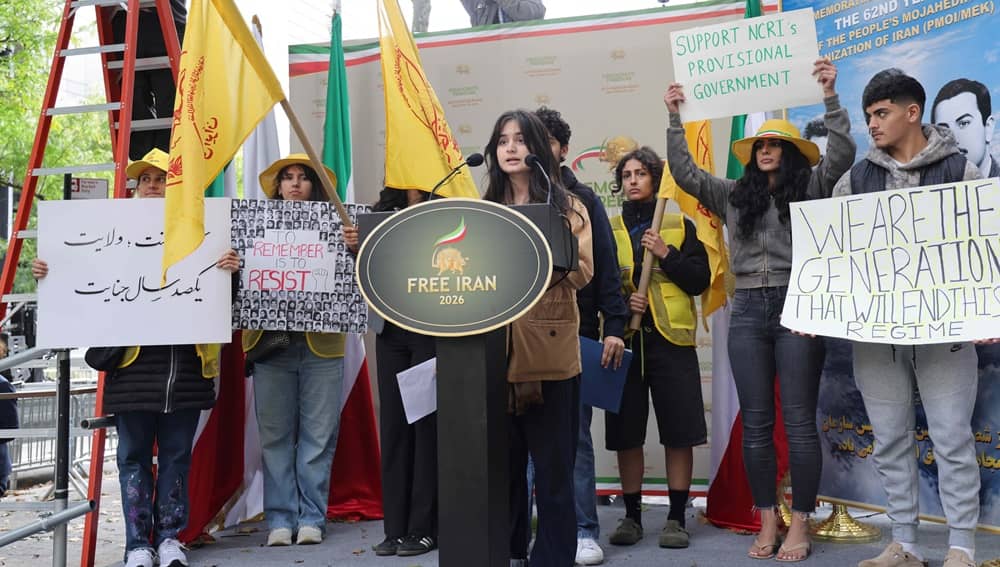
In September, across from the United Nations in New York, supporters of the Iranian Resistance gathered while world leaders met inside. The demonstration was familiar in one sense—flags, portraits of political prisoners, slogans against the clerical regime—but striking in another. Many of those taking microphones, organizing contingents and speaking about Iran’s future were young Iranians raised in Europe or North America, some of whom had never lived in Iran.
That fact carries more sociological weight than it may first appear. Diaspora movements often fade by the second generation: memory becomes ritual, ritual becomes nostalgia, and political commitment weakens. Yet here were young people inheriting not simply their parents’ grievances, but an organization, a political vocabulary and a sense of unfinished struggle. Their presence offered a direct challenge to one of the most persistent claims about the People’s Mojahedin Organization of Iran—the assertion that it has organization but no social roots.
The reaction was revealing. Supporters of the clerical regime and partisans of the former monarchy attacked the rally and its participants across social media, each from opposite political directions. Their hostility underscored a basic paradox. A movement supposedly irrelevant to Iranian society continues to generate enough political energy to provoke its most determined adversaries.
Protesters outside UN demand end to Iranian regime, political executions https://t.co/XUv1qZJIW1 pic.twitter.com/FPDAupKasp
— New York Post (@nypost) September 23, 2026
When the Movement Could Be Seen
There was once a brief period when the PMOI’s social reach did not have to be inferred. Between the Shah’s fall in 1979 and the violent closure of political space in 1981, it was able to organize openly.
The organization emerged from the Shah’s prisons as a relatively small revolutionary force, whose leadership had largely been executed or imprisoned. Within two years, it had established offices across Iran, attracted large numbers of students and young people, published a mass-circulation newspaper and held meetings drawing tens of thousands. Historians and Western media have recorded gatherings numbering well into the hundreds of thousands and estimated that the PMOI-called demonstration in Tehran on June 20, 1981, have drawn as many as 500,000 people.
The importance of that period is not simply numerical. It showed what happened when the movement briefly operated without the full weight of state repression. After June 1981, that world disappeared. Offices were closed, supporters were hunted, imprisonment became widespread, and affiliation could carry a death sentence.
🚨 INSPIRING BEYOND WORDS: I joined thousands of Iranian-Americans, including countless young people and former political prisoners of the Regime, outside the UN today.
The people of Iran and their families throughout the world want Regime change, and they want it now! #FreeIran https://t.co/sLzgEO9oIs pic.twitter.com/XSjNhcoiNh
— Rudy W. Giuliani (@RudyGiuliani) September 23, 2026
What Repression Hides
This is where the argument about “social roots” often becomes conceptually confused. Authoritarian repression does not merely reduce participation; it changes what participation looks like.
The clerical regime’s repression of the PMOI has been exceptionally severe. Human rights organizations and the UN have documented that PMOI members and supporters constituted the principal group targeted during the 1980 prison massacres. Decades later, people are still being sentenced to death or executed in cases involving alleged links to the organization. In recent years, dozens of its supporters have faced execution following proceedings condemned by human-rights organizations as grossly unfair.
Nevertheless, thousands of PMOI-led Resistance Units continue to operate clandestinely across Iran, engaging in political messaging, graffiti, projections, commemorations and other forms of resistance. The continued prosecution of people accused of belonging to such networks points to a more basic reality: under conditions of such severe repression, an organizational current capable of reproducing itself underground cannot simply be dismissed as socially irrelevant.
@Reuterspictures , window to our rally in New York. Thousands of Iranian Americans, supporters of @iran_policy @Maryam_Rajavi pic.twitter.com/rs0sgPbdLV
— OIAC: Organization of Iranian American Communities (@OrgIAC) September 23, 2026
A Movement That Reproduces Itself
This is the more revealing sociological test.
Political movements survive not merely by preserving institutions, but by reproducing commitment. They must persuade people who did not experience the founding trauma to accept the cause as their own. That becomes progressively harder with each generation.
Yet the PMOI has repeatedly produced new cohorts. The student attending Massoud Rajavi’s lectures in Tehran in 1980 belongs to a different Iran from the young activist operating underground today. The prisoner who refused to renounce the movement in 1988 belongs to another generation still. And the Iranian-American or Iranian-Canadian organizing in New York in 2026 may have been born decades after the events that created the movement.
This is intergenerational political reproduction: the transmission of identity, memory and organization across time.
It also extends across geography. Young supporters raised in Western societies have no coercive reason to adopt the politics of their parents. They have competing identities, careers and political cultures available to them. When some nevertheless become active organizers, the phenomenon cannot simply be dismissed as residue from the revolutionary generation.
The Iranian people have been fighting for their freedom for decades. They are organized, courageous, and ready for change.
It’s time to support them. Hear from Yalda⬇️#StopExecutionsInIran #UNGA81 pic.twitter.com/UPvtlkQXay
— OIAC: Organization of Iranian American Communities (@OrgIAC) September 23, 2026
The Politics of Sacrifice
Money provides another measure. For decades, supporters of the Iranian Resistance have financed its media and political activities through public fundraising campaigns and donations from people inside the country and the diaspora, often accompanied by personal accounts of imprisonment, execution or political commitment.
Financial contribution is costly participation. It is one of the mechanisms through which a dispersed political community sustains itself—and through which the movement has sought to preserve its independence from foreign governments.
The Paradox of Erasure
For decades, the Iranian regime has invested heavily in propaganda aimed at portraying the PMOI as a movement with no popular support or social base inside Iran. In reality, the clerical dictatorship has spent nearly half a century trying not only to undermine the movement, but also to make any evidence of its social roots and support networks invisible: banning the organization, criminalizing association with it, killing thousands of its supporters and turning even its name into an object of state propaganda. Such repression can destroy public visibility. It does not necessarily destroy political inheritance.
HEAR OUR CHANTS! We stand with the Iranian People! pic.twitter.com/efBAeBi2ht
— OIAC: Organization of Iranian American Communities (@OrgIAC) September 23, 2026
That is why the young people in New York matter. So do the activists sentenced to death inside Iran, the anonymous members of Resistance Units, the families who continue donating, and the political identities transmitted from one generation to the next.
A political organization can survive in exile as a shell. What is harder to explain is its ability to keep generating people born long after its founding who voluntarily assume its risks, language and ambitions.
That is not evidence of an extinct movement.
It is evidence of a political tradition that went underground—and remained alive.