

Four-minute read
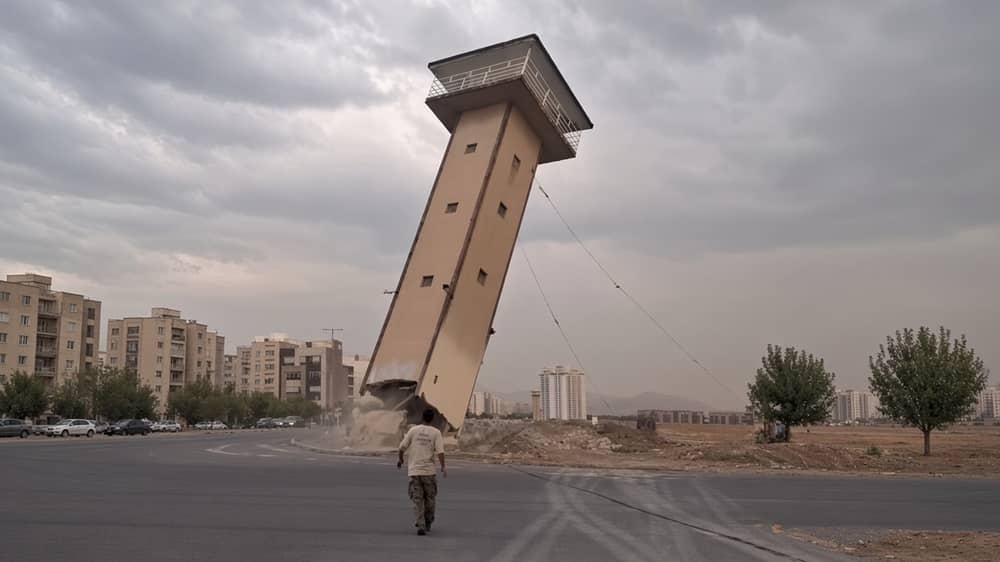
Iranian state television chose an unsettling phrase to announce the completion of the demolition of Gohardasht Prison, also known officially as Rajaei-Shahr. “In the near future, no trace of the prison will be seen in Rajaei-Shahr,” the broadcaster reported on October 5, 2026, after the remaining walls and watchtowers were brought down. For an ordinary obsolete prison, the language might have been unremarkable. Gohardasht, however, was one of the principal killing grounds of the 1988 massacre of political prisoners—and one of the few surviving physical crime scenes whose architecture later entered an international criminal case.
The judiciary presented the demolition as urban renewal. During an officially organized media tour on October 4, 35 reporters and photographers from roughly 20 domestic outlets were taken to the site as authorities declared the operation complete. The 60-hectare complex is to be redeveloped for residential, commercial, recreational and educational purposes; prison officials said roughly 50 hectares had been “freed” for investors, while about 17 hectares controlled by the Prisons Organization were expected to be auctioned.
But the question is not whether Karaj needs redevelopment. It is why a site tied to mass executions, torture and enforced disappearance was razed without an independent forensic examination, international documentation mission or preservation process—after years of warnings that precisely such evidence was being destroyed.
🚨 Iran is demolishing Gohardasht Prison to erase evidence of its crimes against humanity.
Today, authorities tore down watchtowers at a principal site of the #1988Massacre, where political prisoners were executed after minute-long "hearings".
The death corridor and execution… https://t.co/rs0xbCWJ79 pic.twitter.com/fzupux4Q4m
— M. Hanif Jazayeri (@HanifJazayeri) October 4, 2026
A Crime Scene with a Court Record
Gohardasht’s significance is not based on opposition testimony alone. In 2022, the Stockholm District Court sentenced former Iranian prison official Hamid Noury to life imprisonment for participating in executions there in 1988. Sweden’s Court of Appeal later upheld the judgment in its essential parts, finding the prosecution’s evidence “robust and overall compelling” and affirming that a large number of prisoners, including people linked to the PMOI, had been executed at Gohardasht.
The physical geography of the prison mattered to that case. Survivors reconstructed the “Death Corridor,” the rooms where prisoners waited to be questioned, and the hall where groups were hanged. Testimony described prisoners being selected, moved through specific corridors and escorted toward execution; models and detailed descriptions of Gohardasht were presented during proceedings connected to Noury’s trial.
#Iran News in Brief
According to reports from inside Iran, the clerical regime has been secretly moving thousands of prisoners from Gohardasht Prison to Qezel-Hesar Prison. The fate of #PoliticalPrisoners in Gohardasht Prison remains unknown.https://t.co/iJmtafgdeM pic.twitter.com/Xb8bXH2GNf— NCRI-FAC (@iran_policy) August 1, 2023
The former UN Special Rapporteur on Iran, Javaid Rehman, went further in his 2024 findings, concluding that substantial evidence established crimes against humanity—including mass murder, torture, persecution and enforced disappearance—during the 1988 killings, and stating that the crime of enforced disappearance remains ongoing. He also documented a broader state practice of destroying graves and concealing material capable of establishing responsibility.
The Warnings Were Repeated
The demolition cannot credibly be described as an unforeseen development. The National Council of Resistance of Iran had been warning about the destruction of evidence for years. In 2017, it reported damage to graves associated with 1980s executions in Tabriz, Mashhad and Ahvaz. In April 2021, it warned that authorities were threatening the Khavaran mass graves; weeks later, 1,112 relatives of victims appealed to the UN and Western governments. In 2023, when Gohardasht was emptied and its inmates moved to Ghezel Hesar, NCRI warned that closing the prison could become a prelude to eliminating a major crime scene. In August 2025, it condemned the leveling of Plot 41 at Tehran’s Behesht-e Zahra cemetery. And on September 15, 2026, as demolition at Gohardasht accelerated, it again called for urgent international intervention.
The clerical regime in #Iran has completely closed down Gohardasht Prison in Karaj, infamous for being the site of #1988Massacre and #CrimesAgainstHumanity that continued to take place since the 1980s until today. https://t.co/0zoXD71If7
— NCRI-FAC (@iran_policy) August 9, 2023
Iran Human Rights Monitor issued a separate warning on September 16, describing the demolition of Gohardasht together with the destruction of mass graves as an effort to erase evidence of crimes against humanity. Its report specifically cited the destruction of the prison’s physical layout—including areas remembered as the “Death Corridor” and “Death Hall”—and called for the site to be preserved for future accountability proceedings. Iran Human Rights Society has likewise spent years documenting the 1988 massacre, including the scale of killings at Gohardasht and the prison’s place within the nationwide execution system.
These warnings were not occurring in isolation. Amnesty International and Justice for Iran documented as early as 2018 a systematic campaign to bulldoze, build over or otherwise damage suspected mass graves from the 1988 massacre, warning that vital forensic evidence was being deliberately eradicated. UN experts subsequently raised repeated concerns over Iran’s failure to preserve and investigate mass graves, including formal communications in 2022 and again over the destruction of Plot 41 in 2025.
Iran's Regime Moves to Erase Gohardasht Prison, a Key Crime Scene of the #1988Massacrehttps://t.co/gqHTZSvVum
— NCRI-FAC (@iran_policy) September 17, 2026
From Gohardasht to Ghezel Hesar
When Gohardasht was emptied in 2023, many prisoners were transferred to Ghezel Hesar, which has since become one of the most notorious centers of Iran’s expanding execution apparatus. The prison now appears repeatedly in reports of mass executions, political prisoners, overcrowding, beatings, mock executions and severe deprivation. A recent investigation based on information from inside the prison described extreme overcrowding, inadequate food and medical care, collective violence and chronic psychological terror.
Iran HRM has documented Ghezel Hesar as a central site for political executions and prisoner resistance. In 2026, it reported the executions there of political prisoners accused of PMOI affiliation, violent raids on political wards, and a hunger strike by roughly 1,500 death-row prisoners protesting executions. The “No to Execution Tuesdays” campaign, which began at Ghezel Hesar in January 2024, has since spread to dozens of prisons nationwide.
🚨 Authorities in Iran continue razing Gohardasht Prison—a key site of the #1988Massacre.
Crimes against humanity are not only committed through murder; they are also perpetuated through the destruction of evidence, denial of truth and obstruction of justice.
CC: @drmaisato https://t.co/dgBcKcRY3a pic.twitter.com/j5ERbMfwhy
— M. Hanif Jazayeri (@HanifJazayeri) October 4, 2026
This is why the destruction of Gohardasht is not merely an argument over preserving a building. A site where mass executions were carried out, whose layout became evidence in a European criminal proceeding, has now been physically erased while the state’s execution machinery continues elsewhere. The clerical regime may call the land valuable real estate. For survivors and families of those killed, it was also evidence.
The authorities have now achieved what state television announced with striking candor: soon, “no trace” will remain. The international failure is that this outcome was warned about repeatedly—in 2017, 2021, 2023, 2025 and again weeks before the bulldozers finished their work—and yet no effective preservation mechanism arrived before the crime scene disappeared.