

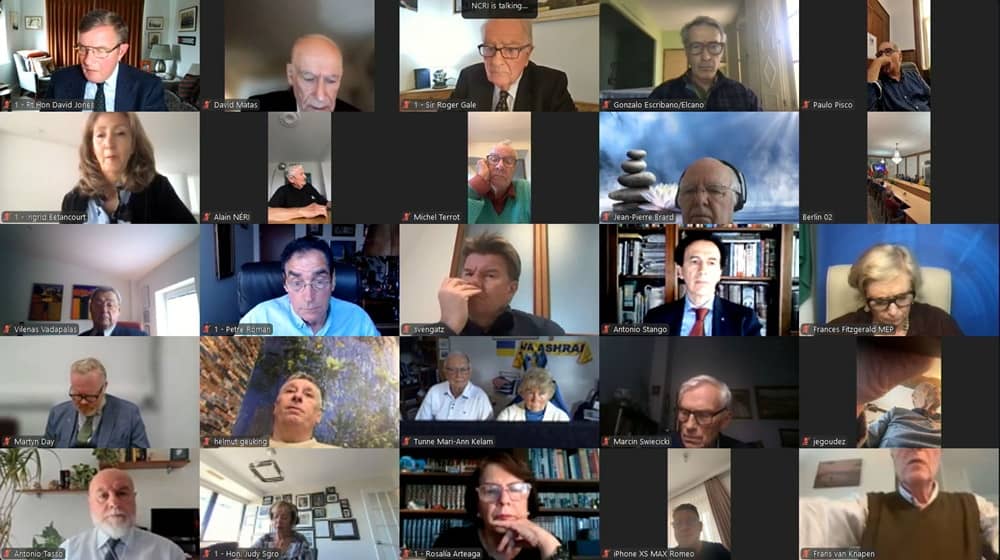
An online international conference convened by the National Council of Resistance of Iran (NCRI) on October 9, 2026, on the eve of the World Day Against the Death Penalty, brought together lawmakers, former heads of government, ministers, lawyers and political figures from Europe, North America and Latin America to condemn the escalating use of executions in Iran and call for a stronger international response.
Speakers urged governments to make an end to executions a condition of political and economic relations with Tehran, pursue accountability through international and national courts, and support independent access to Iranian prisons. A recurring theme was that decades of executions and repression had failed to eliminate Iran’s organized opposition. Participants pointed to the endurance of the People’s Mojahedin Organization of Iran (PMOI/MEK), the expansion of Resistance Units inside the country and the NCRI’s proposed democratic transition as evidence that an organized alternative had survived despite sustained repression. The online conference featured NCRI President-elect Maryam Rajavi as its keynote speaker.
Mrs. Maryam Rajavi opened by paying tribute to political prisoners executed for opposing the clerical authorities and to those currently facing death sentences. Referring to prisoners who maintained their defiance until their final moments, she said: “These courageous men stood strong against the terror of execution. Standing before the gallows, they sang songs of freedom.” She also highlighted the “No to Execution Tuesdays” campaign sustained by political prisoners for more than two years and the families who continue gathering outside prisons to protest death sentences.
Mrs. Rajavi said at least 46 political prisoners had been executed over the previous six months, including nine PMOI members and 37 people arrested during uprisings. She argued that the intensification of executions reflected the authorities’ fear of renewed revolt rather than political stability.
“However, in today’s conditions, with nationwide resistance growing, the regime will not be able to decide the fate of our people through executions,” she said. “Neither the current regime can save its rotten power, nor will the remnants of the Shah be able to take Iran back to monarchical dictatorship.”
Message to conference on World Day Against the Death Penalty
The World Day Against the Death Penalty is humanity's clear "No" to the Iranian regime—a regime defined by executions and massacres.
For nearly half a century, the main target of this regime's executions has been the… pic.twitter.com/Nv7ds1z8KU— Maryam Rajavi (@Maryam_Rajavi) October 9, 2026
Mrs. Rajavi placed the abolition of capital punishment within the NCRI’s broader political program, contrasting decades of repression with the Resistance’s stated commitment to abolishing executions in a future republic.
“For nearly half a century, the main target of this regime’s executions has been the Iranian Resistance,” she said. “Yet, standing against this regime, the National Council of Resistance of Iran holds high the banner for the abolition of the death penalty in tomorrow’s free Iran.”
She added that the NCRI sought “a society free from execution and torture” based on human rights, democratic choice, separation of religion and state and equality between women and men.
The NCRI President-elect then detailed an international initiative she had proposed in a letter to the UN Secretary-General three days earlier. Her demands included recognition of major past killings as international crimes, an immediate halt to political executions, creation of an independent international criminal-justice mechanism, prosecutions under universal jurisdiction, referral of serious violations to the Security Council and relevant international courts, and unrestricted access for UN investigators to prisons and detainees.
Central to her proposal was a demand that governments place human rights at the center of their relations with Tehran: the end of executions and killings of protesters should be made a condition of economic, political and diplomatic relations and of international agreements with the Iranian authorities, she said.
British MP Bob Blackman, chairman of the Conservative Party’s 1922 Committee, said international attention to regional military confrontation was obscuring what he called the “real battle” inside Iran—between the population and organized Resistance on one side and the ruling authorities and IRGC on the other. He described executions as an instrument intended to suppress that confrontation and argued that years of impunity had strengthened Tehran rather than moderated its behavior.
Blackman called for enforcement of sanctions, disruption of IRGC-linked financial networks and firm measures where Iranian diplomatic facilities were used for hostile activities. But he argued that pressure alone did not constitute a policy for Iran’s political future.
“The resistance movement needs and deserves recognition,” he said. Blackman noted that the Iranian Resistance, including the PMOI and NCRI, had sustained “more than five decades of struggle for freedom and democracy, first against the Shah’s dictatorship and then against the ruling religious dictatorship,” describing that history as evidence of its “sustained commitment as an organized opposition to dictatorship in Iran.”
De vrouw verdient de Nobelprijs voor de Vrede. @Maryam_Rajavi_F gaat door met haar tienpuntenplan voor een seculier, niet-nucleair, zelfstandig, democratisch Iran. Steun haar dan! @notMinBuZa @MinPres @vonderleyen https://t.co/5bmVqUehxU
— Dorien Rookmaker (@RookmakerDorien) October 10, 2026
He also pointed directly to the Resistance Units, saying an orderly transfer of power should follow a successful uprising in which those networks had played a role. He endorsed Mrs. Rajavi’s Ten-Point Plan and said its significance lay partly in the fact that the proposed alternative depended on Iranians themselves rather than a foreign power.
Sir Roger Gale, Deputy Speaker of Britain’s House of Commons, recalled that he and parliamentary colleagues had first become involved with the Iranian Resistance roughly a quarter-century ago. He said the continuing confrontation between Tehran and its own population was the fundamental political crisis facing Iran and argued that executions and arbitrary arrests were attempts to prevent further uprisings.
Sir Gale similarly emphasized the opposition’s longevity. The PMOI and NCRI, he said, had maintained a struggle against dictatorship for more than five decades, first against the monarchy and then against the clerical government. “The record demonstrates its sustained commitment as an organized opposition to dictatorship in Iran,” he said. Gale called Mrs. Rajavi’s Ten-Point Plan a continuing roadmap toward free elections, political pluralism, separation of religion and state, women’s equality, minority rights, abolition of capital punishment and a non-nuclear Iran.
Former Romanian Prime Minister Petre Roman argued that the ability of Iran’s opposition to bring about change was being seriously underestimated internationally. Drawing on his experience of Romania’s 1989 revolution and subsequent democratic transition, Roman said Western governments had similarly understood the brutality of Nicolae Ceaușescu’s rule without fully grasping the capacity for domestic political change.
He criticized what he considered excessive attention to the Iranian authorities’ supposed “resilience” and insufficient recognition of the opposition’s endurance. “It seems that the confidence in the capacity of the Iranian people, the capacity of the Iranian fighters to defeat the regime… is not where it should be,” Roman said. His conclusion was categorical: “The real solution is to put all our focus, all our conviction… in favor of the fighters in Iran.”
Message to conference on World Day Against the Death Penalty
Three days ago, in a letter to the Secretary-General of the United Nations, I called on the UN to lead an international initiative to compel the clerical regime to stop executions, killings, and crimes against humanity.… pic.twitter.com/CjWvGj1bC7— Maryam Rajavi (@Maryam_Rajavi) October 9, 2026
Former Colombian presidential candidate and senator Ingrid Betancourt spoke from her own experience as a former hostage, focusing first on the psychological importance of solidarity with prisoners facing execution. She said international recognition that a prisoner had not been forgotten could mark the difference between despair and resilience.
Betancourt also addressed campaigns against the PMOI. She said that after publicly supporting the Iranian Resistance she had encountered extensive allegations against the movement, an experience that, she said, ultimately strengthened rather than diminished her support. While insisting that every political organization merited scrutiny, she argued that such scrutiny had to be based on evidence rather than repeated accusations.
She rejected both continued clerical rule and restoration of the monarchy and backed the NCRI’s transition proposal and Rajavi’s Ten-Point Plan. Betancourt called on governments to recognize the Iranian opposition as a legitimate interlocutor, demand an immediate end to executions, seek international access to prisoners and pursue accountability for past atrocities.
“Regimes can imprison bodies and they can censor newspapers and they can build walls and they can erect gallows,” she said. “But they cannot execute freedom.”
Former UK minister David Jones proposed action on four fronts: an immediate halt to executions and release of political prisoners; independent access to detention centers and referral of serious violations to UN mechanisms; use of universal jurisdiction against perpetrators of crimes against humanity; and rigorous enforcement of sanctions and disruption of networks used for repression, espionage and terrorism.
Jones said the question of what follows the current government could no longer be deferred. He argued that the decision belonged exclusively to Iranians through free elections, while describing the NCRI’s transition framework as a substantive answer to claims that removing the current system would necessarily produce disorder.
He also explicitly rejected a return to monarchy. “Iran does not need to exchange a theocratic dictatorship for a hereditary dictatorship,” Jones said. “Our message should be for a rejection of both the mullahs and the Shah and a firm commitment to a democratic Iranian republic. We should stand with the Iranian people and their organized resistance in their struggle for a free, democratic, and peaceful Iran.”
Former Italian Foreign Minister, Giulio Terzi, now a senator and chair of the Italian Senate’s EU Policies Committee, said the Resistance had spent four decades warning the international community about the nature of Tehran’s domestic and foreign policies. He argued that years of accommodation had failed and called on democratic governments to support Iranian women and young people challenging the authorities.
“It is time for free democracies to support in all possible ways the struggle for a free Iran,” Senator Terzi said, calling in particular for recognition of the NCRI under Rajavi and what he described as Iran’s democratic Resistance.
Former Kosovo Prime Minister Avdullah Hoti said repression had not forced Iranians to abandon their political demands. “The Iranian people have not surrendered to tyranny,” he said. “Their resistance is becoming increasingly organized through Resistance Units.” Hoti rejected both foreign military intervention and engagement premised on preserving the existing dictatorship, saying political change had to come from Iranian society itself.
He also stressed that opposition to Tehran should not be interpreted as endorsement of the previous monarchy, citing the slogan rejecting “the Shah or the Supreme Leader.” Hoti called on governments to condition their relations with Iran on an end to executions and respect for human rights.
Former Ecuadorian President Rosalía Arteaga Serrano said executions and repression had not silenced Iranian society, pointing to continued protests by workers, retirees, nurses, students and other groups despite severe risks. Women, she said, had remained at the forefront, making equality inseparable from democratic political change.
Message to conference on World Day Against the Death Penalty
October 10th is the #WorldDayAgainsttheDeathPenalty.On this day, we honor all the brave men and women in Iran who were executed for their struggle for freedom.
The World Day Against the Death Penalty is humanity's… pic.twitter.com/oqsqqGj4nA— Maryam Rajavi (@Maryam_Rajavi) October 10, 2026
Arteaga backed Mrs. Rajavi’s Ten-Point Plan and said Iran needed “neither war nor appeasement” but “a democratic republic chosen freely by its people.” She called for an immediate halt to executions, release of political prisoners, independent prison access and accountability for torture and crimes against humanity.
Former Costa Rican Vice President Ana Helena Chacón Echeverría described executions, mass arrests and torture as methods used by an increasingly vulnerable dictatorship to intimidate a population repeatedly demanding change. She called for governments to make ending executions a central condition of political and economic dealings with Tehran and endorsed universal jurisdiction for those accused of crimes against humanity.
Chacón also rejected what she called the false choice between clerical rule and restoration of the monarchy. She contrasted that with the NCRI’s proposed time-limited provisional government followed by elections for a constituent and legislative assembly and the transfer of authority to elected representatives. “Our responsibility is not to choose Iran’s rulers,” she said, “it’s to defend the Iranian people’s right to choose them freely.”
French lawyer, and President of the Administrative Council of the European Lawyers Foundation Dominique Attias focused on prisoners facing imminent execution and called on France and the European Union to act. She demanded public intervention over individual death sentences, support for UN investigations, targeted sanctions and use of universal jurisdiction. Attias also called for all relations with Tehran to be conditioned on stopping executions, arguing that impunity had enabled judges, interrogators and officials involved in executions to avoid accountability.
Canadian MP and former minister Judy Sgro praised what she described as the “remarkable resilience” of Iranians within the NCRI and elsewhere, adding that their courage was unlike anything she had previously witnessed. She called on the UN and governments to implement stronger measures against executions and repression, while stressing that Iran’s future had to be determined by Iranians themselves.
Italian MP Naike Gruppioni called executions of political opponents and protesters an attack on fundamental rights and the rule of law rather than an ordinary judicial matter. She urged governments and international institutions to apply political and diplomatic pressure to halt executions and revoke death sentences. “Freedom is not a crime. Dignity is not negotiable. And human life cannot become an instrument of repression,” she said.
Belgian parliamentarian Loris Resinelli praised Iranian young people and women who had continued resisting despite repression. He said the NCRI had helped keep “the heart of the Iranian Resistance” beating from exile while activists continued their struggle inside the country. Rosinelli backed Mrs. Rajavi’s Ten-Point Plan and argued that clerical rule should not be replaced by what he called the “archaic” system of the Shah.
Former Norwegian parliamentarian Lars Rise likewise highlighted the endurance of Resistance networks despite executions. He referred to their role in protests across cities throughout Iran and said he was encouraged by the movement’s perseverance. Rise criticized the limited international reaction to executions and urged governments to adopt a substantially stronger response. “I’m encouraged to see how perseverant the resistance movement is,” he said.
Former French MP Jean-Pierre Brard similarly emphasized the accumulated sacrifices behind the organized Resistance and warned against allowing a monarchical restoration to appropriate the outcome of a struggle carried by Iranians inside the country. He said supporters in France would continue standing with the Iranian Resistance and summarized his opposition to both systems with the formulation, “Neither Shah nor the mullahs.”
Former German Bundestag member Thomas Lutze also criticized efforts to present Reza Pahlavi as the presumptive leader of a future Iran. Lutze argued that granting political leadership on the basis of birth was intrinsically undemocratic and urged German political figures to oppose a planned award by the Friedrich Naumann Foundation to Pahlavi.
Italian politician Carlo Ciccioli, meanwhile, said he admired the “commitment, self-sacrifice and courage” displayed by the Resistance both inside and outside Iran and urged the creation of a broader international network capable of supporting it and increasing pressure on Tehran. He said the international debate too often concentrated on Iran’s regional conflicts while neglecting the domestic confrontation between the authorities and their opponents.