

Three-minute read
Iranian state outlets on October 10 continued amplifying Supreme Leader Mojtaba Khamenei’s unusually emphatic endorsement of the State Security Forces (SSF), portraying an institution central to domestic repression as a pillar of regime stability. Khamenei called the SSF “one of the strong pillars of the country’s security,” demanded its comprehensive strengthening in personnel, hardware and software, and specifically urged greater use of artificial intelligence for data analysis. He singled out SSF chief Ahmad-Reza Radan as a “brave, tireless and intelligent commander.”
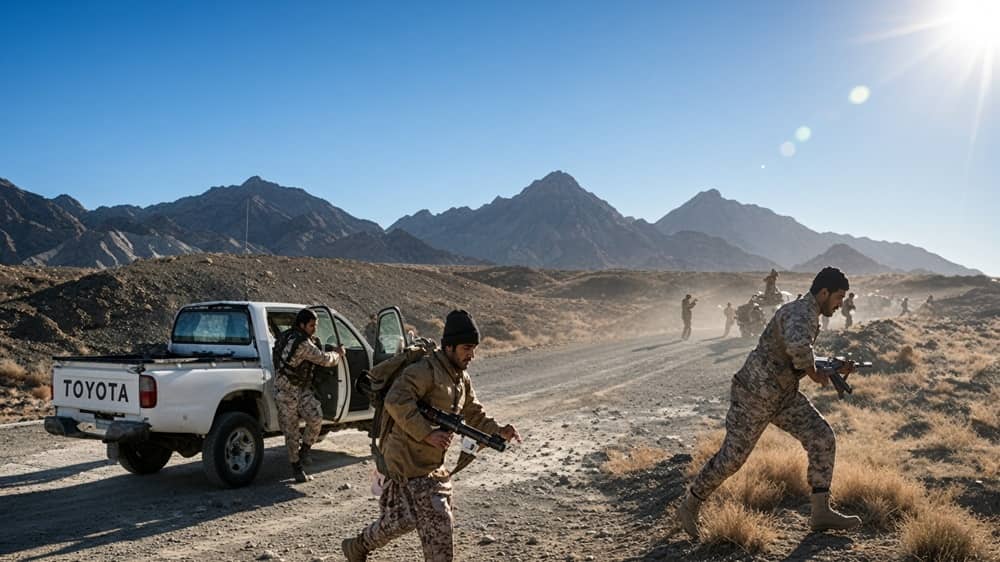
The message is an unmistakable attempt to project command and confidence through the security apparatus. Yet events unfolding as that praise was being amplified exposed a different picture. On October 9, a roadside bomb struck an SSF vehicle near Cheshmeh Ziarat outside Zahedan, killing Nosrat Eftekhari, deputy for cultural and social affairs of the Sistan and Baluchestan police command. Police described Eftekhari as an official involved in strengthening relations among ethnic and religious communities and addressing problems in marginalized areas—making the attack a blow not only to the force but to its effort to extend political control through local influence networks.
The regime’s reaction underscored the seriousness with which it views the deterioration. On October 10, Interior Minister Eskandar Momeni dispatched a special delegation to Sistan and Baluchestan to investigate the recent attacks and identify those involved, while Radan publicly vowed that revenge for Eftekhari was “certain.” The contrast is stark: while Khamenei depicts the police as a fortified pillar of authority, the leadership is simultaneously sending emergency teams to a province where senior police personnel are being targeted.
The Iranian regime’s judiciary chief is warning officials not to “anger the people,” treating #economic collapse as a security threat.
Inflation on some goods has hit 150–160%. The free-market dollar is near 270,000 tomans. Meanwhile the regime is tightening controls on…— NCRI-FAC (@iran_policy) October 6, 2026
Economic data puncture the strength narrative
The economic figures emerging on October 10 further complicate the leadership’s projection of resilience. New estimates from the Central Bank’s Monetary and Banking Research Institute put Iran’s economic contraction at 12.1% in the spring, even worse than the Statistical Center’s earlier estimate of 10.1%. Growth remained negative in July at -5.6% year-on-year. Services contracted 4.2%, industry and mining 12.2%, and the oil sector 10%; agriculture was the only major sector to record positive growth, at 6%.
State news agency IRNA offered an even more politically significant admission on October 10. Its analysis said the currency crisis cannot be reduced to sanctions or war and identified domestic causes including liquidity growth, chronic budget deficits, banking-system imbalances, weak production, trade restrictions and failure to repatriate export earnings. Currency intervention, it warned, may calm volatility and “buy time,” but cannot preserve the rial without structural correction. The report said roughly $23 billion in export proceeds has failed to return to Iran since the beginning of 2025, an amount equivalent to about one-third of the country’s import-related foreign-exchange requirements.
Most damaging to official reassurances is IRNA’s discussion of confidence itself. The outlet acknowledged that households, producers and investors expecting further inflation or rial depreciation move their money into dollars, gold, property and other assets. If people buy foreign currency because they distrust the future value of the rial, it said, supplying additional dollars can relieve pressure temporarily but does not remove the incentive to flee the national currency. That amounts to a state-media admission that the currency problem is also a crisis of expectations about the regime’s economic management.
Three explosions shook #Zahedan on the anniversary of Bloody Friday as Iran’s point-to-point inflation hit 89.8%, the dollar crossed 256,000 tomans, teachers and nurses quit, internet instability spread and the state expanded loyalist mobilization.
The pressures are increasingly…
— NCRI-FAC (@iran_policy) September 30, 2026
The government is simultaneously expanding direct assistance to cushion the consequences. The Labor Ministry announced October 10 that approximately 11 million people covered by the Welfare Organization and Imam Khomeini Relief Committee would receive an additional 500,000 tomans in food credit, raising their latest allocation to 1.5 million tomans. The ministry explicitly said the increase was intended to bolster the purchasing power of lower-income households.
Universities remain under disciplinary pressure
The regime is also continuing to process the political aftermath of the January uprising. On October 10, Mehr quoted Isfahan University of Technology president Zafarollah Kalantari as saying disciplinary authorities had examined around 50 student cases, with preliminary rulings issued in nearly 30. Most penalties involved suspensions of up to two semesters.
Kalantari’s explanation was more revealing than the numbers: he said punishments could be reduced or suspended when students recognized their wrongdoing and accepted that demands should be pursued through channels defined by the authorities. The approach echoes the pattern already visible at Sharif University—disciplinary relief is tied not merely to conduct, but to accepting the regime’s boundaries for permissible political activity.
Clashes outside Zahedan, and a security officer killed in Rask—an incident authorities initially downplayed.
Meanwhile, a senior parliamentary figure says Iran’s economy is “considerably worse,” food #inflation has topped 121%, and energy shortages are disrupting production.…— NCRI-FAC (@iran_policy) October 1, 2026
The political picture over October 9–10 therefore cuts directly against Mojtaba Khamenei’s effort to portray the security establishment as an increasingly capable pillar of the system. The police are being publicly elevated because the regime needs them more, not because the pressures they confront have disappeared.
A senior police official has been killed in a province where Tehran is now dispatching an emergency investigative delegation; the economy remains deeply contracted; state media concede that confidence in the rial cannot be restored by dollar sales alone; and 11 million people require additional food support. The show of strength at the top increasingly rests on an apparatus being asked to contain problems that are multiplying underneath it.