

Three-minute read
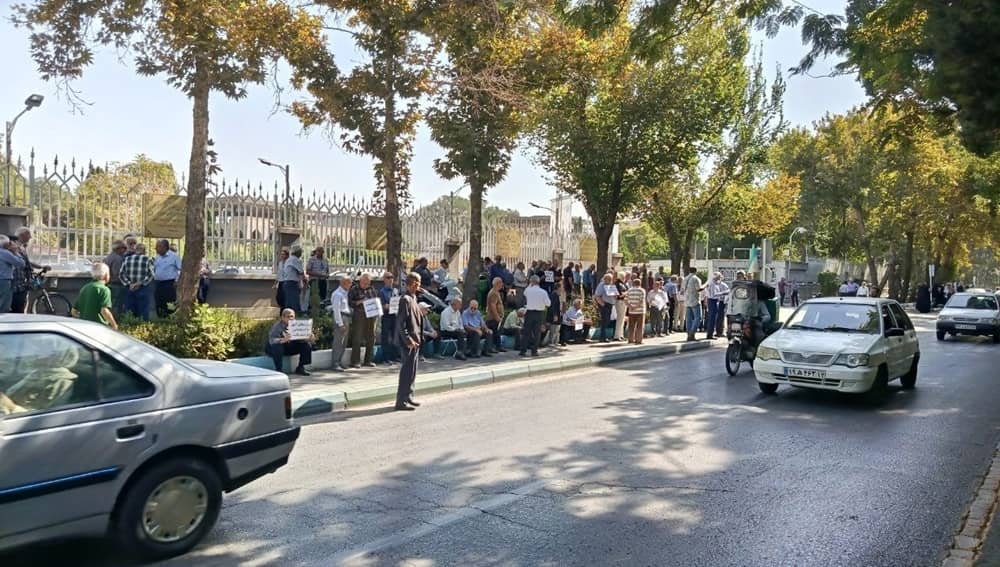
Economic discontent returned visibly to the streets on October 11, with retirees protesting in Isfahan, Shush and Rasht over pensions, inflation, medical costs and declining purchasing power. Videos from the demonstrations show steel retirees marching in Isfahan, Social Security retirees gathering in Shush, and Social Security retirees and teachers protesting in Rasht. In Shush, demonstrators chanted, “Only in the street can we win our rights,” while others demanded the release of imprisoned workers, teachers and protesters.
ILNA independently confirmed protests by retirees in Shush and Rasht, reporting that participants complained about low pensions, deteriorating living conditions, unpaid arrears and shortcomings in supplementary health insurance. The recurrence matters. These are not isolated demonstrations generated by a single unpaid benefit: retirees have been returning repeatedly to the streets as inflation erodes fixed incomes, with previous rounds documented across many of the same cities.
Other economic grievances were visible beyond the pension system. Workers from Pey-Pel Jonoub demonstrated again in Sirjan after months of uncertainty over jobs connected to the iron-ore sector, while residents of Razjerd in Qazvin protested over what they describe as destruction of natural resources and pressure on agricultural land. The Sirjan dispute is particularly persistent: workers have previously said the company could not or would not continue operations and that unemployment insurance would not cover basic living costs.
Armed attacks hit police and army targets in Sistan and Baluchestan in a single day—two officers killed near Zahedan and Nikshahr—as Tehran recasts the #economy as a security problem.
Ghalibaf says the priority is “economic resilience and internal security.” Pezeshkian calls it a…— NCRI-FAC (@iran_policy) October 8, 2026
Economic crisis reaches the professions
One of the day’s most revealing economic reports came not from low-wage workers but from Iran’s medical establishment. Shargh reported that roughly 35% of Iran’s general practitioners no longer practice medicine, with some turning to ride-hailing work or elderly care because medical income no longer covers the cost of maintaining a practice. The president of the General Practitioners Association put the number outside active practice at roughly 35%, while Medical Council spokesman Mohammad-Reza Larijpour said more than 50,000 general practitioners are effectively outside the treatment system.
The numbers expose a broader distortion in the labor market. Most general practitioners reportedly earn about 25–35 million tomans a month, while even a full-time doctor can take home less than 40 million after treatment centers deduct their share of consultation fees. Larijpour said running a private practice under current conditions has become “almost impossible.” Shargh also reported that some specialist-training programs—including cardiac surgery, pediatric surgery, anesthesia and infectious diseases—continue to have vacant capacity. The problem is therefore no longer simply household poverty; prolonged economic deterioration is beginning to hollow out skilled professions and public-service capacity.
The labor data behind this deterioration are similarly stark. Official Statistical Center figures show that 13.55 million of Iran’s 24.82 million workers—54.6%—are employed informally, compared with 45.4% in formal employment. Only about 26.8 million of 66.1 million people over age 15 are classified as economically active, implying labor-force participation of roughly 40%. These figures are official estimates, but they help explain the growth of street vending and other survival work outside stable employment.
The Iranian regime’s judiciary chief is warning officials not to “anger the people,” treating #economic collapse as a security threat.
Inflation on some goods has hit 150–160%. The free-market dollar is near 270,000 tomans. Meanwhile the regime is tightening controls on…— NCRI-FAC (@iran_policy) October 6, 2026
Hardliners turn on Zarif over the regime’s security doctrine
A previously recorded speech by former foreign minister Mohammad-Javad Zarif resurfaced this weekend, an insider admission of how far the regime’s security doctrine has penetrated diplomacy and domestic policy. He said that when neighboring states are treated as threats, Iranian ambassadors become extensions of the Quds Force, and added that authorities have reached the point where “even hijab is seen as a wartime trench.”
Kayhan responded by accusing Zarif of conducting a “suicidal operation against the arms of national security” and giving Washington “breathing space.” Tasnim also attacked the remarks, while Rajanews reportedly called for judicial action. The intensity of the reaction is more significant than the age of Zarif’s original speech: a disagreement over whether economic engagement or security confrontation should organize state policy is being treated as a loyalty question rather than an ordinary strategic debate.
The broader political danger for the ruling establishment is that the constituency under pressure is widening. Economic distress is no longer confined to the poorest households or traditionally restive workers: it now reaches pensioners, teachers, industrial employees, farmers, doctors and other educated professionals. When a system responds to that widening strain by treating alternative policy arguments as attacks on “national security,” it reduces its own room to adjust course. Repression can disperse demonstrations, jail organizers and raise the cost of dissent, but it cannot restore purchasing power, pay pensions or reverse the erosion of professional livelihoods. As material grievances spread across increasingly diverse social groups, coercion can contain their expression only temporarily; it cannot remove the conditions that continually regenerate them.