
Three-minute read
Retirees demonstrated on October 25 in Tehran, Isfahan, Shush, Ahvaz and Rasht, again turning livelihood grievances into political slogans. Protesters demanded imprisoned demonstrators be freed, denounced poverty and corruption, and chanted that neither parliament nor the government represented their interests. In several gatherings, retirees repeated that “only in the street will we get our rights,” underscoring how pension and healthcare disputes continue to produce organized street action rather than being absorbed through official channels.
The economic backdrop remains severe, but the more consequential development is how the state is preparing to manage its political consequences. A 50-signature parliamentary bill proposes restructuring the National Security Council around what it explicitly calls “cognitive security governance” and countering “cognitive threats and wars.” The legislation would require security planning to incorporate political, social, economic and technological developments and would expand continuous coordination of national and provincial security policy. The terminology is revealing: public perceptions, narratives and social reactions are being incorporated formally into the security architecture rather than treated primarily as questions of governance.
That approach extends directly to communications. Parliament’s Article 90 Commission has intervened to oppose plans to float the state-owned Infrastructure Communications Company, which controls Iran’s backbone telecommunications network, on the stock market. MP Mohammad-Taqi Naqdali argued on October 25 that state ownership was necessary because loss of direct control could jeopardize network security and communications stability during crises.
#Iran’s #Economic Collapse, According to the Regime’s Own Media
Iran’s deepening economic crisis is becoming increasingly evident in statistics and reports published by state-run media. https://t.co/w3IaydnX9Q— NCRI-FAC (@iran_policy) October 24, 2026
The same logic is visible in preparations for another internet shutdown. The head of Iran’s Information Technology Organization said authorities would take measures required to “defend the country” if national security were affected, while declining to identify which institution ultimately orders internet restrictions. He acknowledged that such decisions have their own unspecified “responsible authorities.” In other words, after successive shutdowns during unrest and war, disconnecting or sharply restricting international access remains an active security contingency, not an exceptional measure relegated to the past.
Economic pressure is narrowing room for maneuver
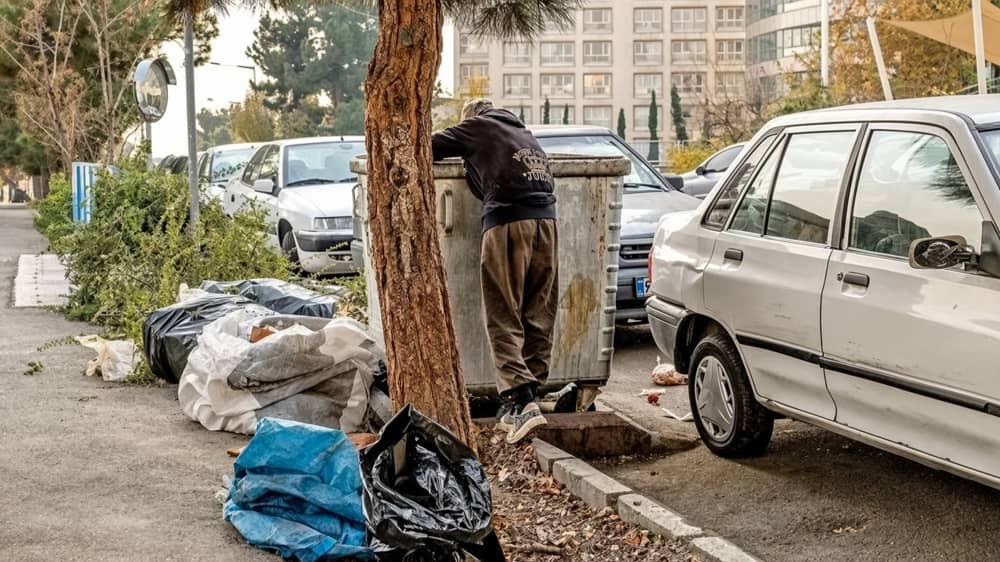
The economic numbers explain why officials are increasingly preoccupied with social control. Official and state-linked reporting already shows wages and pensions badly trailing living costs; housing consumes around half of household expenditure for many families, while food inflation has pushed consumers out of markets altogether. Official figures on the oil squeeze sharpen that picture further: Iran’s traceable floating crude stocks outside the US blockade zone have reportedly fallen to zero, meaning remaining cash receipts largely reflect cargoes delivered earlier and paid for with a lag.
That fiscal pressure matters politically because the state must simultaneously finance imports, pensions, subsidies, damaged infrastructure and the security apparatus. The issue is therefore not simply falling export volume but diminishing capacity to buy time domestically. This comes as telecommunications costs have risen by up to 40%, passenger transport costs have increased, and the government continues to alter fuel pricing and access without resolving the underlying imbalance between incomes and essential expenses.
Pezeshkian now says Iran cannot even plan under its permanent “neither war nor peace” crisis. State media simultaneously reports wages far below living costs, €4.07bn unpaid to food importers, 297,000 people cut from subsidies, 40% telecom price hikes and weakening #oil…
— NCRI-FAC (@iran_policy) October 24, 2026
The fuel issue remains particularly sensitive. Authorities have introduced domestically produced premium gasoline at more than 100,000 tomans per liter while the third tier of ordinary gasoline has already doubled to 10,000 tomans. This premium fuel is not replacing subsidized allocations, but the broader move toward differentiated pricing, tighter station-card access and periodic price reviews suggests officials are proceeding incrementally in an area that triggered nationwide unrest in 2019.
Infighting intensifies while repression reaches memory itself
The regime’s internal conflict also continues to widen. Hardline demonstrators at the Imam Reza shrine recently attacked Hassan Rouhani and Mohammad Javad Zarif and demanded the execution of Masoud Pezeshkian’s son, Yousef, illustrating how a dispute ostensibly about negotiations and war has developed into threats against members of rival political networks. This directly undermines repeated leadership demands that factions preserve cohesion and avoid weakening the system from within.
Repression is meanwhile extending beyond current protests to the control of historical memory. Authorities again prevented families of political prisoners executed in 1988 from entering Khavaran cemetery, forcing them to commemorate their relatives outside the gates.
Iran’s domestic pressure is widening: universities are tightening surveillance and #hijab enforcement, an armed clash erupted in Khash, state media says workers are abandoning jobs as wages collapse, officials admit persistent #poverty, and the government is rewriting its…
— NCRI-FAC (@iran_policy) October 21, 2026
Fresh detentions reinforce the same pattern: a 17-year-old student was arrested and taken to an undisclosed location, while another detainee was sent to prison to serve a five-year, five-month sentence on national-security charges. Authorities are also continuing to pursue alleged participants in the January 2026 uprising months after the protests ended.
The larger significance is that the regime is increasingly treating political survival as a security problem rather than a governance problem. Instead of easing the pressures generating discontent, it is building more capacity to monitor, control and suppress their expression. That posture reflects a system that appears to regard concession as more dangerous than continued deterioration—so the deeper the crisis becomes, the more heavily it leans on coercion, information control and ideological rigidity.