
Four-minute read
The Iranian regime’s president Masoud Pezeshkian gave one of the clearest official descriptions yet of the paralysis gripping Iran on October 24, saying the country must escape its indefinite “neither war nor peace” condition because “in uncertainty, you cannot plan.” State-run Nour News also reported him linking social dissatisfaction to inequality and failures in distributing resources, while other reporting of the same speech quoted him saying many Iranians are now struggling simply to provide their “daily bread.” Pezeshkian said Ali Khamenei had ordered officials before his death to end the stalemate, although he did not explain whether that meant negotiations or another course.
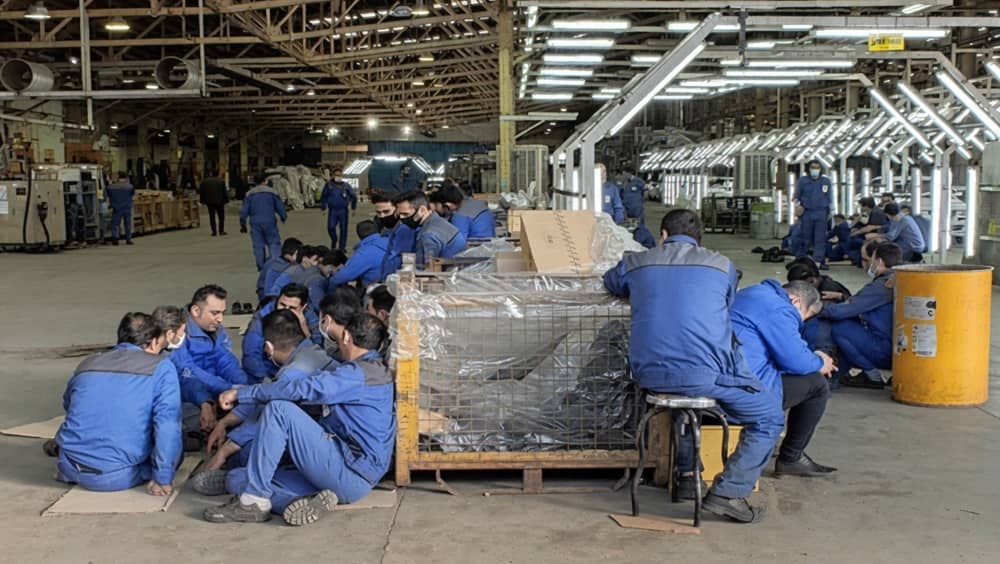
The significance lies less in Pezeshkian presenting a solution than in the admission that permanent crisis is obstructing basic governance. His remarks come as state media itself documents a widening gap between wages and subsistence costs. Tasnim reported October 24 that more than a month after a promised wage review, the Supreme Labor Council has still not convened its wage committee. A labor representative estimated the minimum monthly cost of living for a 3.3-person household at 70–80 million tomans, with some estimates exceeding 91 million, while the official minimum wage is roughly 21.8 million tomans for a single worker and 22.3 million for a married worker without children. Workers are increasingly taking second and third jobs or abandoning workplaces altogether.
Food imports, subsidies and household costs
The same administrative paralysis is threatening basic-goods supply. An IRGC mouthpiece reported that more than 750 importers are owed €4.07 billion for food and other essential goods they already brought into Iran, with some payments delayed for as long as 20 months. Pezeshkian ordered officials on July 13 to pay half the outstanding debt, but Tasnim said that after 100 days the order still had not been implemented, with the Central Bank and Planning and Budget Organization largely exchanging correspondence instead. The outlet explicitly warned that continued non-payment could threaten food security.
#Iran’s #Economic Collapse, According to the Regime’s Own Media
Iran’s deepening economic crisis is becoming increasingly evident in statistics and reports published by state-run media. https://t.co/w3IaydnX9Q— NCRI-FAC (@iran_policy) October 24, 2026
At the same time, the state is narrowing some forms of assistance. Tasnim reported that 297,000 people in more than 109,000 households were removed from the cash-subsidy rolls in October. This comes while authorities are separately rechecking the financial circumstances of tens of millions of people for food-support eligibility. The picture is therefore not of an expanding welfare state but of authorities attempting to ration increasingly expensive assistance while fiscal resources tighten.
Everyday costs are meanwhile rising again. Mobile operators increased internet, telephone and messaging tariffs by as much as 40% beginning October 23, with IRNA saying the companies cited higher equipment, maintenance and network-development costs. Passenger rail tickets have also risen 20–36% for November travel compared with October. These increases arrive on top of the severe food and housing inflation already eroding wages, adding communications and transportation to the list of household expenses moving further beyond stagnant incomes.
State media further acknowledged that inflation above 65% has cut the purchasing power of existing subsidies by more than half within a year and that financing the current electronic food-credit program would impose an estimated annual cost exceeding 1,000 trillion tomans. Rather than resolving the causes of falling living standards, the state is increasingly cycling between subsidies, eligibility screening, price controls and emergency support mechanisms.
"When the regime’s security apparatus feels threatened, it can identify users, monitor #communications, track dissidents across platforms, shut down accounts, restrict connectivity and arrest people over their online activity. But when ordinary Iranians need protection from…
— NCRI-FAC (@iran_policy) October 22, 2026
Oil income weakens as domestic obligations mount
A Fars News Agency report intended to emphasize continuing oil revenue inadvertently highlighted the fiscal squeeze. It said Iran received more than $1.5 billion in oil income in October, bringing receipts since March to more than $17.5 billion. But the same figures show that Iran received around $16 billion during the first six months of the year—an average of roughly $2.66 billion per month. October receipts were therefore about 44% below that earlier monthly average.
Oil income remains central to the regime’s ability to finance imports, salaries, pensions, subsidies and the security apparatus. It also makes Hemmati’s claim that Iran possesses enough foreign-exchange reserves to cover imports through the end of Donald Trump’s presidency difficult to assess: he has not disclosed the volume of usable reserves or how much can actually be accessed under banking restrictions.
Security pressure continues beyond the economy
Domestic insecurity also persisted in the southeast. Retired police colonel Ali Sayyadi was shot dead outside his home in Shahr-e Deraz, Iranshahr. State-linked Borna confirmed the killing but said the attackers, motive and circumstances remain unknown. According to sources, Sayyadi had previously participated in operations against fuel carriers. The killing follows a series of recent armed incidents in Sistan and Baluchestan and again undercuts claims that repeated security operations have stabilized the province.
Iran’s domestic pressure is widening: universities are tightening surveillance and #hijab enforcement, an armed clash erupted in Khash, state media says workers are abandoning jobs as wages collapse, officials admit persistent #poverty, and the government is rewriting its…
— NCRI-FAC (@iran_policy) October 21, 2026
Repression is continuing elsewhere. Rights groups reported that authorities again prevented families of prisoners executed in 1988 from entering Khavaran cemetery, forcing them to leave flowers outside the gates. Separately, 17-year-old high-school student remains detained after security forces arrested him in Sanandaj without a publicly known charge or disclosed detention location, while another was taken to Mahabad prison to serve a five-year, five-month sentence on security-related charges.
Even an unrelated natural disaster added another measure of domestic strain: flooding around Salmas and Maku killed at least three people, including a ten-year-old girl, left two missing and damaged two dozen homes, according to official emergency-service figures.
The broader pattern is increasingly difficult to separate into isolated problems. Pezeshkian is acknowledging that permanent crisis has made planning impossible just as wages fall far behind living costs, food importers go unpaid, subsidies are cut, communications and transport prices rise, and oil receipts weaken. At the same time, coercive pressure on students, prisoners’ families and political dissent continues, while insecurity persists in the southeast. The regime’s external military threats remain a secondary part of this domestic picture: as its economic and political room for maneuver narrows, it continues to signal that retreat is unacceptable. The deeper the system sinks into crises generated or compounded by its own policies, the more heavily it appears to rely on rationing, repression and confrontation rather than durable governance.