

THIS PAGE WILL BE UPDATED WITH THE LATEST NEWS
UPDATE: 7:00 AM CET
Iran’s Prisoners Inspire International Solidarity With ‘No to Executions Tuesdays’
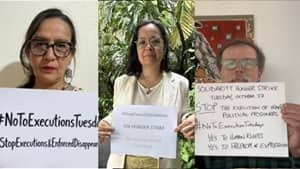
The resistance of prisoners in Iran is finding an expanding international echo, with three human rights figures announcing solidarity with the “No to Executions Tuesdays” campaign.
Andrea Bolaños Vargas, the UN Special Rapporteur on the situation of human rights defenders, and David R. Boyd, a former UN Special Rapporteur, announced solidarity hunger strikes. Ana Lorena Delgadillo, a member of the UN Working Group on Enforced or Involuntary Disappearances, announced plans to join the following week.
Their actions come as prisoners across 66 Iranian prisons marked the campaign’s 144th consecutive week on October 27, 2026.
On October 27, Bolaños Vargas announced that she was joining the solidarity hunger strike for human rights defenders imprisoned and threatened with death for their work. She called for executions to end and those detained to be released.
Her participation brings particular significance: the prisoners’ struggle has prompted the UN expert responsible for defending human rights defenders to adopt their form of protest.
Iran’s Education Crisis: Pezeshkian Asks Families to Build Schools as the State Evades Responsibility
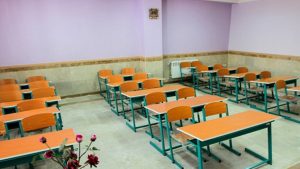
Iran’s deepening education crisis has exposed a fundamental question about the responsibilities of the state: Who is accountable for educating the next generation when schools lack adequate facilities, teachers, and resources?
President Masoud Pezeshkian recently praised citizens who have taken up shovels to build schools for their children, while invoking the country’s wartime conditions to explain the government’s inability to meet its obligations. His remarks offered little indication of a comprehensive strategy to address the structural problems confronting Iran’s education system.
Pezeshkian argued that even governments with substantial financial resources had failed to solve the problem, suggesting that his administration could hardly be expected to do better under current circumstances.
The statement effectively shifted responsibility from the state to ordinary citizens and charitable donors, leaving unanswered questions about the scale of the shortages, the resources available to the government, and the measures planned to ensure that children receive an adequate education.
Public participation in school construction can supplement government efforts. But when citizens are expected to compensate for the state’s failure to provide essential public services, voluntary assistance risks becoming a substitute for public accountability.
Iran’s Poor Face Deadly Risks from Border Smuggling to Street Vending
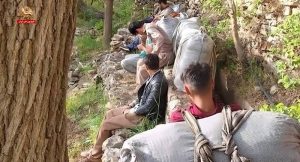
For millions of people across Iran, earning a living has become a struggle against poverty, insecurity, and the threat of physical harm. In the country’s border provinces, Kurdish porters carry heavy loads across dangerous mountain terrain, while Baluch fuel carriers navigate hazardous routes under the threat of gunfire. In major cities, impoverished street vendors risk losing their entire investment when municipal authorities destroy their stalls and merchandise. These are not isolated hardships. They reflect a broader economic and social crisis in which the absence of stable employment, persistent regional deprivation, and coercive state policies leave vulnerable people with few ways to support their families.
A September 23, 2026, report by Mai Sato, the UN Special Rapporteur on the situation of human rights in Iran, highlighted reports of extrajudicial killings of Kurdish porters and Baluch fuel carriers. The report described cases in which border forces allegedly opened fire at close range without warning. In one instance, officials reportedly told a victim’s family that he had fallen while crossing mountainous terrain, but forensic findings contradicted that account, identifying a gunshot wound to the head.
The findings underscore the human cost of a system in which people struggling to survive can face lethal violence while pursuing informal work.
Pharmacies in Iran Cannot Afford to Purchase Medicines

The liquidity crisis across Iran’s pharmaceutical supply chain has affected everything from medicines for patients with rare and serious conditions to widely used products such as insulin, inhalers, and cardiovascular and neurological medications. While medicine shortages are commonly perceived as the main problem in the pharmaceutical market, according to the head of the Iranian regime’s Food and Drug Administration, a significant part of the problem stems from pharmacies’ inability to purchase medicines that are already in the warehouses of distribution companies. The situation has been exacerbated by delays in insurance reimbursements and disruptions in the provision of financial resources, making it increasingly difficult for patients to access their medications.
Hadi Ahmadi, spokesperson for Iran’s Pharmacists Association, criticized the delays in payments owed to pharmacies in an interview with Eghtesad24, a state-run news outlet. He said: “Pharmacies have not received payments owed to them for 11 months, and this has severely affected their financial capacity to purchase medicines. Under these circumstances, although medicines are available in the warehouses of distribution companies, pharmacies lack the liquidity needed to purchase them and supply them to patients. This has resulted in a form of artificial medicine shortage in the country.”
Rising Inflation in Iran Leaves Families with Less to Put on the Table

When Iran’s regime statistics center reports an annual inflation rate of 73.6% in September 2026, the figure may initially seem like just another number in a statistical table. But its real meaning is reflected in families’ shopping baskets, in the heavy silence of household heads standing at pharmacy counters, and in their inability to afford even the most basic sources of protein.
A look at Iran’s economy in the spring of 2026 shows that recession and inflation, working hand in hand, have pushed people’s livelihoods to the brink. The sharp 10.1% decline in economic growth during the same season is evidence of the bitter reality that the engine of production has not merely slowed down but has gone into reverse.
In this environment, when producer price inflation reaches 66.7% in the spring of 2026, it means that factories and businesses are already buckling under the heavy burden of raw material, energy, and financing costs before their products even reach consumers. This pressure inevitably trickles down to the final link in the chain: the public.
Yet the economic picture extends beyond rising prices; the labor market crisis has taken on deeper dimensions. An unemployment rate of 9.1%, alongside an economic participation rate of 40.7% in the spring, sends a clear message to the public.
Iranian Officials Weigh Diplomacy and Military Pressure Over Strait of Hormuz as Tehran Pursues Regional Talks
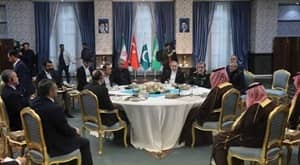
TEHRAN — Iranian officials and political figures on Wednesday put forward a range of approaches to ending the war with the United States and determining the status of the Strait of Hormuz, from regional dialogue and conditional negotiations to maintaining control over the waterway and calls for a more direct response to the naval blockade. The positions came as Hormuz has become one of the main elements of Tehran’s conditions for ending the war.
Foreign Minister Abbas Araghchi, following a four-party meeting in Tehran involving Iran, Saudi Arabia, Pakistan and Turkey, emphasized a regional mechanism for containing the crisis. He said, “Sustainable security must be ensured through the participation of regional countries and without the military presence or intervention of extra-regional powers,” and described continued consultations as a step toward dialogue on regional peace and security.
At the same time, the message coming from the highest level of the power structure focused on ending the war through the implementation of Iran’s conditions. Iran Daily reported that the leader of the Islamic Republic, in a meeting with Supreme National Security Council Secretary Mohsen Rezaei, stressed the fulfillment of conditions set in negotiations with the United States for ending the war and moving beyond the state of “no war, no peace.” The office of the leader of the Islamic Republic also said the meeting addressed securing national and regional security through the “management of the Strait of Hormuz.”
PMOI Supporters in Gothenburg Back Maryam Rajavi and Iran’s Provisional Government Based on Ten-Point Plan
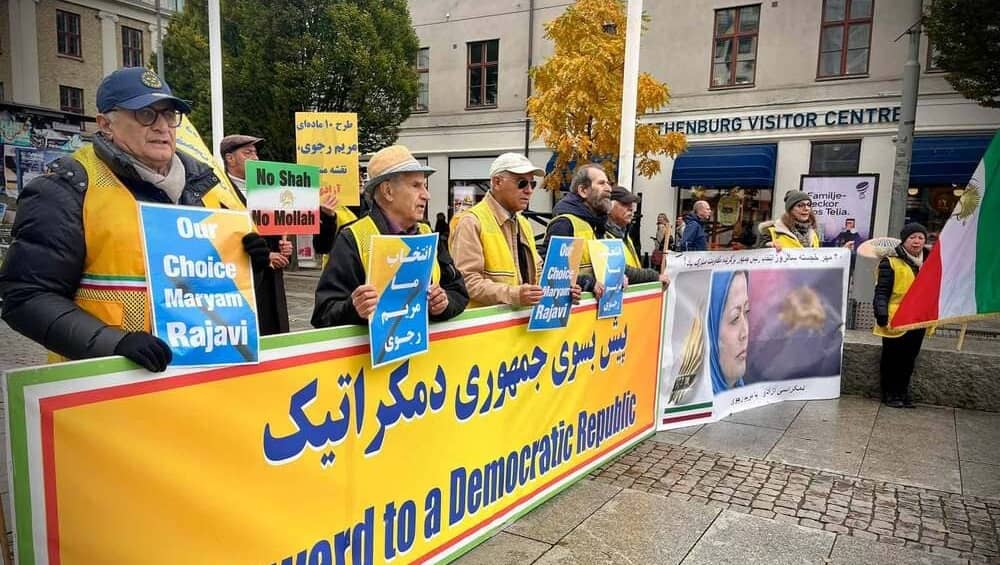
Gothenburg, Sweden – October 24, 2026 – Supporters of the People’s Mojahedin Organization of Iran (PMOI/MEK) held a rally in Gothenburg. For the second consecutive week, they celebrated the anniversary of Maryam Rajavi’s election as president-elect of the provisional government and reaffirmed their support for the National Council of Resistance of Iran (NCRI) as a democratic alternative to Iran’s ruling religious dictatorship, as well as for the provisional government announced by the NCRI, which is based on Mrs. Rajavi’s Ten-Point Plan. The gathering took place on the occasion of the anniversary of October 22, 1993, when the NCRI elected Maryam Rajavi as president-elect of the provisional government for a transitional period leading to the establishment of a democratic republic in Iran.

Under the proposed transition, the provisional government would have a six-month mandate to prepare for elections to a Constituent Assembly, paving the way for the transfer of sovereignty to the Iranian people.
Participants expressed their support for the NCRI’s democratic platform and Maryam Rajavi’s Ten-Point Plan for Iran’s future, which advocates a democratic republic and rejects all forms of dictatorship, whether a restoration of the former monarchical system or the continuation of the current religious dictatorship.
PMOI Supporters Mark Day 241 in Berlin, Condemn Executions and Back a Democratic Republic for Iran
Berlin, Germany — October 26, 2026: On the 241st consecutive day of their protest sit-in outside the Iranian regime’s embassy in Berlin, supporters of the People’s Mojahedin Organization of Iran (PMOI/MEK) demonstrated against the regime’s escalating executions and backed the National Council of Resistance of Iran (NCRI) as the democratic alternative for establishing a democratic republic in Iran. They rejected both the dictatorship of the Shah and the clerical regime.
The demonstrators condemned the execution of political prisoners and the wave of death sentences issued against protesters arrested during nationwide uprisings, and they demanded an immediate end to the death penalty.

The protesters called for the closure of the Iranian regime’s embassy in Berlin as a center of espionage and terrorism operating on German soil. They also demanded accountability for the regime’s systematic repression, human rights violations, and continued executions in Iran.
PMOI Supporters in Luxembourg Condemn Executions, Call for Free, Democratic Iran
Luxembourg – October 24, 2026: Supporters of the People’s Mojahedin Organization of Iran (PMOI/MEK) held an informational street event in Luxembourg, featuring a book table and photo exhibition, to call for an end to executions in Iran, the release of political prisoners, and the establishment of a democratic republic.
Organizers strongly condemned the Iranian regime’s continued use of executions, describing them as flagrant violations of human rights.
Participants displayed photographs of executed prisoners and victims of the nationwide uprising. Through this tribute, they honored those who lost their lives and highlighted the plight of political prisoners and protesters facing the death penalty.

Participants demanded an immediate end to the death penalty in Iran.
They also called for the release of all political prisoners and an end to the persecution of protesters and dissidents.