

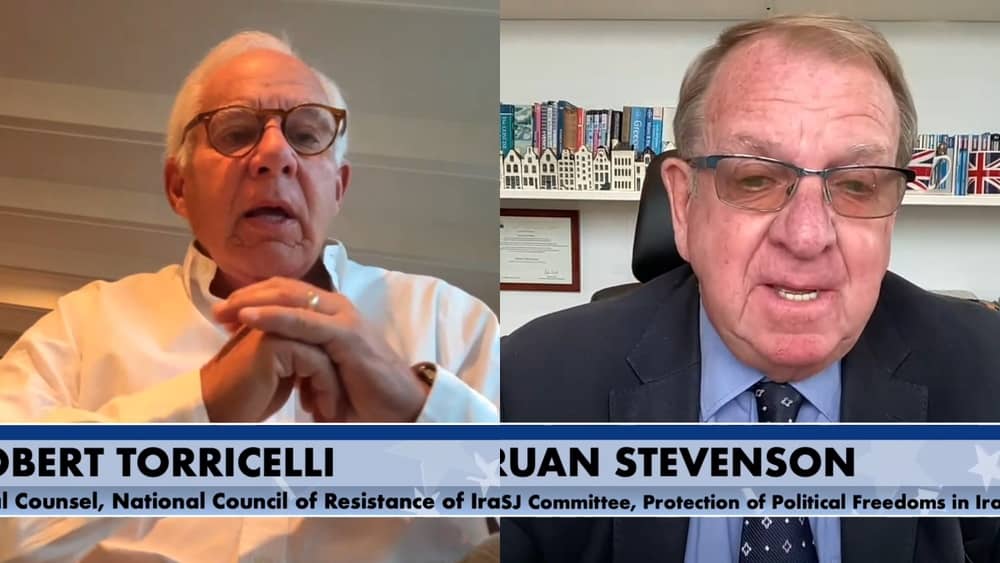
Former U.S. Senator Robert Torricelli and former European Parliament member Struan Stevenson have argued that Iran’s clerical establishment is increasingly vulnerable, while stressing that any lasting political change must ultimately be achieved by Iranians themselves.
In separate interviews on Real America’s Voice (RAV) in late October, the two longtime supporters of the Iranian Resistance assessed the consequences of military conflict, the prospects for another nationwide uprising, and the political alternatives to the ruling system. Both rejected the suggestion that Iran must choose between the current regime and a return to the Pahlavi monarchy.
Torricelli: A weakened regime is not a defeated regime
Senator Torricelli said the ruling establishment had demonstrated more resilience than many expected under military and economic pressure. But he cautioned against interpreting its survival as evidence of strength.
“Don’t get confused because it hasn’t folded that it isn’t weakened,” he said, arguing that the prolonged American campaign had damaged Iran’s economy and internal security forces.
He maintained that weakening the regime’s coercive apparatus could create opportunities for popular resistance, but insisted that external pressure alone could not bring about a durable political transition.
“In the end, of course, the regime only falls because people internally, the Iranian people themselves, rebel against it and end it,” he said.
Senator Torricelli identified the Islamic Revolutionary Guard Corps (IRGC) as central to the regime’s ability to suppress dissent. He called for continued pressure on the organization and criticized aspects of Washington’s military strategy, including what he described as a failure to secure the Strait of Hormuz before the conflict.
The former senator also urged Democrats and Republicans to maintain a common position against the regime acquiring nuclear weapons and warned against an abrupt American withdrawal. He argued that political and economic pressure should continue, while ruling out the need for a U.S. ground invasion.
A challenge to the claim that Iran has no alternative
Turning to the future of Iran, Senator Torricelli disputed the idea that the only options were continued clerical rule, chaos, or restoration of the monarchy.
He pointed to Iran’s professional institutions, its diaspora, and the organized opposition as potential resources for a political transition. In particular, he praised the People’s Mojahedin Organization of Iran (PMOI/MEK) and the National Council of Resistance of Iran (NCRI).
Speaking about Maryam Rajavi and the opposition network, Senator Torricelli said: “They’ve laid out plans to govern. They have the personnel to govern. They have the skilled people.”
He also highlighted resistance networks inside Iran and argued that the regime’s pursuit of PMOI members reflected its perception of them as a political threat.
“Of course there’s a resistance, and of course there’s an opposition,” he said, rejecting what he described as a false narrative that there was no credible alternative.
Stevenson: Iranians do not want to exchange a turban for a crown
In a separate interview, Struan Stevenson predicted that another nationwide uprising would follow the January 2026 protests, citing the public’s continued rejection of clerical rule.
“The next uprising is bound to happen, and it’s bound to happen soon,” he said.
He argued that the revolution of 1979, which overthrew the shah, remained relevant to debates about Iran’s future. “They don’t want to replace the turban with the crown,” he said, emphasizing that the next political system should be chosen by Iranians rather than imposed by a political claimant.
Stevenson sharply criticized Reza Pahlavi, the son of the deposed shah, questioning his claim to represent a viable alternative and disputing the extent of his support inside Iran. His remarks challenged efforts by Pahlavi’s supporters to present him as a transitional leader.
A report broadcast during Stevenson’s segment revisited the January uprising, the regime’s deadly crackdown, and subsequent executions. It also recalled abuses committed under the former monarchy’s SAVAK intelligence service, drawing a connection between the demand for accountability and opposition to a restoration of royal rule.
Although Senator Torricelli focused more heavily on U.S. policy and Stevenson on the prospect of renewed domestic protests, both placed the decisive role in Iran’s future with the Iranian people. Their interviews presented organized resistance, rather than either outside intervention alone or an inherited claim to authority, as central to any transition away from clerical rule.