
THIS PAGE WILL BE UPDATED WITH THE LATEST NEWS
UPDATE: 7:00 AM CET
Telecom Retirees, Farmers, And Environmentalists Confront State-Linked Cartels in Protests Across Iran
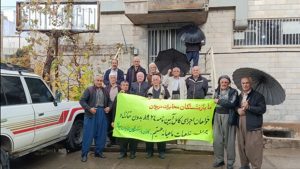
On Monday, November 2, 2026, Iran witnessed a widespread wave of simultaneous protest rallies across occupational, agricultural, and environmental sectors in nine cities and provinces: Tehran, Isfahan, Kurdistan (Sanandaj and Bijar), Lorestan, Kermanshah, Ilam, Zahedan, and Shahroud. Retirees, farmers, and environmental activists took to the streets to denounce the looting of pension rights, the deprivation of winter fuel quotas for agriculture, and the destruction of natural and water resources by economic conglomerates affiliated with the Office of the Supreme Leader and the Iranian regime’s Revolutionary Guards (IRGC).
Retirees of the Telecommunication Company of Iran (TCI) held simultaneous protest gatherings in Tehran, Isfahan, Kurdistan (Sanandaj and Bijar), Lorestan, Kermanshah, and Ilam, demanding the payment of overdue benefits and the full implementation of the long-stalled 2010 employment and welfare regulations.
Protesters directed their anger squarely at TCI’s controlling shareholders—the “Execution of the Khomeini’s Order” (Setad) and the “IRGC Cooperative Foundation”—identifying them as the primary culprits behind the plundering of company resources and the freezing of retirees’ entitlements. In Isfahan, demonstrators highlighted the lawlessness of these state-backed entities, chanting: “Iran’s Telecom does not recognize the law,” “The major shareholder stole our rights,” and “We will not rest until we reclaim our rights.” Similar slogans were echoed in Sanandaj, Bijar, and Ilam, where retirees vowed to sustain their street presence until their misappropriated funds are fully restored.
Azadeh Alemi: A Life Devoted to Freedom and Resistance

To tell this story, we must go back several decades and travel to Iran. It is 1981. Three-year-old Azadeh Alemi encounters prison bars for the first time. She will spend six months there, in Hamedan Prison, alongside her grandmother. Shortly before that, just seven days apart, her two uncles, Hadi, aged 25, and Reza, aged 22, had been executed on charges of belonging to the People’s Mojahedin Organization of Iran (PMOI/MEK). Even the wife of one of her uncles was not spared: she was killed while five months pregnant. At the time, Azadeh’s mother, who was also affiliated with the PMOI/MEK, was imprisoned and sentenced to eight years in prison, while her father and grandfather had fled into exile. Her grandmother had been arrested specifically to force her daughter to provide information.
A few years later, at the age of six, Azadeh would return to prison, this time with her mother, who had recently been released. The two were confined in a cramped, cold and claustrophobic cell in Evin Prison, with a tiny window high up on the wall through which barely any light filtered. They had only two blankets spread out on the freezing floor. The only sound breaking the silence was that of the locks clanging each time her mother was taken out of the cell for interrogation and torture.
It is 1988, just months before the massacre of political prisoners in Iran. Azadeh has already been released from prison when her mother, still detained, is freed as well, thereby escaping the fate that awaited her and reuniting with her daughter. This is when their flight to Turkey begins: accompanied by smugglers, mother and daughter cross the mountains along the border on horseback, leaving behind the life they had known in Iran.
Women in Ward 4 of Qarchak Prison Protest Food Poisoning
Women prisoners held in Ward 4 of Qarchak Prison refused to accept prison meals on October 30, 2026, in protest against poor food conditions and the distribution of spoiled food that caused food poisoning among a number of inmates.
According to reports from inside the prison, several women became ill after consuming prison food. However, no medical treatment or healthcare services were provided to the affected prisoners. Authorities at Qarchak Prison have shown little concern for the condition of those suffering from food poisoning.
In addition to protesting the authorities’ indifference toward sick prisoners, the women also objected to the poor quality and extremely small portions of food provided for lunch and dinner.
Medical services in Qarchak Prison remain in a critical condition. According to prisoners, each woman is allocated only one pain-relief tablet per month, while inmates are denied access to essential medicines and adequate medical care.
Under such circumstances, the condition of prisoners suffering from food poisoning is particularly alarming, as they require timely medical examinations and treatment.
Iran Regime Promotes Nuclear Weapons Rhetoric Amid Economic Collapse and Fear of Social Unrest
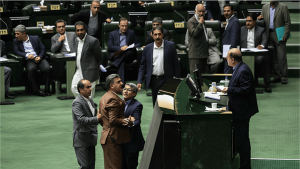
As Iran’s economic crisis deepens and social tensions intensify, officials and affiliated figures of the ruling establishment have increasingly raised the prospect of revising the country’s nuclear doctrine and pursuing nuclear weapons. The growing calls, coming from Friday prayer leaders, members of parliament, and regime supporters, point to an effort to turn the nuclear issue into an instrument of domestic propaganda and external intimidation.
The timing is significant. With widespread economic hardship, declining public confidence, and growing concern within the establishment about another popular uprising, the regime is attempting to project an image of strength and strategic capability. Its increasingly explicit nuclear rhetoric appears designed to serve two purposes: restore the morale of its own weakened ranks and create fear among regional countries amid continuing military tensions.
One of the most explicit calls came from Abdolali Haj-Ali Akbari, Tehran’s Friday prayer leader, who questioned why the regime should not reconsider its nuclear doctrine.
He claimed that more than 70 percent of Iranians supported such a change, citing an unspecified opinion poll without providing information about its date, methodology, or where it had been conducted.
Frankfurt Cultural Affairs Chief Boycotts Reza Pahlavi Award Ceremony Amid Growing Opposition
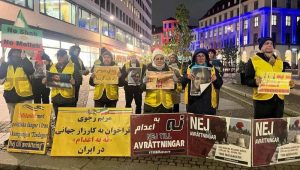
Opposition to the planned presentation of the Friedrich Naumann Foundation’s 2026 Freedom Prize to Reza Pahlavi in Frankfurt is gaining momentum, with the city’s cultural affairs chief announcing that she will boycott the November 7 ceremony at the historic Paulskirche.
Ina Hartwig, a Social Democratic Party (SPD) politician responsible for cultural affairs in Frankfurt, described the foundation’s decision as “very unfortunate” and confirmed that she would not attend the event. Her announcement adds to growing criticism from political representatives, Iranian human rights activists, and members of the Iranian diaspora who reject the attempt to portray the son of Iran’s former shah as a representative of the Iranian people.
The controversy centers not simply on the choice of an individual recipient, but on the political implications of presenting a hereditary claimant associated with Iran’s former monarchy as the symbolic representative of an entire population struggling for freedom and democracy.
Triple-Digit Inflation Hits Clothing and Footwear

The Consumer Price Index (CPI) reached 761.8 in October. Put simply, the cost of purchasing a fixed basket of goods and services has increased more than 7.6-fold compared with the base year of 2021–2022.
According to the state-run Eghtesad Online newspaper, an analysis of the Statistical Center of Iran’s October report and a comparison with historical index data indicate that new records have been set for overall inflation and inflation in several goods and services categories. The overall Consumer Price Index rose from approximately 542.3 in March 2026 to 761.8 in October. Accordingly, prices increased by 40.5% between the beginning of the Iranian calendar year on March 22 and October 22.
This represents the highest increase in the overall index during the first seven months of the Iranian calendar year, which begins on March 22, since 2011.
The previous record was set in 2022, when prices increased by 31.2% during the first seven months of the year. This year’s increase therefore exceeds the previous record by 9.3 percentage points. Annual inflation in the overall index also reached 76.8% in October, marking the highest figure in the entire available time series.
Insecurity in the Strait of Hormuz Drives Up Costs
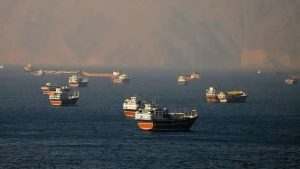
For some tanker owners, transiting the Strait of Hormuz is so profitable that they are willing to continue operating despite the risk of attack. But the same high freight rates that boost shipping companies’ revenues also drive up the cost of transporting oil and goods—a cost that is partly passed on to producers and ultimately to consumers.
Recent reports of attacks on ships in the Strait of Hormuz show that the dispute between the Iranian regime and the United States over clearing naval mines is only part of the problem. Even if the main shipping routes are free of mines, the risk of being struck by a projectile or approached by attacking boats can still make passage costly and unsafe.
In the latest incident, a tanker was struck by two explosive devices attached to its hull on Thursday, October 29, about 25 nautical miles northeast of Khasab, Oman.
According to Reuters, citing information from the United Kingdom Maritime Trade Operations (UKMTO), the explosions caused a fire in the engine room and temporarily halted the vessel.
This incident differs from striking mines drifting in or deliberately placed along a shipping route. The Iranian regime previously said that four tankers had exploded and caught fire after hitting mines. The claim has not been independently verified, and the US Central Command (CENTCOM), rejecting Tehran’s account, has emphasized the clearance of the main shipping routes.
Electricity Prices Rise in Iran, Adding to the Burden on Citizens

Since October 23, electricity bills for consumers in Iran have also included the cost of fuel used by power plants.
The spokesperson for Iran’s regime-controlled electricity industry said changes in power plants’ fuel rates had affected the final cost of electricity, which is why fuel costs are now included in electricity bills.
Meanwhile, Ehsan Zabihzadeh claimed that “there has been no increase whatsoever in electricity prices” and noted that electricity bills go up once a year. He added that the cost is determined by a working group comprising representatives of the Ministries of Energy, Petroleum, and Economic Affairs and Finance, as well as the Plan and Budget Organization.
No figure or percentage has been announced for the increase in electricity bills.
The change comes ahead of a winter in which Iranian regime officials themselves have forecast fuel shortages.
Mohammad Reza Aref, the regime’s first vice president, said the government expects a daily gas shortfall of 100 million to 250 million cubic meters during the cold season, attributing it to damage caused by the war. He expressed hope that around 100 million cubic meters of gas supply could be restored by the start of winter.
Iran: Manouchehr Fallah, Father of a Daughter, at Risk of Execution

Manouchehr Fallah, born in 1983/84 and from Rasht, Gilan Province, worked as a sales representative before his arrest. He is the father of a daughter named Asal. The letter he wrote on 8 February 2025 to mark his only daughter’s sixteenth birthday illustrates the impact of his imprisonment and death sentence on his family life. Security forces arrested Fallah on 17 June 2023. The available information does not specify the exact place of arrest. According to the case information, the investigating judge granted bail, but the final registration of the bail and his provisional release did not take place. In his first case, Branch Three of the Revolutionary Court in Rasht, presided over by Mehdi Rasekhi, sentenced him to a total of 22 months and 17 days’ imprisonment on charges of “insulting Khamenei” and “propaganda against the system”. The enforceable sentence was stated to be one year and three months and, according to the information provided, ended in July–August 2024. He was nevertheless not released.
On 22 July 2024, Fallah began a 28-day hunger strike in protest at the uncertainty surrounding his situation and the obstacles to his provisional release. In a second case, Branch Two of the Revolutionary Court in Rasht sentenced him to death for moharebeh (enmity against God) in 2024/25. According to the available information, the hearing took place by videoconference without his chosen lawyers present. After the Supreme Court upheld the initial sentence, it was overturned following the acceptance of an application for retrial, and the case was referred to another branch of equal jurisdiction. In May–June 2026, Branch One of the Revolutionary Court in Rasht, presided over by Ahmad Darvish-Goftar, again imposed the death sentence. According to the latest report, dated 21 October 2026, the Supreme Court upheld this sentence as well, and the case was referred to the Criminal Sentences Enforcement Unit in Rasht.
Iran–US Negotiations: Internal Political Differences, the Prospect of Renewed Conflict

Relations between Iran and the United States remain uncertain as diplomatic contacts continue alongside military preparations.
The American midterm elections introduce additional political considerations into Washington’s decision-making.
Meanwhile, Iranian officials have expressed different positions concerning negotiations, nuclear restrictions and the conditions necessary for an agreement.
Middle East security analysis generally distinguishes between political disagreement, institutional competition and an actual breakdown of decision-making. These distinctions are particularly relevant when examining Iran’s complex political structure.
President Masoud Pezeshkian has supported diplomatic engagement, indicating that Iran’s leadership has authorized the government to pursue negotiations.
Foreign Minister Abbas Araghchi has also expressed support for diplomatic efforts while emphasizing Iran’s preparedness for further military confrontation.
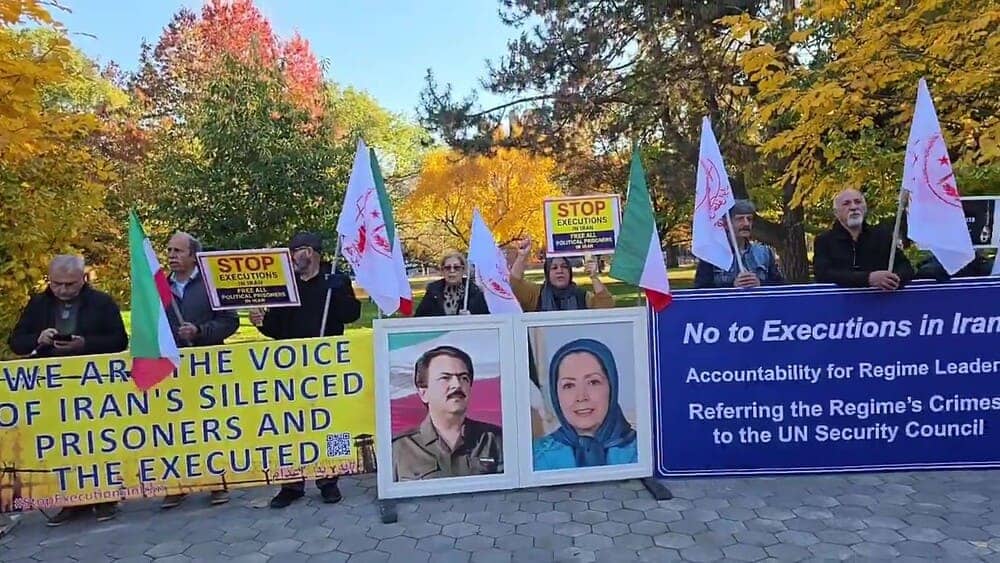
Toronto Rally Condemns Executions, Demands Freedom for Political Prisoners and Regime Change in Iran
Toronto, Canada – October 31, 2026: Supporters of the People’s Mojahedin Organization of Iran (PMOI/MEK) staged a rally in Toronto to denounce executions in Iran, pay tribute to victims of the nationwide uprising, and highlight the plight of political prisoners and protesters facing execution.

Demonstrators strongly denounced the Iranian regime’s continued use of the death penalty, describing it as a flagrant violation of human rights. Participants displayed photographs of executed prisoners and those killed during the nationwide uprising. Through this tribute, they honored the victims and drew attention to the plight of political prisoners.
PMOI Supporters Gather in Vancouver to Denounce Executions and Demand a Democratic Republic in Iran
Vancouver, Canada – October 31, 2026: Supporters of the People’s Mojahedin Organization of Iran (PMOI/MEK) staged a rally in Vancouver, demanding an end to executions in Iran, the freedom of political prisoners, and the establishment of a democratic republic.
Demonstrators voiced strong opposition to the Iranian regime’s ongoing practice of executions, describing it as a blatant violation of fundamental human rights.

Participants reiterated their determination to continue opposing the clerical regime. They voiced support for the organized Iranian Resistance and its democratic alternative, founded on Mrs. Maryam Rajavi’s Ten-Point Plan. The plan envisions a democratic republic in Iran grounded in freedom, respect for human rights, and the separation of religion and state.
PMOI Supporters Rally in Ottawa, Condemning Executions and Calling for a Democratic Republic in Iran
Ottawa, Canada – October 31, 2026: Supporters of the People’s Mojahedin Organization of Iran (PMOI/MEK) held a rally in Ottawa, calling for an end to executions in Iran, the release of political prisoners, and the establishment of a democratic republic.
Demonstrators strongly condemned the Iranian regime’s continued use of executions, denouncing them as flagrant violations of human rights.

The protesters demanded an immediate end to the death penalty in Iran. They also called for the release of all political prisoners and an end to the persecution of protesters and dissidents.
Participants reaffirmed their commitment to continuing the struggle against the clerical regime. They expressed their support for the organized Iranian Resistance and its democratic alternative, based on Mrs. Maryam Rajavi’s Ten-Point Plan, which calls for the establishment of a democratic republic in Iran based on freedom, human rights, and the separation of religion and state.