
In an article published in the Washington Examiner titled “The drums of war and Reza Pahlavi’s false promise of deliverance,” Ken Blackwell examines the danger of renewed war against Iran and challenges Pahlavi’s efforts to present himself as the country’s future leader.
Blackwell holds the Iranian regime responsible for the repression and unresolved crises driving public anger, while warning that another war could deepen civilian suffering and give the authorities further justification to suppress dissent. He rejects any framing that treats the regime and Pahlavi as comparable political forces, arguing that Iran’s central struggle is between an unaccountable ruling system and a population seeking freedom and sovereignty.
The article questions Pahlavi’s unverified claims of mass defections and his reliance on overseas media exposure, arguing that neither establishes a credible domestic organization or a popular mandate. Blackwell urges journalists and policymakers to scrutinize these claims rather than mistake prominence for leadership. He concludes that Iran’s liberation must come through the organized struggle of its people—not foreign military intervention or an exiled claimant seeking to inherit power—and that a democratic republic requires rejecting both the present dictatorship and the restoration of a discredited authoritarian past.
The full article appears below.
The drums of war and Reza Pahlavi’s false promise of deliverance
Iran is approaching a dangerous convergence of internal repression and external war. The crises that drove the January uprising remain unresolved. The regime has answered public anger with lethal force, mass arrests, and communications restrictions, while renewed American and Israeli military action threatens deeper suffering. In this setting, Reza Pahlavi again presents himself as ready to take charge, calling for defections and implying that foreign pressure could open his path to power.
The central issue is not a contest between two comparable poles: the regime and Pahlavi, with the Iranian people trapped between them. That framing grants him political weight, organization, and legitimacy he does not possess. Iran’s real conflict is between a repressive ruling system and a society seeking freedom and sovereignty. Pahlavi is not an equal force in that struggle, but an opportunistic claimant who may exploit war, media exposure and public desperation to manufacture the appearance of an alternative.
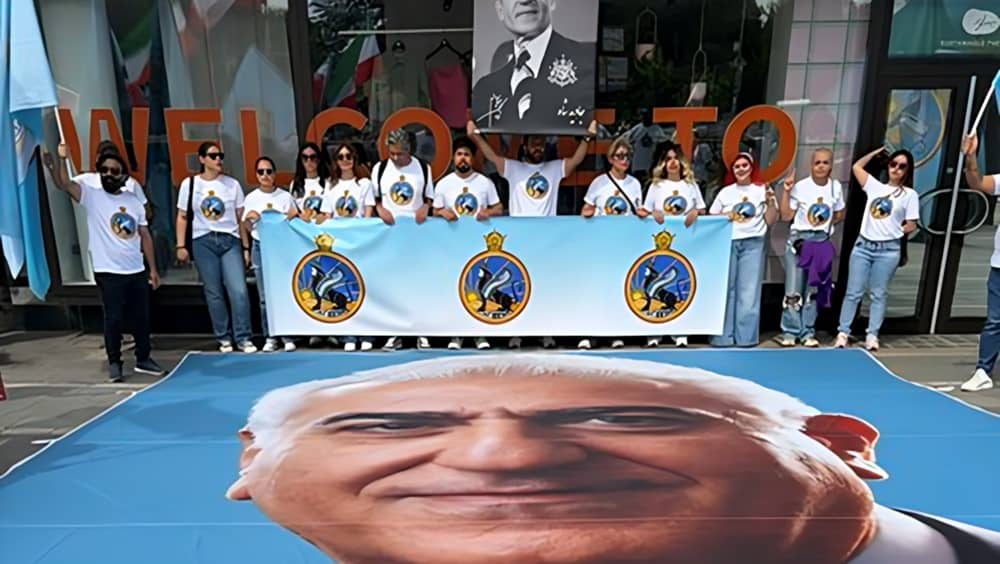
What Reza Pahlavi Was Really Selling in Frankfurt
https://t.co/EvRVXz6SMx— NCRI-FAC (@iran_policy) November 9, 2026
That distinction is essential as the drums of war grow louder. October reporting indicated that President Donald Trump opposed proposed Israeli strikes before the American midterm elections, leaving open the possibility of action afterward. Another campaign is not inevitable, but the danger is substantial. The closer Iran moves toward war, the easier it becomes for figures with little domestic presence to present themselves abroad as indispensable.
Responsibility for this peril begins with the regime. Its policies have exposed Iran to repeated crises while denying citizens control over national affairs. The January uprising revealed its governing bankruptcy. Demonstrations rooted in economic hardship became a broader political challenge, and the authorities responded lethally. The regime could punish citizens but not address why so many had turned against it.
No foreign power created the lived experience of corruption, exclusion and unaccountable rule. The regime claims to defend national sovereignty while stripping the nation of political sovereignty. Its definition of security increasingly means protecting the ruling system at the population’s expense.
War may threaten the regime, but it can also serve it. Emergency conditions justify tighter controls, hinder independent reporting and allow dissent to be branded as collaboration with the enemy. Confrontation can become an instrument of domestic survival. Reuters reported in October that senior Iranian officials described prolonging negotiations ahead of the American midterm elections despite the economic consequences. Such calculations show how readily the regime’s interests displace the public’s need for relief.
Rejecting the regime’s conduct does not require endorsing another war or accepting that foreign military action will deliver Iran to a self-appointed leader in exile. Recent experience provides no basis for that assumption. Neither the June 2025 war nor the military campaign launched in February 2026 toppled the regime. Military pressure inflicted serious damage without producing political liberation.
Pahlavi is not one of three equivalent actors alongside the regime and foreign governments. He commands no proven national organization inside Iran, has demonstrated no capacity to replace the state, and has offered no independently verifiable evidence of a popular mandate. His relevance arises chiefly from platforms provided abroad and his attempt to attach himself to military pressure others may unleash.
Pahlavi has encouraged military action against the regime’s leadership and coercive institutions while presenting himself as the political beneficiary. Encouraging foreign strikes on one’s own country carries an exceptional burden of responsibility. It demands candor about civilian risk, political chaos, and the possibility that war will strengthen repression. It also requires evidence of the organization, legitimacy, and capacity to convert disruption into democratic change. Pahlavi has supplied none.
His claims about defections illustrate the problem. He told conservative commentator Hugh Hewitt that more than 160,000 people had applied through his initiative, including military personnel, security-force members, and civilian officials. Yet he provided no independent substantiation, and no visible wave of defections followed. A number announced in an interview is not an organization, chain of command, or force capable of changing events.
Iran’s clerical rulers are under a naval blockade and bracing for another uprising. Their most durable strategic depth may not be geographical at all.
https://t.co/Np4xoLuiwB— NCRI-FAC (@iran_policy) September 2, 2026
Such assertions can create a false sense that the regime’s coercive apparatus is collapsing and an organized alternative is ready to assume power. For people inside Iran, that illusion can be fatal. Those taking extraordinary risks may face arrest, torture or execution while the promised ‘phantom army’ remains invisible.
Media prominence has obscured the gap between image and reality. Sympathetic Persian-language coverage, especially from broadcasters outside Iran, has elevated Pahlavi as though visibility established leadership. Iran International has been particularly instrumental in amplifying this image. But repetition cannot create an organization, confer a democratic mandate, or establish command over people risking their lives inside Iran.
There is little evidence that Pahlavi commands significant support inside the country.
Monarchist slogans have appeared occasionally, but scattered chants and limited video clips do not establish broad backing. Some circulated videos have been challenged as containing dubbed or superimposed pro-Pahlavi slogans. Isolated footage cannot give him ownership of a diverse protest movement with widely differing grievances and aspirations.
His Oct. 27 appeal for Iranians to contact his team through a Telegram bot does not resolve these doubts. Another registration drive cannot validate earlier claims; it makes accounting more necessary. Where are the previously announced networks? What measurable result did they produce? Why trust a new appeal when the old numbers were never independently verified?
The same problem appears in his offer of protection to security personnel who defect. Encouraging them to resist repression is legitimate, but promising their future treatment assumes authority Pahlavi does not possess. Accountability, amnesty, and due process belong to a legitimate democratic order, not an aspiring ruler’s discretion. A free Iran must guarantee fair treatment without allowing any individual to act as though its future institutions were his to command.
His political record also deserves scrutiny. Pahlavi has defended his father’s legacy rather than clearly confronting its repression and abuses. A figure seeking democratic credibility cannot evade the authoritarian practices of the system from which he derives his title and identity. Iran’s future cannot be built by sanitizing the past or replacing one form of unaccountable rule with nostalgia for another.
Reza Pahlavi Glorifies the Legacy of Repression, Corruption, and Despotism
#Iran
https://t.co/1H4wZm92zH https://t.co/JejnaTPkXX— NCRI-FAC (@iran_policy) April 18, 2026
Journalists, broadcasters and foreign policymakers must examine claims about secret networks, mass defections and national leadership with the same rigor applied to official propaganda. Access, polished interviews and repetition are not evidence. Believing that a vast internal force is ready to rally behind Pahlavi could lead decision-makers to misjudge both the consequences of war and the prospects for transition.
The danger is not that Iran is divided between powerful camps. It is that war may devastate the country, reinforce the regime’s repression and create an opening for a weak but heavily promoted claimant to appropriate the people’s sacrifices. Treating Pahlavi as a serious national force without demonstrated support or organization helps create the fiction on which his claim depends.
Iran is ready for fundamental change, but liberation will not come from the air or opportunists waiting to claim the ruins. It will come through the organized struggle of the Iranian people, who have already paid an immense price for freedom. Their movement must not become a backdrop for someone else’s ambition. Iran’s future begins by rejecting both present tyranny and restoration of a discredited past, and by recognizing the people as the decisive force in shaping a democratic republic.
Kenneth Blackwell (@kenblackwell), former U.S. ambassador to the U.N. Commission on Human Rights, is president of the Council for National Policy and chairman of the Conservative Action Project.