
Four-minute read
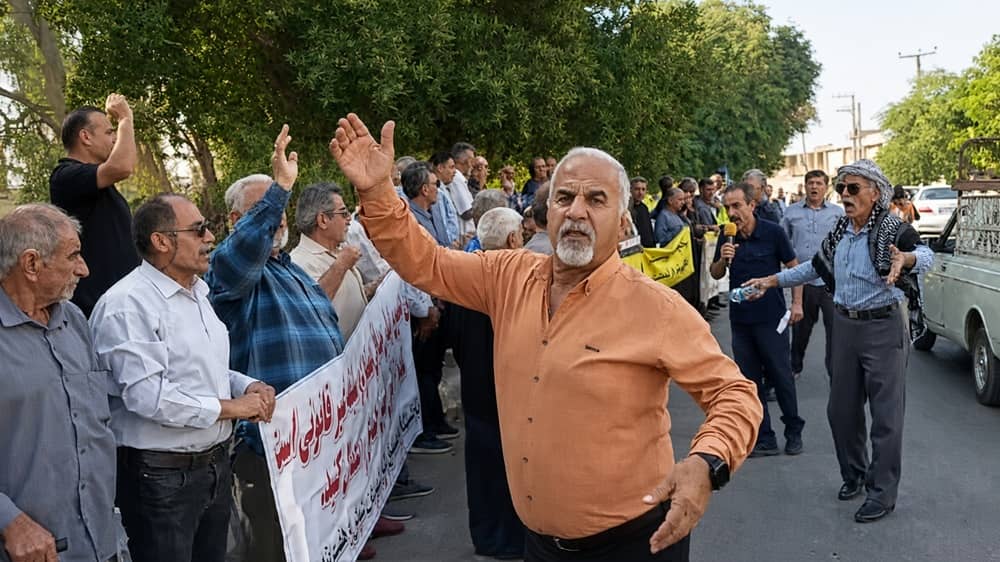
Retirees demonstrated Sunday, November 22, in Tehran, Isfahan and Shush over inadequate pensions, soaring prices and deteriorating living conditions.
In Shush, Social Security retirees marched chanting, “The government’s achievement is stealing from the people” and “Our pensions are enough for only one week.” Some denounced parliament, accusing officials of corruption and neglect.
Steel-industry retirees marched toward the governor’s office in Isfahan, chanting, “Enough promises—our tables are empty.”
In Tehran, retirees and teachers demanded improved pensions, the release of imprisoned teachers and an end to executions. Protesters chanted, “United and determined, against the death penalty.”
Electricity-sector employees also demonstrated outside the Energy Ministry, while drivers protested outside the Momtaz Iranian company.
Meanwhile, truck drivers reportedly launched a strike in several cities, including Tehran, Bam, Sirjan, Dezful, Bandar Abbas and Isfahan. Their union called for nationwide participation, protesting freight rates that have failed to keep pace with rising operating costs.
The protests followed a Saturday disclosure by MP Ahmad Bigdeli that the government was resisting promised midyear wage adjustments because it could not afford corresponding increases for public employees.
A bus accident that killed 13 oil workers sparked ~1,000 people in #Abdanan chanting “Death to the dictator.” Years of economic collapse and grievances mean any spark can set Iran off. #IranProtests
By Farid Mahoutchihttps://t.co/LATOjavBY4— NCRI-FAC (@iran_policy) November 18, 2026
Factional Clash Forces Parliament to Suspend Proceedings
An extraordinary confrontation among regime loyalists forced the cancellation of Sunday’s parliamentary session.
The dispute centered on imprisoned hardline lawmaker Hamid Rasaee, who attended parliament during temporary prison leave but discovered that his electronic voting and participation system remained disabled.
Several lawmakers demanded that his access be restored. According to the IRGC-affiliated Tasnim news agency, the confrontation escalated into an altercation between a protesting lawmaker and the session’s Quran reciter.
Mediation failed, prompting acting chairman Ali Nikzad to suspend proceedings.
The spectacle exposed the depth of factional hostility. A dispute over the parliamentary privileges of a convicted regime loyalist was enough to prevent the legislature from conducting its business.
Parliamentary officials nevertheless held a separate meeting on next year’s budget, emphasizing spending priorities involving economic crisis, security and healthcare.
Iran, Nov. 18: New restrictions on subsidized bread purchases spark anger as food prices soar. Reports say 5 protesters remain detained after #Abdanan's anti-regime demonstrations. Workers protest unpaid wages, patients shoulder nearly 70% of healthcare costs, and pollution shuts…
— NCRI-FAC (@iran_policy) November 18, 2026
Judiciary Announces Asset Seizures Against 50 People
The judiciary announced Sunday that authorities had seized the assets of 50 people in Rey, south of Tehran, over allegations of activities threatening state security.
Prosecutor Mohammad-Mahdi Rahimi also said judicial sentences had been issued against some defendants, whom he described as rioters.
Authorities disclosed neither their identities nor the specific charges, the value of confiscated property or details of the proceedings.
The announcement demonstrates how the regime is extending the consequences of political repression beyond imprisonment to the seizure of private assets.
Iran, Nov. 20: Labor representatives say wages cover barely 10 days of living costs. Reports emerge of two protesters' death sentences being upheld. #Bread queues grow, transport costs rise and officials warn of winter blackouts. Meanwhile, the regime expands Basij mobilization…
— NCRI-FAC (@iran_policy) November 20, 2026
Economic Contraction Exposes the Scale of the Crisis
Newly reported figures from the Central Bank-affiliated Monetary and Banking Research Institute claimed that Iran’s economy contracted approximately 5.2% during the summer, following a 12.1% contraction in spring.
The oil sector recorded the sharpest decline, shrinking 31.7%. Industry and mining contracted 10%, while services fell 1%. Agriculture was the only major sector reporting growth, at 6%.
The figures indicate that the economic crisis extends beyond inflation to substantial declines in production and the government’s revenue-generating capacity.
Against this backdrop, Tasnim reported Sunday that authorities had begun transferring a meager 100,000 tomans from existing subsidies into digital wallets for eligible recipients in three income deciles.
Far from providing additional relief, the measure merely redistributes existing assistance while the regime raises prices and further erodes household purchasing power. The contrast is stark: ordinary Iranians are expected to survive on shrinking incomes and token subsidies, while the ruling establishment continues to devote enormous resources to its military and security apparatus and costly regional confrontations.
Iran, Nov. 21: Bread controls now operate in seven provinces as bakers protest and fuel queues persist. Workers, students and consumers demonstrate, while #Abdanan arrests rise to 12. Tehran faces renewed blackout fears, and Pezeshkian acknowledges failing enterprises and…
— NCRI-FAC (@iran_policy) November 21, 2026
Electricity Restrictions Return as Winter Approaches
The regime’s electricity authorities announced the introduction of planned supply restrictions beginning November 22, citing shortages of fuel for power stations.
Tavanir said affected subscribers would receive advance notifications through official electricity-service platforms.
The company’s managing director also warned that households and businesses substantially exceeding prescribed consumption limits could face prolonged disconnections.
Although officials have attributed the worsening situation partly to wartime damage to energy infrastructure, chronic fuel shortages and recurring blackouts predate the conflict.
For households and businesses already struggling with inflation and declining incomes, renewed electricity interruptions threaten further financial losses.
Pezeshkian keeps publicly warning of winter energy crises, oil-sale blockages & #IranProtests. Hardliners (and Mojtaba Khamenei) want him to stop “advertising weakness.” He might be more worried about an unprepared population exploding than about signaling vulnerability abroad.…
— NCRI-FAC (@iran_policy) November 21, 2026
Pezeshkian Warns of Hardship but Emphasizes Obedience
Addressing clerics Sunday, Masoud Pezeshkian warned of the country’s deepening economic and social problems, arguing that a nation struggling with persistent shortages and hardship could not claim genuine strength.
Careful not to provoke Supreme Leader Mojtaba Khamenei’s hardline loyalists, Pezeshkian reaffirmed his obedience to the leadership and urged clerics and neighborhood religious institutions to help address the country’s mounting difficulties.
In remarks reported Sunday from a meeting the previous evening, he also called for an end to the damaging uncertainty of the country’s “neither war nor peace” situation.
Behind his carefully worded appeals lies a political warning. Pezeshkian appears to be pressing the regime’s leadership to accept compromises that could ease economic pressures before they ignite nationwide unrest. Yet, unwilling to openly challenge Khamenei or his loyalists, he couches his warnings in declarations of allegiance, hoping to influence the regime’s course without becoming the target of its hardline factions.
Deepening cracks in Iran’s ruling elite: public factional clashes over #diplomacy, war strategy & economic policy intensify amid ~89% inflation, collapsing living standards, unrest fears and stalled talks with Washington. Authority is fragmenting. By @MehdiOghbai…
— NCRI-FAC (@iran_policy) November 18, 2026
The regime is displaying two contradictory tendencies: increasing reliance on coercion against dissatisfied citizens while struggling to maintain cohesion among its own loyalists.
The economy’s deterioration makes this contradiction more dangerous. With wages losing value, public services under strain and essential supplies increasingly subject to restrictions, the authorities have fewer means of containing dissatisfaction without resorting to force.
The growing danger for Tehran is that its internal divisions are deepening just as the economic pressures capable of igniting wider unrest continue to accumulate.