
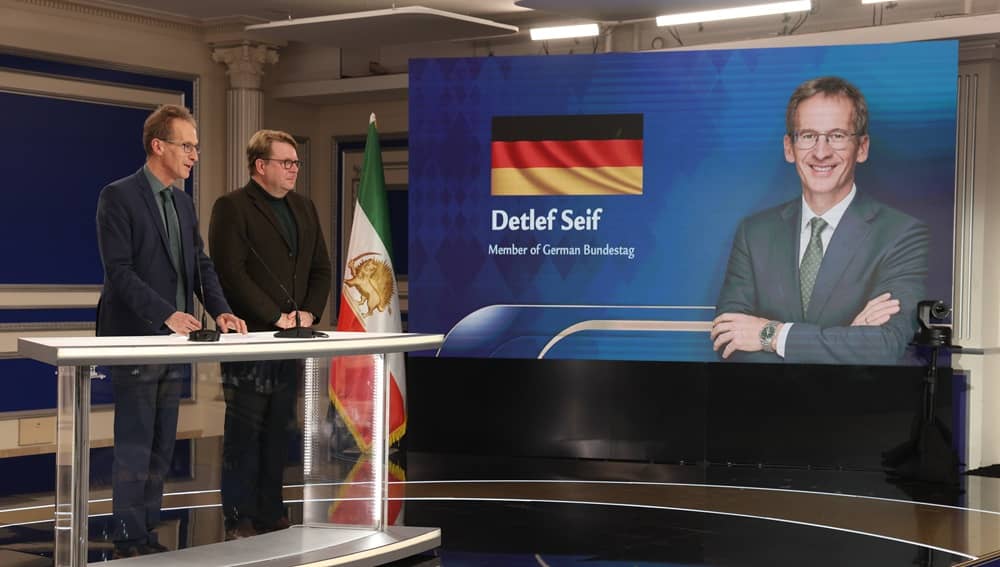
Addressing the November 21, 2026, international conference on Iran, German Bundestag member Detlef Seif declared that a government waging war against its own population has forfeited any right to exist, pointing to live fire against protesters, hospitals turned into places of fear, mass abductions, and escalating executions following bazaar-led protests. Quipping on John Bercow’s style to tell Reza Pahlavi to “play golf and forget your aspirations,” Seif said Tehran fuels regional conflict through its proxies and spreads transnational repression across the EU.
Welcoming Germany’s February criminal-code provisions against spying and intimidation as well as the EU terror listing of the Revolutionary Guards, he urged rigorous enforcement, tracking financial flows, and dismantling structures on the ground. Aligning with a new approach advocated by Carsten Müller and Hans-Ulrich Seidt, Seif opposed foreign military intervention or externally imposed regime change while urging lawful support for Iran’s democratic opposition and freedom movement.
A translated version of Detlef Seif’s speech follows below.

Ladies and gentlemen, esteemed friends of a free Iran. We had stage directions that the two of us wanted to come on stage, so of course we did that too. As a member of the German Bundestag, it is a special honor, and also a personal concern, to be with you today. I don’t want to top what John Bercow said, though I was the rapporteur for Great Britain and Brexit in the German Bundestag for years. He chaired sessions excellently. You became famous in a historic way with “Order.” And I have to tell you, that “Order” you delivered today: “Reza Pahlavi, play golf and forget your aspirations.”
When we look at Iran today, we see a country on the brink and a regime without any legitimacy. The protests of the past year began in the bazaars and swept across the entire country, and there the brutality of the mullahs revealed itself once again. Hospitals, places where you actually go to get help—became places of fear. Militias fired live ammunition indiscriminately at demonstrators. Tens of thousands of people were abducted, and the execution machine is running at full speed. And then I can summarize just one thing: a government that wages such a war against its own population has forfeited every right to exist.
It was also pointed out earlier how important this particular development is for the entire Middle East and peace on the ground. For we must also see that this current regime of injustice is actually number one when it comes to supporting Hamas, Hezbollah, and the Houthis. If that is not ended, then there cannot be peace in the Middle East—that is not merely a question of fate for Iran—and Israel will never be able to live safely in the region either.
And in Germany, and indeed across the entire European Union, we are also experiencing how this regime is increasingly trying to spread fear among us in EU member states. That is called transnational repression, and therefore I am grateful that in Germany in February we included a new provision in the Criminal Code that penalizes spying on and pressuring people even more severely alongside the other criminal provisions that already exist. Here we must be tough, and this must also be used extensively.
🚨 EXCLUSIVE | Detlef Seif: " Iran's Regime Has Lost Every Legitimate Right to Be a Government"
German Bundestag member Detlef Seif told Simay Azadi reporter @Ehsaneghbale after the Nov 21 Paris conference: "A government that persecutes its people the way the current Iranian… https://t.co/3PZvrNF2Uu pic.twitter.com/Jzn5GKYjAL
— SIMAY AZADI TV (@en_simayazadi) November 28, 2026
And one point was also a personal concern of mine, which we also discussed in Germany at an event last year: the inclusion on the EU terror list regarding the Revolutionary Guards. Nobody can explain why this terrorist group and gang was not listed until now, and therefore that is already a great success.
Ladies and gentlemen, parliamentarians and legal scholars know that regulations are one thing; the question is lived practice. And here is what matters now: we must combat this terrorist organization sustainably, investigate financial flows, eliminate all structures on the ground, and not simply say, “Now they are listed and that’s that.” I also see it as a personal concern to stay on top of this so that we leave them no room in Germany either.
No dictatorship can last forever when a people unitedly strives for its freedom. We stand clearly—well, I think many Bundestag members, I don’t need to say anything here about my friend Carsten Müller, that’s completely clear—we stand at your side, and I also share the view of my colleague Carsten Müller and Ambassador Hans-Ulrich Seidt, who published a piece on this, that it is very important here to implement a new approach. Iran policy in recent years in Germany, and also in the European Union, has been too hesitant. On our own, solely with diplomacy on one side and pressure through sanctions on the other, we will not get by.
But one thing is also clear: we feel bound by international law, and of course we do not want to make an active contribution to a war that is carried into Iran, nor do we want regime change from the outside. But what we can do, and what we should do, is support this democratic opposition, this freedom movement, in the way we can under international law—through organizations, through support, through signals. And in that, you have us at your side.
Thank you very much.