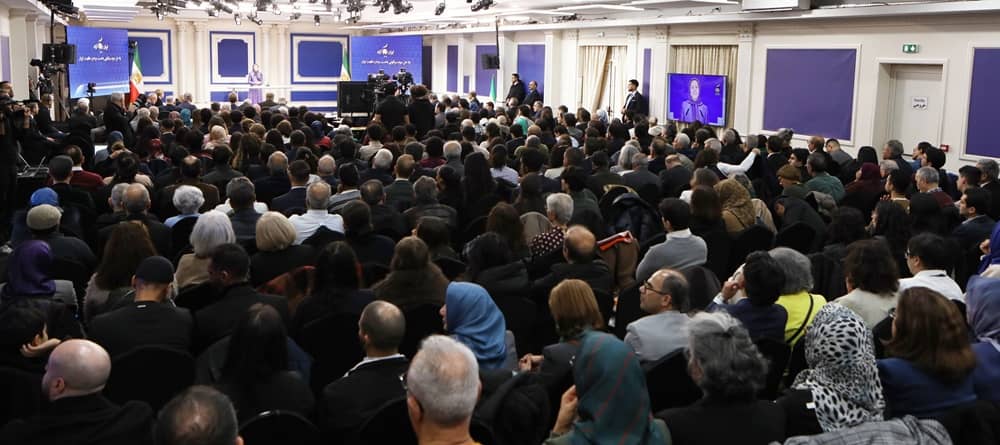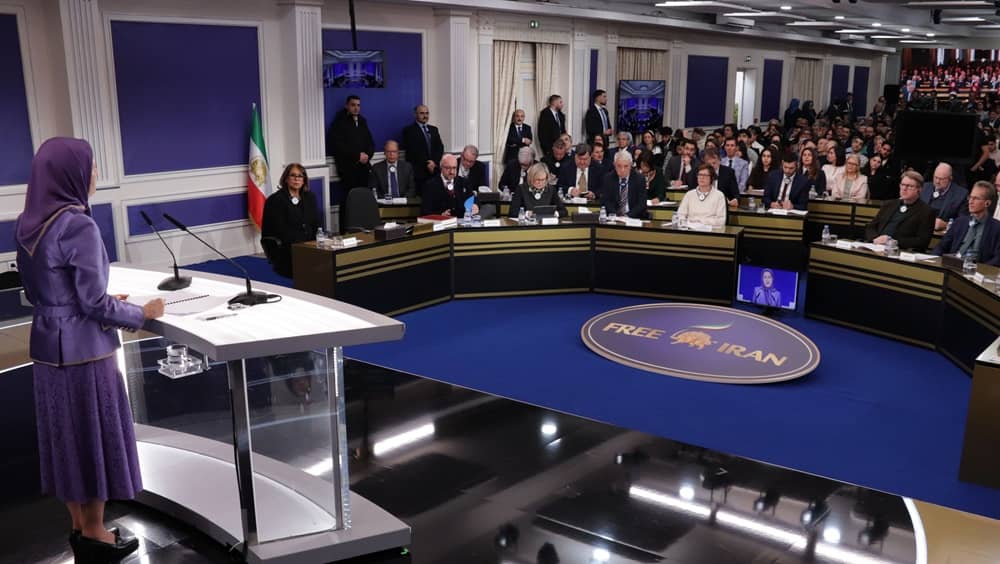
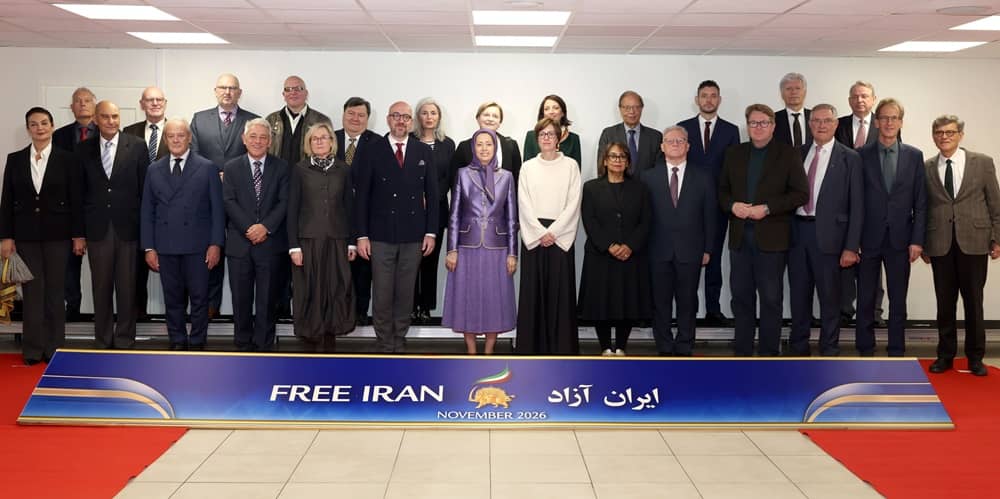
Former European leaders, ministers and senior parliamentarians from several countries joined an international conference on Saturday, November 21, 2026, calling for a new policy toward Iran based on democratic change by the Iranian people rather than continued accommodation with Tehran or foreign military intervention. The conference, titled “The Third Option: Overthrow by the Iranian People and Resistance,” focused on the role of the organized Iranian Resistance and its Resistance Units inside the country, the surge in executions and repression, and what speakers described as the failure of Western policies toward Tehran. Participants also strongly rejected efforts to present Reza Pahlavi, son of the ousted Shah, as an alternative to the current regime, arguing that Iranians should not be forced to choose between religious and monarchical dictatorship.
Mrs. Maryam Rajavi, President-elect of the National Council of Resistance of Iran (NCRI), delivered the keynote address, arguing that the fundamental threat to the clerical authorities came not from external confrontation but from an increasingly restive society and an organized movement capable of turning popular revolt into political change.
Mrs. Rajavi said the military and political tensions surrounding Iran had obscured what she described as the central conflict determining the country’s future: the confrontation between the population and the ruling system.
“The central source of the regime’s existential crisis is the resistance of the Iranian people and society’s readiness for uprising and the regime’s overthrow,” she said. She pointed to the continuing operations of Resistance Units and rebellious youth, arguing that Tehran’s execution of PMOI members and protesters and the intensification of repression were attempts to prevent another uprising.
Marking the seventh anniversary of the November 2019 uprising, the NCRI President-elect said the protests had demonstrated both the scale of popular opposition and what an eventual confrontation over the regime’s survival could look like. She praised the protesters and Resistance Units involved in that uprising and said the authorities remained unable to resolve the threat posed by another nationwide revolt.
The Third Option Conference: Overthrow by the Iranian people and Resistance
We call on Europe to adopt a firm policy toward this regime.
And the clearest expression of such resolve is to stand with the Iranian people and their Resistance in their struggle to overthrow the… pic.twitter.com/ntf65KrMX7— Maryam Rajavi (@Maryam_Rajavi) November 21, 2026
Mrs. Rajavi framed the political alternative in explicit terms.
“We have said that the solution to the Iranian crisis lies neither in appeasement nor in foreign war,” she said. “The developments of the past year have put this proposition to the test.”
She said change had to come through “a force rooted in Iranian society and independent of foreign powers,” one that had established its credentials in the struggle against both the Shah’s dictatorship and clerical rule.
“This is the Third Option: overthrow by the Iranian people and their organized Resistance, spearheaded by the Resistance Units and the Liberation Army.”
Mrs. Rajavi described the Resistance Units and Iran’s rebellious youth as the force underlying Tehran’s continuing fear of another uprising. She linked executions of imprisoned PMOI members, repression of protesters, surveillance and the regime’s foreign conflicts to what she called its fear of this domestic opposition.
She also sharply criticized Western efforts to elevate remnants of the former monarchy, saying such initiatives ultimately assisted Tehran by allowing it to portray the political alternatives as either continuation of clerical rule or restoration of the Shah.
Watch Live: European politician meet to discuss concern about Iran's threat to continent https://t.co/O4S5YjKSeN
— John Solomon (@jsolomonReports) November 21, 2026
“The key to change lies in the hands of the Iranian people and the Iranian Resistance,” Mrs. Rajavi said, describing a movement that had “endured through fire and blood for 45 years” under the slogan “Neither Shah nor Mullahs.” She said the NCRI sought a secular democratic republic based on gender equality, autonomy for oppressed nationalities, abolition of the death penalty and a non-nuclear foreign policy.
Mrs. Rajavi called on European governments to condition relations with Tehran on an end to executions and the killing of protesters, close Iranian embassies she accused of serving as centers for espionage and terrorism, and formally recognize the Iranian people’s struggle against the regime and the struggle of rebellious youth against the IRGC.
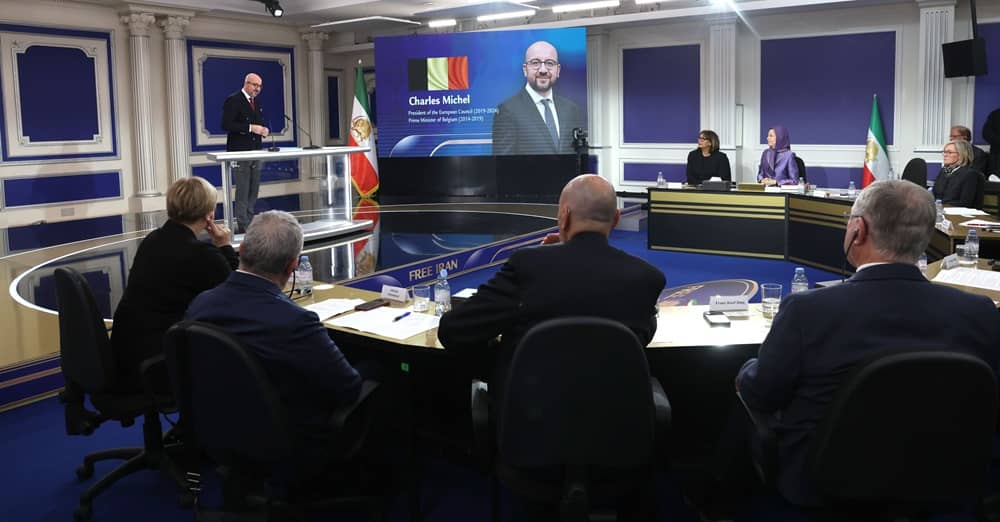
Former European Council President and Belgian Prime Minister Charles Michel said Europe and the United States had to fundamentally rethink their approach to Iran.
“We tried appeasement, we got more oppression. We tried concessions and negotiations, we got blackmail and hostage-taking,” Michel said. “We witnessed military confrontation, and we got more destruction and suffering, and the regime is still there.”
He drew three conclusions: the clerical authorities would not reform; foreign military intervention could not deliver democracy; and democratic change led by Iranians themselves should become “the cornerstone of European policy.”
Michel said the claim that Iran lacked an organized alternative was itself part of Tehran’s propaganda.
“There is indeed an alternative. It did not appear yesterday,” he said. “For more than four decades, Iranian men and women have risked everything to keep the flame of freedom alive. The MEK and its Resistance Units on the ground are at the forefront of this struggle.”
Former EU Council President @CharlesMichel urges 3 lessons for the EU on Iran:
1⃣ The mullahs won't reform.
2⃣ Foreign war can't deliver democracy—We don't have to choose between appeasement vs. war.
3⃣ The alternative: democratic change led by Iran's people.CC: @kajakallas https://t.co/PZUYnu4yIs pic.twitter.com/dUy4zLviUn
— M. Hanif Jazayeri (@HanifJazayeri) November 21, 2026
Addressing Resistance members inside Iran and at Ashraf 3, Michel added: “You are not spectators of history; you are making history.”
He described the NCRI as a political alternative with a program, support inside Iran and an international network, and said Mrs. Rajavi’s Ten-Point Plan supplied a democratic framework for the transition.
Michel also rejected Pahlavi as an alternative. He criticized the former Shah’s son for praising his father’s legacy and for advocating foreign military intervention, and said hereditary status could not confer democratic legitimacy.
“The people of Iran do not need a would-be king; they need democracy,” Michel said. “We cannot oppose one dictatorship while opening the door to another one. The future of Iran belongs neither to the Shah nor to the mullahs; it belongs to the Iranian people.”
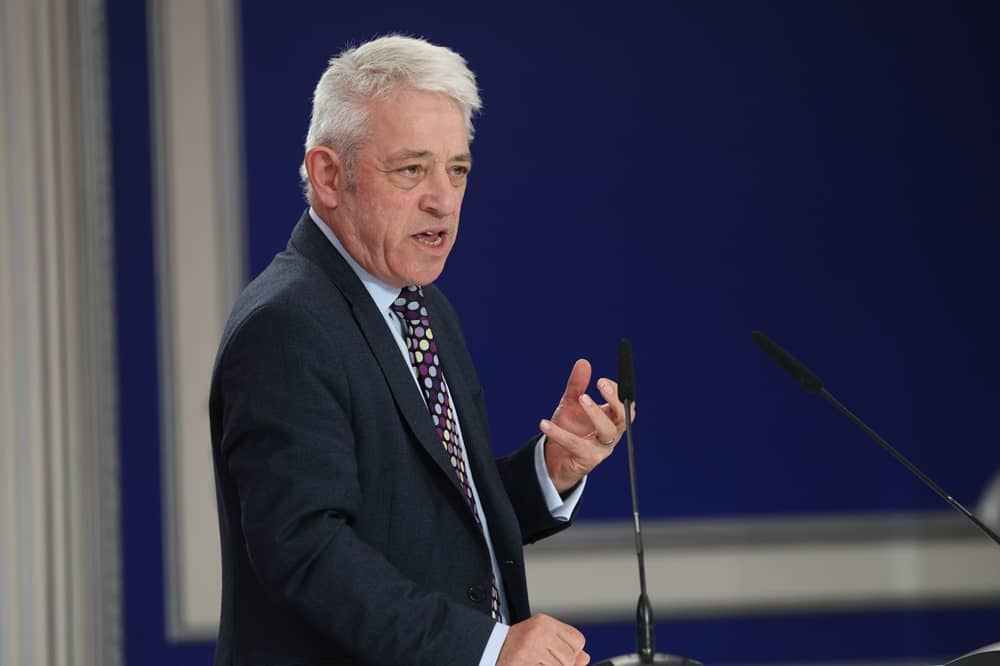
Former Speaker of the UK House of Commons John Bercow similarly said Tehran could neither be transformed through accommodation nor removed through war.
“What we know about the regime is that it cannot be improved by appeasement or removed by war,” he said.
Bercow devoted a large portion of his remarks to Pahlavi, arguing that his continued defense of his family’s record, his lack of democratic mandate and the role he proposed for himself in a future political system disqualified him as a credible republican alternative.
Vanmorgen om 4 uur opgestaan om mijn Iraanse vrienden bij te staan en hen te steunen bij het bereiken van iets wat voor ieder mens vanzelfsprekend zou moeten zijn: in vrede leven in je eigen land, zonder bang te hoeven zijn voor de overheid.
Onder de aanwezigen waren John… pic.twitter.com/ieKwd3NvXe
— Dorien Rookmaker (@RookmakerDorien) November 21, 2026
He described Pahlavi as “a prince without a people” and “a relic of royal rule,” and argued that his promotion diverted international attention from the organized opposition inside Iran.
Bercow contrasted that with what he described as nearly five decades of sacrifice by the NCRI and PMOI.
“Courage, conviction, commitment,” and compassion, he said, were characteristics he associated with Mrs. Rajavi and the organized Resistance. Those qualities, he added, had been “forged in the furnace over almost five decades of service, of sacrifice, and of struggle.”
Bercow pointed to the Ten-Point Plan’s commitments to freedom of speech, association and the press, separation of religion and state, minority rights, gender equality, universal suffrage, abolition of capital punishment and a non-nuclear republic.
He also emphasized what he saw as a fundamental difference between Pahlavi’s political project and the Resistance: the latter, he said, was built around a cause rather than personal advancement.
“These people have made a lifelong commitment to serve a cause,” Bercow said.
“The future of Iran does not belong to a prince because of his birth. It does not belong to a cleric because of his title. And it does not belong to a politician because of his ambition. It belongs to the people of Iran themselves.”
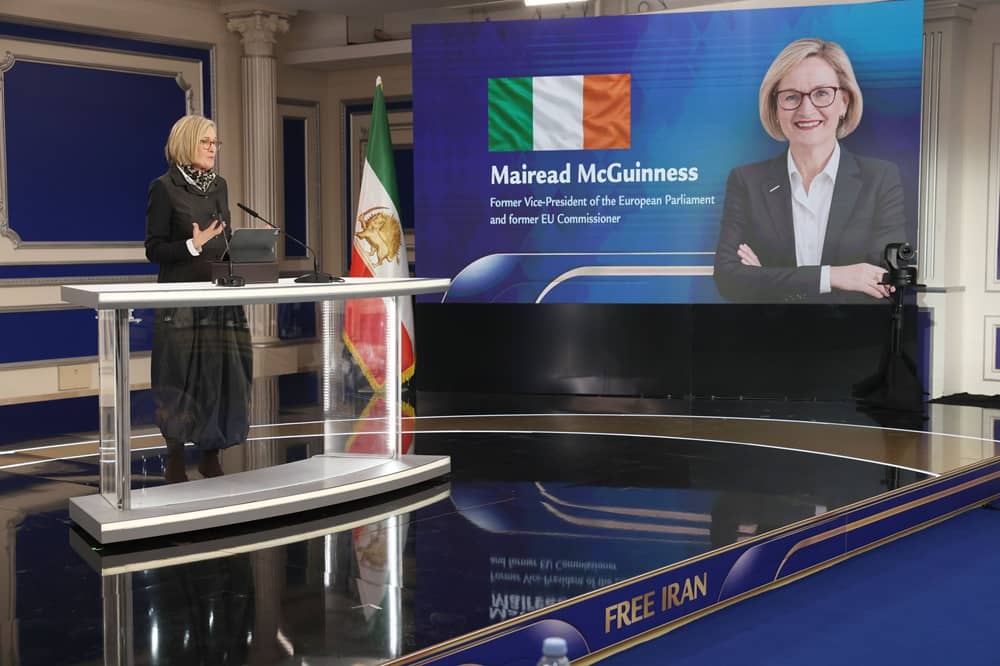
Former European Commission Vice President and former EU Commissioner Mairead McGuinness placed the Iranian crisis within a broader erosion of democratic institutions worldwide and warned that both war and internal repression were compounding the suffering of Iranians.
Citing the UN Special Rapporteur on Iran, she noted that Iranians had been caught between “external aggression and internal repression” and said war had not reduced repression but had intensified it.
https://t.co/Uoz9ZfIfBR pic.twitter.com/Qd8YMYEefs
— Dorien Rookmaker (@RookmakerDorien) November 21, 2026
McGuinness stressed that a successful democratic transition required more than the removal of a dictatorship. It demanded durable institutions capable of preventing another concentration of power: independent courts, parliamentary oversight, electoral integrity, free media, minority protections and genuine political competition.
“In a true democracy, people have the right to choose a government, criticize it, oppose it, and replace it peacefully at the next election,” she said.
She said the desire for democracy among Iranians was evident, particularly among young people, but warned that the transition would require “courage and determination” and broad agreement on the institutions and political rules of a future Iran.
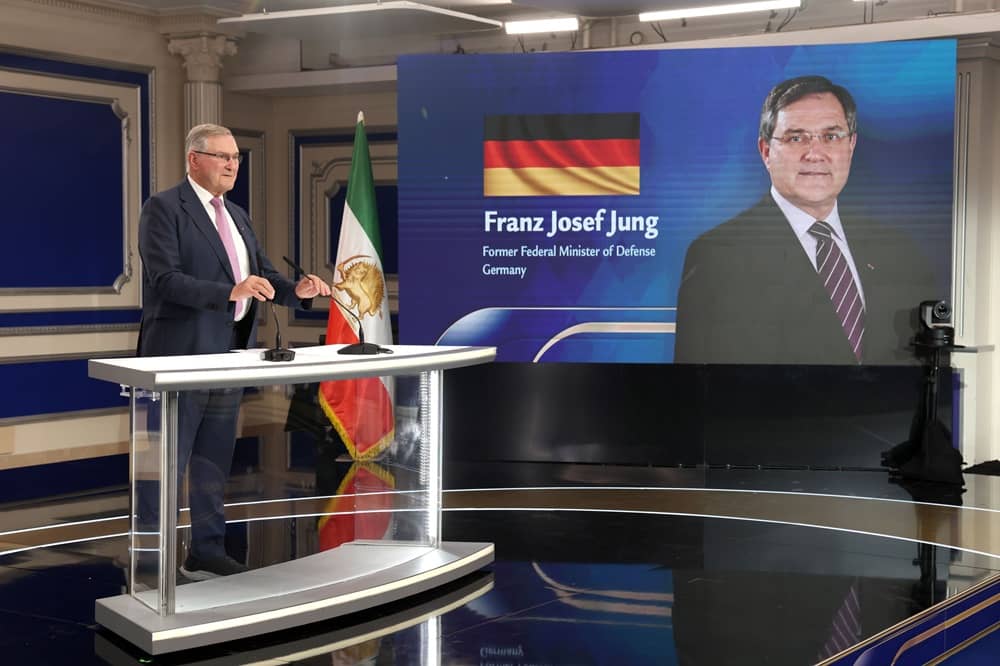
Former German Defense Minister Franz Josef Jung, now president of the association representing former members of the Bundestag and European Parliament, said the best way out of Iran’s crisis was replacement of the existing system with democratic government.
Jung argued that the regime’s increasing repression and fear of opposition were signs of weakness, while its regional activities and nuclear program also threatened European security.
He said nationwide protests had demonstrated Iranians’ rejection of both “the ruling mullahs’ dictatorship” and “a return to the monarchic dictatorship of the Shah’s era.”
“The ‘Reza Pahlavi’ alternative… is simply not credible,” Jung said, arguing that Pahlavi had neither repudiated his father’s abuses nor clearly separated himself from the Revolutionary Guards.
The Third Option Conference: Overthrow by the Iranian people and resistance
We gather here at a time when our country, Iran, remains at the epicenter of a regional and international upheaval.
Change in Iran comes through a force proven in the struggle against both the Shah’s… pic.twitter.com/pc8ut11svj— Maryam Rajavi (@Maryam_Rajavi) November 21, 2026
Jung said Mrs. Rajavi’s Ten-Point Plan, including free elections, political freedoms, separation of religion and state, gender equality, judicial independence, abolition of torture and the death penalty and a non-nuclear Iran, should receive explicit European Union support.
Former Polish Foreign Minister Anna Fotyga, who previously chaired the European Parliament’s Subcommittee on Security and Defense, drew on Poland’s experience with the Solidarity movement and resistance to Soviet rule.
Fotyga said decades of repression under both the Shah and clerical rule demonstrated the cost paid by Iranians seeking freedom. She emphasized, however, that opposition to Tehran required more than denunciations from abroad.
“We have not only to condemn, and not only diplomatically to support, but we have to know that Iran has a well-organized opposition—really well organized, very prudent, caring for people, their security in particular, and their well-being,” she said.
Fotyga praised what she described as the Resistance’s long-developed leadership, organization and caution in confronting a heavily armed dictatorship, saying those qualities had made it easier for her to support the movement during her years in the European Parliament.
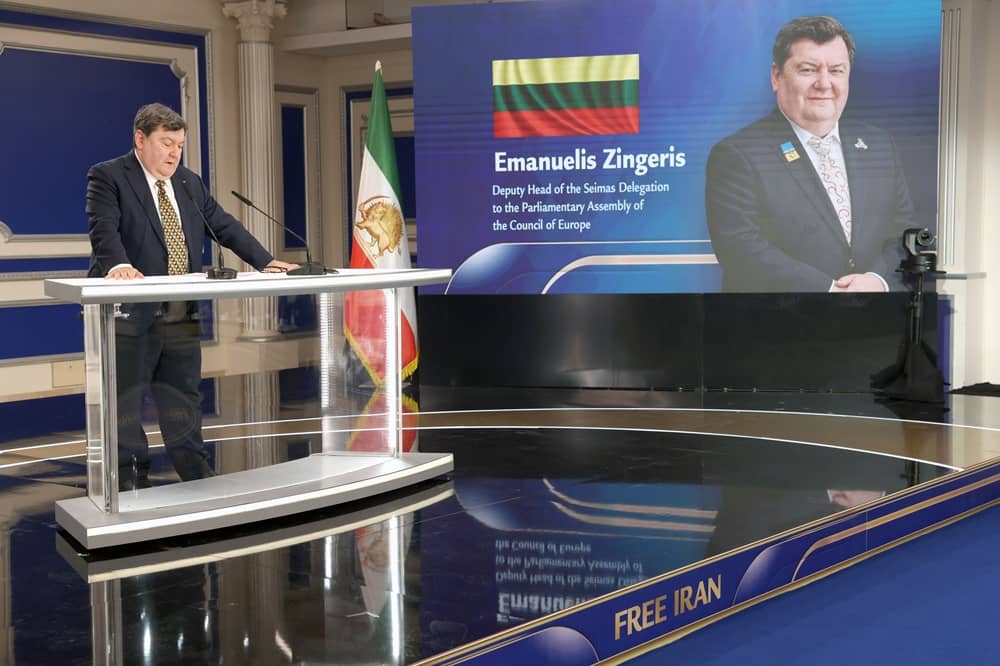
Lithuanian parliamentarian Emanuelis Zingeris, deputy head of his country’s delegation to the Parliamentary Assembly of the Council of Europe, compared Iran’s political prisoners with dissidents who resisted Soviet rule in Central and Eastern Europe.
He highlighted the case of political prisoner Mohammad Javad Vafaei Sani, recipient of a Magnitsky Human Rights Award and repeatedly sentenced to death. Quoting from a message attributed to Vafaei Sani, Zingeris said: “I remain steadfast in my pledge, and I will not bow before oppression until the people of Iran will be free.”
Zingeris urged Europe to treat human rights and freedom as strategic priorities rather than subordinating them to economic concerns, and pledged continued support for the Iranian democratic movement. He also called for implementation of measures targeting the IRGC and said democratic countries should unite around “extremely visible support for the freedom of the Iranian people.”
German Bundestag member and Judiciary Committee chair Carsten Müller said Iran’s future could not be secured by replacing one form of dictatorship with another.
“Iran and the Iranian people are not helped if they are shifted from one terribly bloodthirsty dictatorship into another, monarchist dictatorship,” Müller said. “The Iranian people want to be free, and we want to help them in that and stand by their side.”
He also rejected reliance on foreign military action.
“We cannot rely on help coming from the outside, or on a military intervention bringing freedom to the Iranian people,” Müller said. “The Iranian people want to win freedom themselves, they can win it themselves.”
Fellow Bundestag member Detlef Seif focused on repression both inside Iran and beyond its borders. He cited Germany’s measures against transnational repression and called for sustained action against IRGC structures, including investigation of financial networks and operations in Europe.
Seif said German and EU policy toward Iran had been “far too restrained” and argued that neither diplomacy nor sanctions alone were sufficient.
At the same time, he explicitly rejected foreign-imposed regime change.
“We do not want an active contribution when it comes to a war that we carry into Iran, or regime change from the outside,” Seif said. “But what we can do and what we should do is support this democratic opposition, this freedom movement,” through measures consistent with international law.
The Third Option Conference: Overthrow by the Iranian people and Resistance
The key to change is in the hands of the Iranian people and Resistancehttps://t.co/TV1bs79OKO— Maryam Rajavi (@Maryam_Rajavi) November 21, 2026
Italian MP Naike Gruppioni, a member of the Chamber of Deputies’ Foreign Affairs Committee, focused on executions, women and political prisoners. She said diplomatic convenience, economic interests and political calculations could not justify silence over repression.
Addressing Iranian women directly, Gruppioni said: “You are not victims to be pitied; you are protagonists in a battle for freedom.”
She called on Europe to go beyond statements of concern and demand an end to executions, the release of political prisoners, an end to persecution of women and accountability for those responsible for repression.
Gruppioni also rejected war as an answer and warned against replacing the current system with another authoritarian structure.
“Iran does not need a new dictatorship, nor an authority with a different face but the same claim to control citizens’ lives,” she said.
She reaffirmed her support for Mrs. Rajavi’s Ten-Point Plan and said a genuine democratic transformation could not occur without women being fully represented in political decision-making.
Italian MP Alfredo Antoniozzi, vice president of the Brothers of Italy parliamentary group and a former member of the European Parliament, said Iran’s crisis would be solved neither through military force nor through negotiations confined to governments.
“I do not believe that this issue will be resolved with bombs, nor merely through negotiations between governments, which remain on the surface,” Antoniozzi said. “We must go deeper.”
He argued that democratic societies had a responsibility to demonstrate to Iranians that broad international public opinion supported their struggle for freedom and political dignity.
Here is a clean add-on you can paste into the report after the existing senior European figures and before the lower-ranking former parliamentarians/activists.
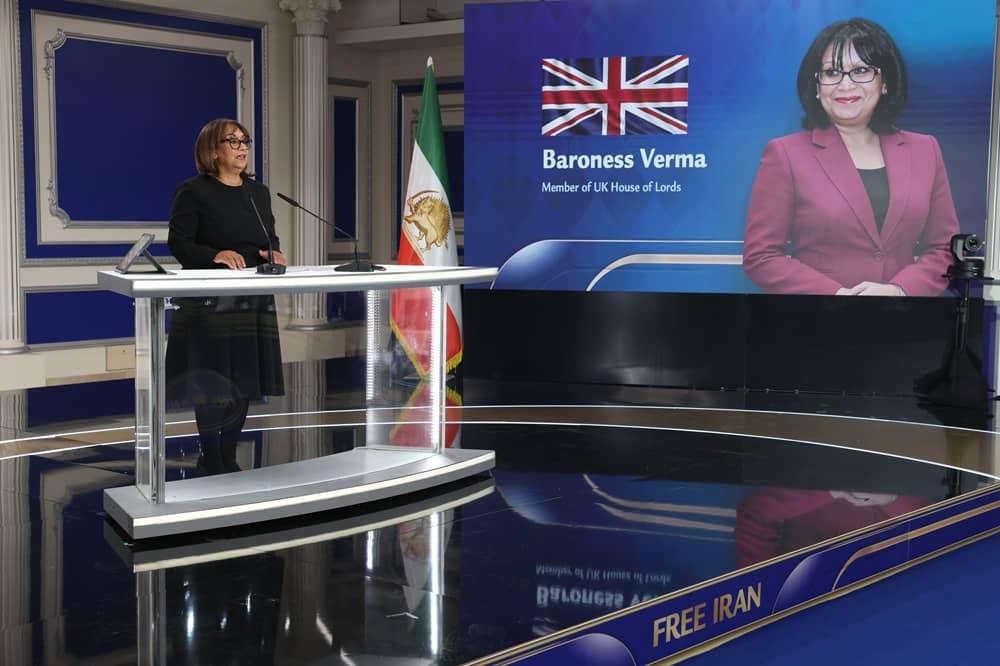
“For more than four decades, the NCRI and the PMOI have built an organized, democratic alternative while championing women’s leadership,” former UK International Development Minister Baroness Verma, a member of the House of Lords said. She described the movement, as democratic Muslims, as an antithesis to religious fundamentalism and said Mrs. Rajavi’s Ten-Point Plan offered a “modern, inclusive, and progressive” framework based on a pluralistic democratic republic, gender equality, abolition of the death penalty and rejection of nuclear weapons.
addresses an international conference on November 21, 2026
Baroness Verma also called for stronger accountability measures against Iranian officials. She urged governments to make greater use of universal jurisdiction and said the recent proscription of the IRGC had to be followed by enforcement against its assets, financial networks and individuals benefiting from wealth accumulated outside Iran.
“If we are going to be serious,” she said, governments needed to “crack down on those people and their properties, their assets, and all they have accumulated outside of Iran.”
Fellow House of Lords member Lord Steve McCabe focused on executions, political prisoners and the need for governments to engage directly with the organized opposition. Referring to death-row political prisoner and Magnitsky Human Rights Award recipient Mohammad Javad Vafaei Sani, Lord McCabe said his case reflected both the authorities’ reliance on executions and the persistence of resistance inside the country.
He also rejected preferential treatment for Reza Pahlavi by Western governments. While saying Pahlavi was entitled to put his case before Iranians, Lord McCabe argued that Iran’s future could not be determined by advocates of hereditary monarchy or preservation of religious tyranny.
“It must be the result of free and fair elections,” he said.
Lord McCabe said his experience of more than 20 years with the PMOI and NCRI had led him to view the movement as a credible democratic alternative.
“This movement offers a credible, democratic alternative to the ruling theocracy and deserves international recognition and political support,” he said, urging the British government and other European states to engage directly with the NCRI.
He stressed that the Resistance was not asking foreign governments to wage war on its behalf. “The Resistance isn’t asking Western governments to fight its battle,” Lord McCabe said. “It’s seeking political support for the Iranian people’s legitimate struggle for freedom, justice, and democracy.”
Former Norwegian Climate and Environment Minister Ola Elvestuen said international attention should focus less on the external dimensions of the Iranian crisis and more on what he described as the regime’s struggle against its own population.
“They fear the enemy within: a society demanding change and a resistance determined to achieve it,” Elvestuen said. He argued that the appropriate response was “not appeasement, but supporting the opposition and those who fight for a free and democratic Iran.”
Elvestuen also linked political repression with Iran’s environmental crisis, citing water shortages, land subsidence, drying lakes and wetlands, air pollution and deforestation as further consequences of systemic mismanagement.
He concluded by rejecting the choice between clerical rule and monarchical restoration.
“The choice is not between the mullahs and another Shah,” Elvestuen said. “The democratic alternative is the organized resistance.” He said Europe should maintain pressure over executions, accountability and human rights while supporting the Iranian people and their Resistance.
Former German ambassador Dr. Hans-Ulrich Seidt, who previously served as Germany’s ambassador to Afghanistan and Korea and as Inspector General of the German Foreign Office, presented a strategic assessment of the internal opposition based on a study he co-authored with Bundestag Judiciary Committee chairman Carsten Müller.
Amb. Seidt said three decades of European diplomacy aimed at managing and moderating Tehran had failed, while military force had also failed to produce democratic change.
“Neither in Iraq nor [in Afghanistan] could democracy be achieved from outside through the use of military force,” he said. “Is there another, a third option? Yes.”
That third option, Amb. Seidt said, was the organized opposition inside Iran.
He argued that spontaneous protest, however significant, was not sufficient to overthrow an entrenched dictatorship. An effective opposition, he said, required organization, structures inside the country, accumulated experience, a coherent political program and leadership.
“What impresses me about the Mojahedin and the National Council of Resistance is that you have this experience, across generations,” Amb. Seidt said.
He pointed to Resistance members who had fought the Shah in the 1970s, subsequent generations who continued the opposition in later decades, and young activists now building on that experience.
Seidt also cited Mrs. Rajavi’s Ten-Point Plan as evidence of a developed political program and argued that the NCRI possessed both organizational continuity and leadership.
He urged European governments to overcome longstanding reluctance to engage with the PMOI and NCRI.
“European foreign policy must be ready to conduct dialogue with the democratic opposition,” Seidt said.
He argued that Tehran’s own efforts to suppress the PMOI should be understood as evidence of its significance: “When the Iranian regime says that the Mojahedin are the most dangerous opposition, it is an indicator of how important and how relevant this opposition is.”
Amb. Seidt concluded that Iranians alone must decide their country’s future, while Europe’s role was to support those who had worked and sacrificed “for generations for a free and democratic Iran.”
Former Norwegian parliamentarian Lars Rise similarly argued that opposition to the existing regime was not enough by itself. The decisive question, he said, was which political force possessed “the principles, the organization, and the capacity to replace it.”
Rise criticized efforts to promote Pahlavi internationally and said Iran required “a democratic alternative rooted in the people’s struggle, not a manufactured substitute promoted from abroad.”
He said that alternative had to combine rule of law, political freedom, social cohesion and democratic organization, adding that he saw those principles reflected in Rajavi’s Ten-Point Plan.
Rise, who said he had worked alongside the Iranian Resistance for nearly 30 years, emphasized the movement’s endurance as another measure of its credibility. He concluded that his support would continue for as long as necessary, saying that if required, he was “ready to fight for another 30 years.”
Former European Parliament Vice President Alejo Vidal-Quadras, now president of the International Committee in Search of Justice, said Europe had persisted for decades with a fundamentally flawed approach toward Tehran even as the regime became increasingly vulnerable.
“There is a profound paradox in Europe’s policy towards Iran,” Dr. Vidal-Quadras said. “While the Iranian regime is isolated, weakened, vulnerable, and despised by its people, European diplomacy continues to treat it as an indispensable partner.”
He argued that decades of engagement, concessions and accommodation had been interpreted in Tehran as weakness and had produced “warmongering, hostage-taking, and terrorism.”
Dr. Vidal-Quadras also referred to the November 2023 assassination attempt against him in Madrid, which he said was linked to his support for the PMOI, NCRI and Maryam Rajavi. He said the case demonstrated that Tehran’s repression extended beyond Iran’s borders.
“Supporting the NCRI and PMOI is not just a political position. It means taking a serious risk,” he said.
Turning to Iran’s domestic situation, Dr. Vidal-Quadras cited the growing number of executions and said European policymakers remained trapped by the assumption that the regime was permanent despite repeated uprisings.
“The Iranian people demand fundamental change, rejecting both the past dictatorship of the Shah and the current criminal rule of the mullahs,” he said.
He sharply rejected efforts to promote Reza Pahlavi, arguing that Western attempts to give him legitimacy damaged Iran’s democratic movement. “The Iranian people must never be forced to choose between two dictatorships,” Dr. Vidal-Quadras said, adding that genuine transition required pluralism, free elections, gender equality, separation of religion and state and abolition of the death penalty.
He called on Europe to end what he described as the illusion that concessions could moderate Tehran, make an end to executions and the release of political prisoners central conditions for relations, act against the IRGC and its transnational networks, and recognize the Iranian people’s right to resist dictatorship.
“The future of Iran belongs to them alone, to the people alone,” Dr. Vidal-Quadras said. “And it is our duty to support them and their organized resistance in their struggle for freedom, justice, and democracy.”
Former European Parliament member Dorine Rookmaker said the regime’s intensifying repression should be understood as evidence of its fear of domestic opposition.
Addressing political prisoners, Resistance Units and members of the movement at Ashraf 3, Rookmaker said: “The more we see the regime being oppressive and aggressive, the more we know they fear you. They fear you. It’s a point of weakness, a sign of weakness.”
She also highlighted what she described as the leading role of women in both nationwide uprisings and the organized Resistance.
Rookmaker contrasted that model with Pahlavi, saying he offered no credible political vision and relied on foreign powers rather than Iran’s own population.
“Beyond being the son of the deposed Shah, he offers no credible vision for Iran’s future,” she said. “His campaigning divides rather than unites.”
She cited the cases of political prisoners Zahra Tabari and Arghavan Fallahi, and quoted Fallahi as saying: “We, our generation, Generation Z, oppose dictatorship and dependency. We stand against both the Shah and the mullahs.”
Rookmaker described Mrs. Rajavi’s Ten-Point Plan as a clear democratic alternative based on freedom, human rights, gender equality and free elections, and urged governments to “engage seriously with the NCRI as a democratic alternative.”
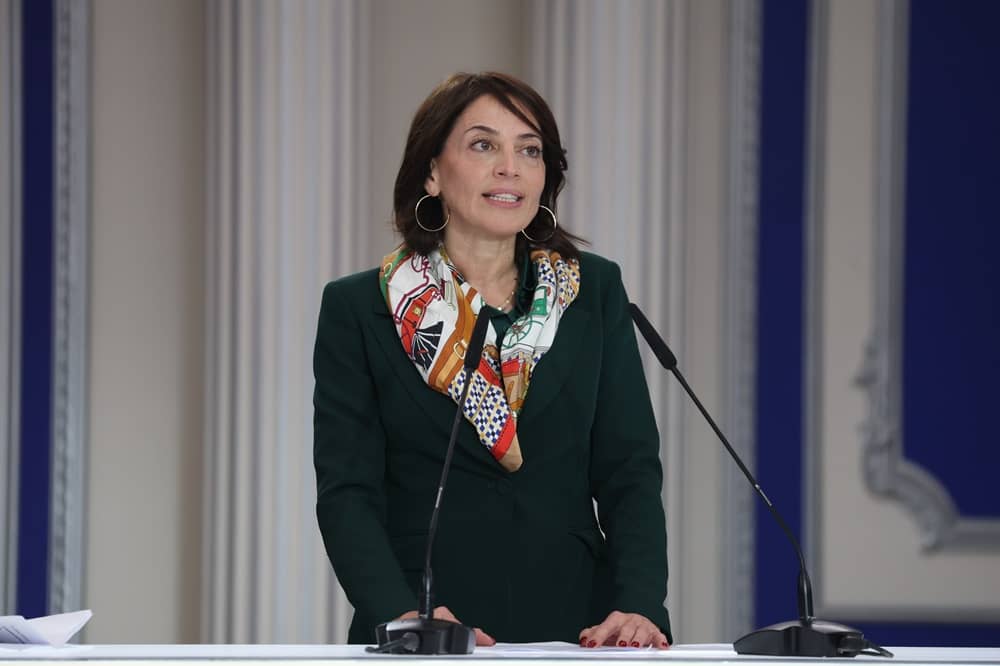
A member of the Parliament of Estonia Juku-Kalle Raid said Estonia’s own history under Soviet occupation had taught its people the danger of Western calls for caution toward authoritarian systems.
Recalling how some in Western Europe once cautioned against “rocking the Soviet boat,” he said the same logic should not now be applied to Tehran.
“We wanted freedom,” he said. “It was like someone from the free world saying now: ‘Don’t rock the mullahs’ boat.’ Is that okay? No. It isn’t okay.”
Raid said information about Iran’s repression had to be carried back to “every parliament” and “every country,” and noted that a significant portion of Estonian MPs had publicly supported a free Iran.
He also mocked the idea of hereditary restoration and said Iranians should instead have free speech, free media, free elections and the right both to vote and to stand for office.
“Every Iranian citizen should have an opportunity for free speech, free media, free elections,” he said.
Fellow Estonian parliamentarian Ando Kiviberg, chair of the parliament’s Constitutional Committee, said the central issue in struggles against dictatorship was political will.
“There’s no such thing as an eternal, forever-lasting dictatorship regime in human history,” Kiviberg said. “For any regime, for any dictatorship, there is an end.”
He argued that Europe also needed the determination to support those fighting for freedom, warning against the temptation in prosperous democracies to avoid involvement in struggles elsewhere.
Kiviberg called for accountability for those responsible for executions and repression.
“Behind every execution, behind every crime committed in the name of the regime, are individuals,” he said, urging governments to make clear that those responsible would ultimately be brought to justice.
He concluded by pledging Estonian support for Iranians seeking freedom and said his country would continue pressing European politicians to provide whatever support was possible.
Argentine lawmaker Damián Arabia said his country’s experience with terrorism attributed to Tehran gave Argentina a particular stake in confronting the Iranian regime.
He cited the 1992 bombing of the Israeli Embassy in Buenos Aires and the 1994 AMIA Jewish community center bombing, as well as the death of prosecutor Alberto Nisman shortly before he was due to testify before Congress about the AMIA investigation.
Arabia said Argentina would not be intimidated and noted that his government had designated the IRGC as a terrorist organization.
He also said a parliamentary majority in Argentina had supported the Iranian Resistance’s Ten-Point Plan and argued that the Iranian people had the right to determine their future free of both religious dictatorship and monarchy.
“We believe the Iranian people have the right to decide their own future,” Arabia said, describing that future as one “without religious dictatorship, without political executions, without any repression, and without any Shah.”
He called instead for a democratic, secular and pluralistic republic based on equal rights for women and men.
Geneva parliamentarian Patrick Lussi said Iran faced both a deep human-rights crisis and a crisis of political legitimacy, but argued that continued repression had been met by “an exceptional resistance.”
He criticized what he described as fruitless engagement with Tehran and said “the time for dialogue without conditions and without concrete results” should end.
“At the same time, we must support the other face of Iranian reality,” Lussi said, referring to “an organized resistance that fights for freedom, democracy, justice and human dignity.”
Lussi called on Switzerland to designate the IRGC as a terrorist organization, adopt a parliamentary resolution condemning executions, and deny entry to senior Iranian officials implicated in repression and human-rights violations.
He also endorsed Mrs. Rajavi’s Ten-Point Plan, citing its commitments to a democratic republic, separation of religion and state, gender equality, abolition of the death penalty, human rights and peaceful coexistence.