

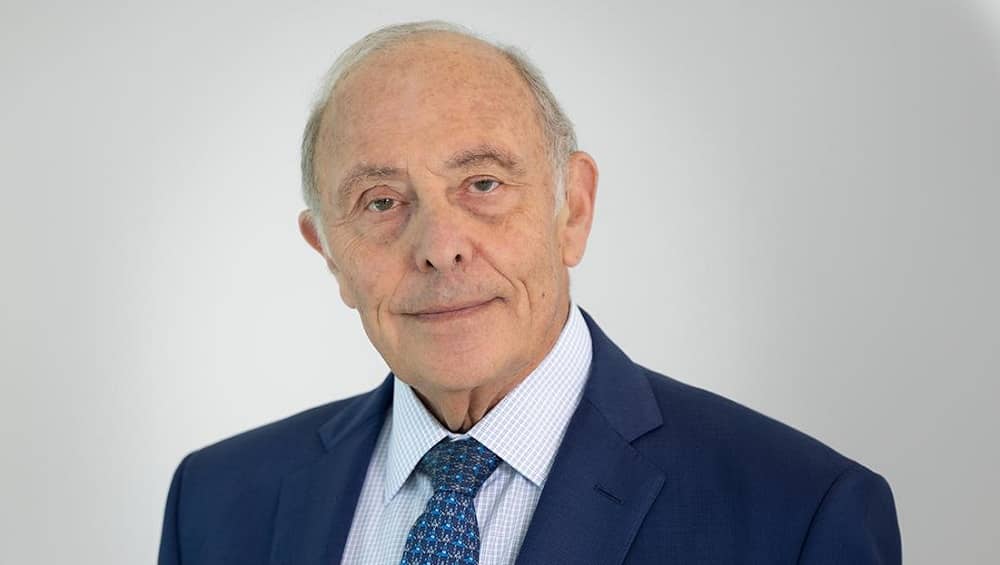
In his remarks delivered remotely at the conference with the Iranian Resistance, Professor Claudio Grossman, Special Adviser to the ICC Prosecutor and Member of the UN International Law Commission (ILC), emphasized the urgent need for accountability for the 1988 massacre in Iran, during which over 30,000 political prisoners were killed by the clerical regime. In this international conference, Prof. Grossman highlighted the importance of the newly released report by Dr. Javaid Rehman, which documents the extent of the atrocities and the ongoing lack of justice for the victims.
Prof. Grossman, who has extensive experience in human rights law as a former chair of the Committee Against Torture and former president of the American Commission on Human Rights, praised Dr. Rehman’s report for its thoroughness, legal rigor, and its emotional depth, underscoring its significance in documenting one of the worst massacres committed by a government in the 20th century.
He called for a comprehensive response from the international community, including full reparations for victims, accountability for perpetrators, and measures to ensure such atrocities are not repeated.
Prof. Grossman also reflected on recent events, such as the brutal suppression of the 2022 uprising, as further evidence of the regime’s ongoing human rights abuses. He concluded by calling for global solidarity with the victims and survivors of the 1988 massacre and urged the international community to work together to ensure justice and prevent future atrocities.
The full text of Prof. Claudio Grossman’s speech follows:
My apologies for not being able to participate in person in this important conference. It’s important indeed because of many reasons and each of them are so powerful that each of them would be enough to consider this a very relevant and meaningful gathering. The first one is that we’re receiving the report of Dr. Javaid Rehman released on July 17th.
As a former chair of the Committee Against Torture myself and former president of the American Commission on Human Rights, I had the opportunity to see and participate in numerous reports, but this one stands out because of the seriousness, soulfulness, the legal grounds invoked, the veracity of its assertions and really from the point of view of the contribution in general to what it means to supervision in attempt to achieve accountability and the description of the situation that is taking place in Iran that took place in 1988 stands out as one, as I said before, of the top documents that have been really composed and created by a reporter in the international community. My sincere congratulations to Dr. Rehman for this very important report. Now, this is however not the most relevant issue of this report.
Dr. Rehman has been a vehicle to tell this horror story of what happened in Iran and the content of this report is also what it stands out. It is difficult to think about a massacre of more than 30,000 people. Again, Iran has with this one of the world records in terms of the extensity and atrocity committed in 1988.
One person’s violation of human rights is enough to ask for accountability, for reparations, to express solidarity of the victims. And when we witness the extent of the massacres and the killings that took place, it’s simply something that defies our imagination.

But it’s not only a question of defiance, it’s a call for action, for a need to struggle to achieve, among other things, accountability for this awful massacre that I said before stands out as one of the worst massacres committed by a government in the 20th century.
I mentioned a third reason why this is a very important report, because it’s a call for action. It’s a call for action because of the atrocities committed and because of the need for accountability and the need to offer reparations, full reparations to the victim, including monetary damages, the moral suffering, the obligation of non-repetition, measures of satisfaction and accountability.
That’s what constitutes a holistic reparation. And while that would be enough to justify the need for action, there is also another reason why a need for action is essential. Namely, the fact that when this type of atrocities do not result in action, in accountability, in telling the truth and reparation, they are simply announcing that more atrocities will follow.
And this is what happened in Iran. The international community has witnessed the fact that hundreds of people opposing the current situation in Iran have been exterminated abroad, for example. And we have seen again a lack of accountability.
And again, we have witnesses, among others, extensive repression, as it happened in 2022, where we witnessed in horror how peaceful demonstrations were brutally repressed.
As I close my remarks, I want to extend my solidarity to the victims, to the survivors of the massacres of 1988 and reiterate the need for all of us to work together in order to achieve effective action so that we can live in a world and have the contribution in Iran as a free society.
Thank you very much.