

Three-minute read
Fresh demonstrations over wages, pensions and employment spread across Iran on September 7, 2026, adding another layer of pressure as the government prepares to impose a new fuel price. The latest reports show telecom and Social Security retirees protesting in Kermanshah, Isfahan, Sanandaj, Tehran, Ahvaz, Shush, Ilam and Hamadan, while separate demonstrations involved workers and healthcare staff. Protesters in Kermanshah chanted “unemployment and inflation are the scourge of the people,” “unity against poverty and corruption,” and “peace, welfare, freedom.” In Tehran, retirees declared: “We have no livelihood; we are sick of war.”
Domestic reporting confirms that the unrest is not confined to pensioners. ILNA reported on September 7 that workers from the Poya Nakh textile factory had again protested outside the Ilam governorate over their uncertain employment status. Around 180 workers have been without work for more than a year, according to the report, and one worker said repeated approaches to provincial authorities had produced no definitive answer.
In Kurdistan, more than 300 nurses and healthcare workers gathered outside the provincial governorate over low pay, delayed overtime payments, staff shortages and disputed nursing tariffs. A local news agency reported that protesters chanted “Promises are enough; our table is empty” and demanded the resignation of incompetent officials. Together with renewed retiree demonstrations, the protests show livelihood grievances appearing simultaneously across several occupational groups rather than remaining concentrated in a single sector.
Soaring Costs and Renewed Protests Expose Iran's Regime Fear of Another #IranProtests
by @shahriarkia https://t.co/M4YSnNRODX— NCRI-FAC (@iran_policy) September 6, 2026
Fuel Price Doubles with Little Notice
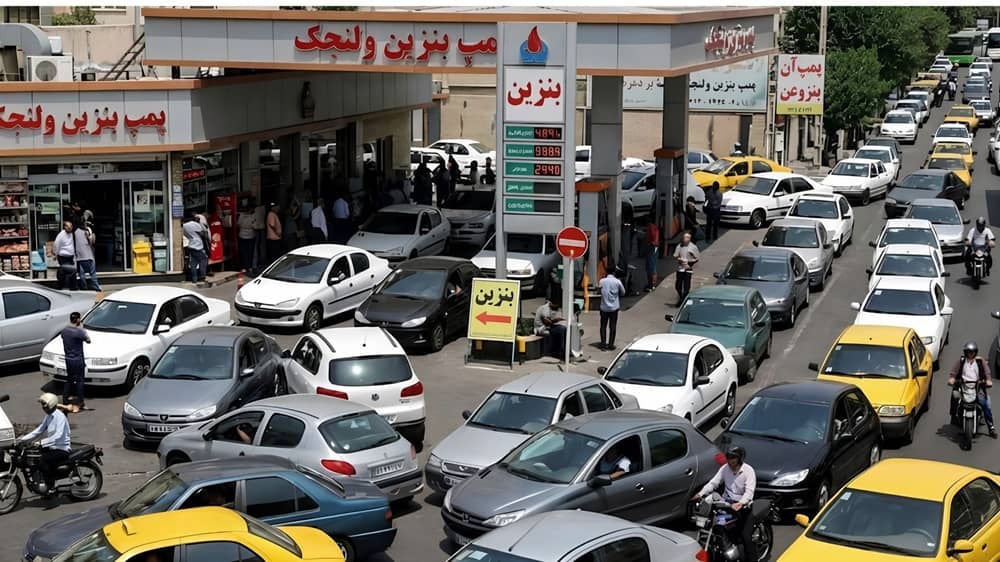
Against that backdrop, government spokeswoman Fatemeh Mohajerani announced late on September 6 that the gasoline price charged through station cards—the so-called third tier—will double from 5,000 to 10,000 tomans per liter from September 8. Seeking to avoid a nationwide backlash like the November 2019 uprising, the regime has opted for a phased price increase, leaving the subsidized monthly allocations of 60 liters at 1,500 tomans and 50 liters at 3,000 tomans unchanged. State television carried the announcement, including the government’s claim that additional revenue will be directed toward household livelihoods.
The government insists the measure represents a “gradual” adjustment because most motorists supposedly remain within the two cheaper quotas. On September 7, Mohammad-Sadegh Azimifar, head of the National Iranian Oil Refining and Distribution Company, said 80 to 85 percent of consumers would not be affected. But the third-tier price itself rises 100 percent in a single step, announced little more than a day before implementation. Shana reported that average gasoline consumption during the first five months of the year was about 132 million liters a day against production of roughly 122 million, leaving a 10-million-liter daily gap.
Officials are therefore trying to present the increase simultaneously as economically necessary and socially limited. IRIB quoted Azimifar saying the phased approach was intended to give consumers time to move toward alternative fuels, while the government emphasizes that the cheaper quotas remain intact. Yet for drivers whose livelihoods depend heavily on vehicles—or who already face shortages, long distances or greater-than-average consumption—the higher marginal price can translate directly into operating costs.
"The latest phase of Iran’s crisis is therefore distinguished not only by #economic deterioration but by the erosion of political discipline at the top," writes @MansoreGolestan https://t.co/GlE7r4Uwut
— NCRI-FAC (@iran_policy) September 4, 2026
Officials Acknowledge the Political Risk
The timing is politically significant because senior officials are increasingly linking economic management to regime stability. Parliament speaker Mohammad-Bagher Ghalibaf said on September 6 that the country’s “main battle” alongside the military confrontation is now over production and people’s livelihoods, citing inflation, unemployment and market instability. More revealingly, he warned that people may tolerate hardship but will not tolerate “mismanagement and underperformance,” while stressing the need to preserve the regime’s “internal cohesion.”
Yet that cohesion is visibly fraying. Following former regime president Hassan Rouhani’s calls for a referendum on war or peace, the confrontation spilled beyond official media into loyalist street and social-media agitation. Footage circulated by regime supporters shows demonstrators targeting Rouhani personally, reviving the “Friday morning” taunt associated with the November 2019 gasoline uprising and telling him, in effect, that his political “expiration date” has arrived. Online, the rhetoric has gone further: loyalist accounts have circulated courtroom and prison imagery and openly demanded that Rouhani be put on trial, with calls to prosecute him—often alongside Javad Zarif—spreading under hardline hashtags. There is no indication of an actual indictment, but the campaign shows how the regime’s factional warfare is increasingly moving from elite exchanges into the street and its loyalist cyber base.
The clerical regime is therefore raising fuel prices while livelihood protests are spreading and its own factions are openly accusing one another of endangering national cohesion. The pressure point is broader than gasoline: economic hardship, fear of renewed unrest and the unresolved dispute over war versus negotiation are increasingly feeding the same internal struggle that Mojtaba Khamenei has repeatedly tried to suppress.