

Three-minute read
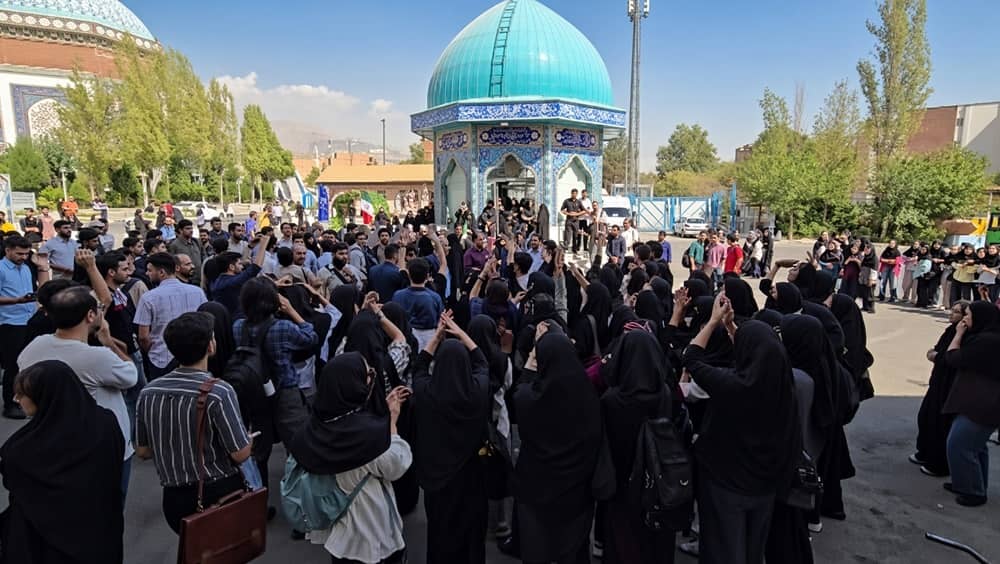
Iran’s new academic year is opening with protests that are rapidly crossing the boundary between campus grievances and broader political discontent. On September 28, 2026, students at Tehran’s Allameh Tabataba’i University protested higher tuition, poor dormitory and food conditions, unemployment and compulsory hijab. Chants included “Inflation and high prices are the scourge of the people,” “Forced labor, unemployment, compulsory hijab for women,” and “No barracks, no business enterprise—long live the university.” Students also demanded the release of imprisoned students and warned: “Don’t think it’s just one day; our date is every day.”
The timing is significant. Just one day earlier, the Ministry of Science ordered universities to publicize and enforce a new “grooming, ethics and university conduct” directive, including clothing compatible with what it calls “Iranian-Islamic culture,” with particular emphasis on informing incoming students. Science Minister Hossein Simaei Sarraf said the guidelines “must definitely be implemented.”
Allameh is not isolated. Students at Lorestan University boycotted university food over its price and quality, while reports from Alzahra University said around 150 students had been barred from campus, many allegedly without written disciplinary rulings. Some reportedly discovered the restriction only when they attempted to enter.
The Iranian regime’s own media are connecting the dots:
• Inflation: 83.8%
• January unrest began with an “#economic spark”
• Security chiefs warn every “spark” could become a “flame”
• Universities, hijab and even pessimism are increasingly treated as security issues.…— NCRI-FAC (@iran_policy) September 26, 2026
The Rial’s Fall Reaches the Campus and the Street
The students’ economic slogans coincided with another sharp fall in the rial. The free-market dollar climbed through 240,000 tomans during Monday’s trading and was reported at roughly 244,000 tomans later in the day, about 11,000 tomans higher than less than a week earlier. Iran’s Gold and Currency Information Network recorded a gain of more than 17 percent over the past month.
The gap with the state-controlled exchange system is widening as well. The official remittance dollar was raised Monday to about 172,851 tomans, leaving a gulf of roughly 40 percent between official and free-market rates. With the Central Bank already reporting point-to-point inflation above 83 percent, the exchange-rate slide is adding another layer of pressure to imported goods, production inputs and household expectations.
Housing illustrates what those numbers mean in daily life. A labor activist told the IRGC-run Tasnim that roughly 70 percent of a worker’s monthly income can now disappear into rent before other expenses are paid. He said workers were moving to city outskirts, selling assets, taking additional jobs and, in some cases, returning to their parents’ homes. A missed salary payment, he warned, could now push a family toward homelessness.
"Even by the Iranian regime’s own measurements, the #economy is contracting at an extraordinary pace," writes Farid Mahoutchi.https://t.co/vvd8XGsOG9
— NCRI-FAC (@iran_policy) September 22, 2026
Retirees Name the Institutions They Blame
Telecommunications retirees also returned to the streets Monday in Isfahan, Kermanshah, Sanandaj and Shafarud, continuing protests over pensions, insurance and unpaid entitlements. In Isfahan they chanted, “We built Telecommunications; the IRGC took it and we lost,” alongside “We have seen no justice, only heard lies.” Other slogans attacked state broadcasting and government officials.
The language is important. These demonstrations are no longer confined to demands for recalculating pensions. Protesters are increasingly naming institutions they regard as responsible for their economic losses. Telecommunications retirees have staged repeated demonstrations over ownership, benefits and insurance throughout September, including protests previously documented in numerous cities.
Economic pressure is also visible outside the major cities. Fresh demolitions were reported in Hesar Shalpush in Malard, where residents said long-standing homes and businesses were razed without a clear mechanism for alternative housing or compensation. Earlier enforcement operations in the same county had demolished 115 structures in July and another 196 in August. Families can also face fines after losing the structures themselves.
"Iran’s accumulating #economic pressures moved visibly into the streets on September 20, 2026, as retirees demonstrated in several cities while the rial again weakened sharply," writes @shahriarkia.https://t.co/scTS9SL15B
— NCRI-FAC (@iran_policy) September 20, 2026
Producers Squeezed from the Other End
Farmers face a parallel squeeze. Bean growers reported that harvesting alone can now cost around 45 million tomans per hectare, before planting, irrigation, fertilizer, pesticides and other inputs. Water shortages, heat and rising fuel costs have pushed production expenses still higher. Meanwhile, reports cited a price spread exceeding 113 percent within the bean market, with some produce bought from farmers at around 100,000 tomans per kilogram and ultimately reaching consumers at multiples of that price.
The risk extends beyond this year’s harvest. Agricultural representatives warn that growers who lose money may switch crops next season, reducing future supply and placing further upward pressure on food prices. In other words, producers and consumers are being squeezed simultaneously: farmers face costs that threaten production while households confront prices increasingly detached from wages.
What makes September 28 notable is not any one protest or economic statistic, but the disappearance of the old boundaries between them. At Allameh, tuition, food, unemployment, compulsory hijab and political imprisonment appeared in the same protest. Among retirees, pension grievances turned into slogans against the IRGC and state broadcasting. In housing, the inability to afford shelter is colliding directly with state enforcement.
That convergence is politically more consequential than another record for the dollar. When economic hardship, personal freedoms and institutional grievances begin appearing in the same slogans, what starts as a dispute over prices or services can become a broader argument over the system administering them.