
Three-minute read
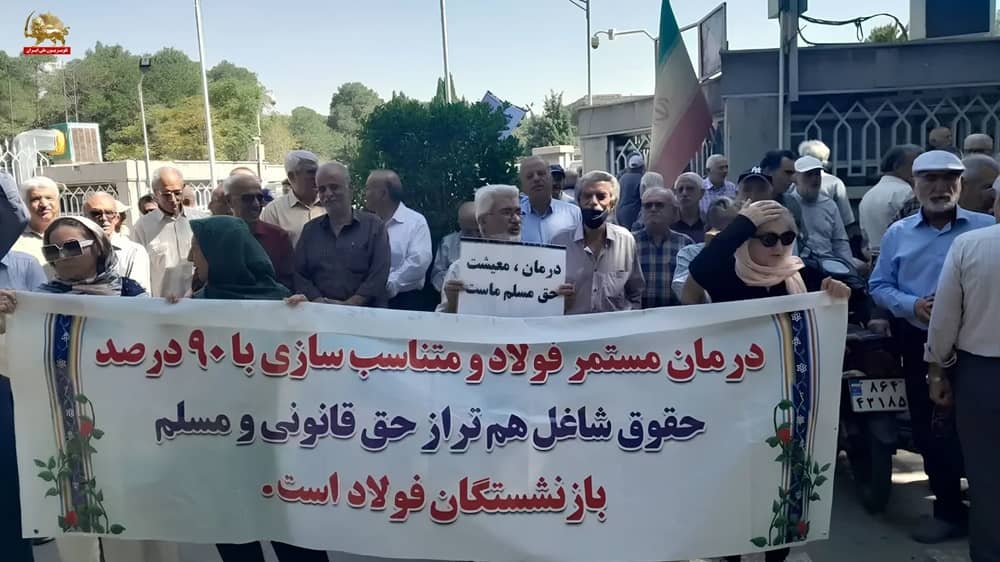
Retirees protested across Isfahan, Shush, Kermanshah, Tehran, Rasht and Ahvaz on October 18, alongside other labor and consumer protests, as economic grievances continued to spill into explicitly political slogans. In Isfahan, steel and mining retirees chanted “The enemy is right here; they lie and say it’s America” and “Only in the street will we get our rights.” In Shush, Social Security retirees demanded “welfare with dignity,” while other gatherings targeted corruption, inflation and collapsing purchasing power. The protests are cutting across pension, labor and livelihood issues while increasingly rejecting the regime’s effort to attribute domestic hardship primarily to foreign pressure.
That sensitivity is visible at the top. The Assembly of Experts issued a statement acknowledging that inflation, purchasing-power losses, housing, employment and production problems are eroding public trust, while also warning that national problems must not become victims of “factional disputes” and “erosive rivalries.” More revealingly, it called for the regime’s nightly street mobilizations to continue “until threats are removed” and “full security is established,” describing them as a source of support for the armed forces and officials. The language shows that these gatherings are being treated as part of the regime’s domestic security architecture.
That effort at staged unity is itself being undermined by factional attacks. Pro-regime gatherings have featured slogans branding Mohammad-Javad Zarif a “traitor” and accusing him of serving America, even as senior institutions as well as the regime’s supreme leader demand cohesion.
Iran’s regime is acting like one afraid of the next eruption: 11 people arrested months after #IranProtests and branded part of a foreign “coup,” 44 million screened for extra food aid, and hardliners accusing rival insiders of serving Washington. The fear is that these pressures…
— NCRI-FAC (@iran_policy) October 17, 2026
Economic stress is hollowing out basic services
The deterioration is also visible in Tehran’s school system. Governor Mohammad-Sadegh Motamedian said the capital has 7,000 fewer students this academic year while the surrounding counties gained 17,000, attributing part of the shift to economic pressure pushing families out of Tehran. He said the province still needs about 9,000 classrooms and 638 schools, while 80 schools promised by Tehran municipality have not been delivered. This is not just an education statistic; it is evidence of households being displaced by living costs while public infrastructure fails to keep pace with the migration.
The nursing crisis is deeper than the 700-person shortage reported in Bushehr. The head of Bushehr University of Medical Sciences told IRNA that the province cannot attract enough nurses because pay is too low compared with nearby oil and petrochemical jobs. Nationally, Nursing House secretary-general Mohammad Sharifi-Moghaddam has said roughly 70,000 nurses are outside the profession, with average monthly pay around 25–28 million tomans and resignation rates continuing to rise. The significance is institutional: a health system already struggling with shortages is losing trained staff because the profession no longer provides a sustainable livelihood.
Food consumption tells a similar story. The Health Ministry says Iranians consume only about one serving of dairy per day, well below recommended levels. Price pressures are a major constraint: official data shows dairy prices up 147% year-on-year, while food inflation reached 134% nationally and 140% in rural areas. The production base has also contracted sharply. Dairy industry spokesman Mohammadreza Bani-Tabaa says nearly 80% of dairy companies have closed over the past two decades, reducing the number from around 1,000 to roughly 200. Consumption is falling at the same time productive capacity has been hollowed out.
Pezeshkian lists Iran’s fault lines—power, water, gas, fuel, banking, budget, pensions—as a cleric is stabbed to death in Sari. Central Bank’s goal: just slow the #inflation rate. By @MansoreGolestan https://t.co/eBARBew5k6
— NCRI-FAC (@iran_policy) October 15, 2026
Oil revenues face a further squeeze
Iran’s oil position is becoming more precarious. The latest tanker-tracking data reported by Reuters indicate that crude exports have effectively fallen to zero under the US naval blockade, while only limited LPG and jet-fuel cargoes have managed to get through. At least eight LPG tankers and one jet-fuel tanker reportedly breached the blockade, but the volumes are far too small to replace crude revenues.
The regime has already acknowledged the underlying problem. Central Bank governor Abdolnaser Hemmati said earlier that oil income had fallen to zero and that crude exports had “practically stopped,” even as Tasnim continued to highlight earlier budget oil receipts. Separate data show crude production falling below 2 million barrels per day, compared with roughly 3.26 million a year earlier. The political significance is straightforward: oil revenues fund salaries, pensions, subsidies, imports and the security state. A prolonged cutoff narrows the regime’s room to buy social peace precisely when protests and welfare demands are rising.
Tehran’s response to the rial’s slide past 270,000 tomans isn’t restoring confidence—it’s rationing it. A $2B dollar sale that fades in days. A $10k purchase scheme that requires 2.5 billion tomans most people don’t have. A crackdown on #Tether and gold. All while chasing $21B in…
— NCRI-FAC (@iran_policy) October 17, 2026
New defense minister, old crisis logic
Parliament meanwhile approved Mehrdad Akhlaghi as defense minister by 237 votes to 15, replacing Aziz Nasirzadeh, who was killed during the war. Akhlaghi immediately issued threats toward US forces, while Mohsen Rezaei claimed Iran had prepared a military plan more destructive than previous rounds of fighting.
The broader picture is of a regime reeling under mounting socio-economic pressure and deepening internal conflict, yet responding by keeping both warmongering and repression at full intensity. Rather than easing tensions or addressing the structural causes of discontent, the leadership continues to threaten external escalation while tightening control at home. The logic appears defensive: in a system already worried about unrest, factional fracture and declining authority, any visible retreat risks being read as weakness.