

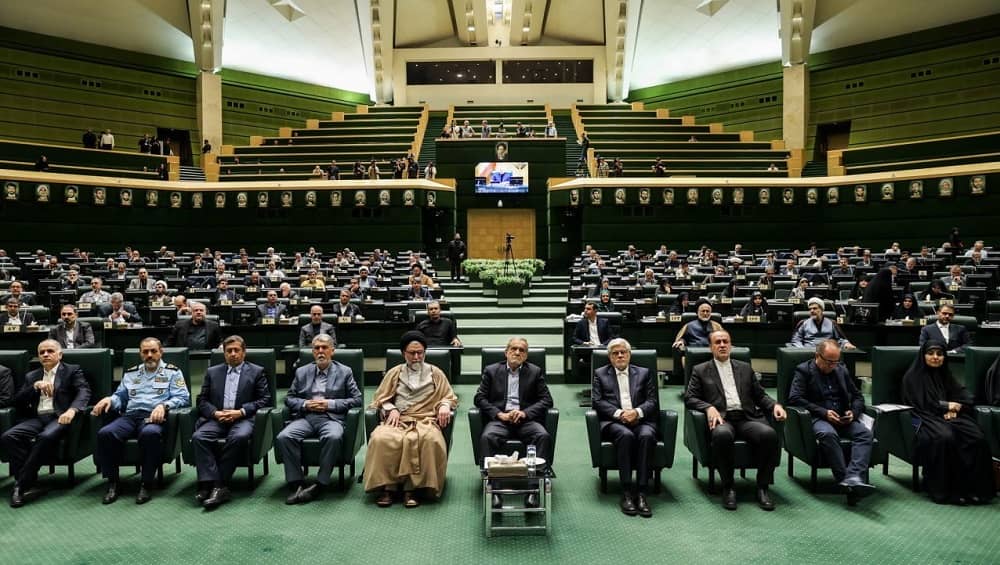
On Sunday, August 18, the parliament of the clerical dictatorship in Iran continued its sessions for the second consecutive day to vet the cabinet nominees of the new president, Masoud Pezeshkian. The morning session focused on key ministries such as Intelligence, Economy, and Foreign Affairs. As the proceedings unfold, it becomes increasingly clear that this tightly controlled process is less about evaluating the competence of the nominees and more about ensuring the government’s absolute loyalty to Supreme Leader Ali Khamenei.
Additionally, the scene has devolved into a battleground for factional infighting, where rival gangs within the regime seize the opportunity to undermine each other, jockeying for power and influence under the watchful eye of Khamenei.
Unrivaled Incumbent
Esmail Khatib, the nominee for Minister of Intelligence, defended his track record with characteristic arrogance, thanking Parliament and security officials for their “support”— a clear signal of his confidence in the Supreme Leader’s backing. He boasted about his role in suppressing dissent, claiming that under his watch, “arrests and detentions have decreased, and actions have been more compassionate.” Yet, this so-called compassion has been nothing more than a calculated attempt to mask the regime’s ongoing brutality.
Khatib conveniently overlooked the glaring failures of the intelligence apparatus under his leadership in recent years. Instead, he attempted to shift focus by claiming that Tehran’s intelligence services are in close collaboration with 53 countries, emphasizing the regime’s supposed strength in international intelligence cooperation. He praised “the increased interaction with foreign intelligence services” and the strengthening of “Iran’s hidden and security diplomacy,” pledging to further enhance these efforts in the future.
Reasons Behind #Khamenei’s Forced Approval of Masoud Pezeshkian in #Iran’s Sham Electionhttps://t.co/OC0zjoxuLn
— NCRI-FAC (@iran_policy) July 11, 2024
The controversy surrounding Khatib’s tenure as Intelligence Minister reached a peak when, just days before the killing of Hamas leader Ismail Haniyeh in a highly secured region in Tehran, Khatib had publicly claimed that his ministry had dismantled a “Mossad infiltration network.”
Despite these concerns, Khatib’s position seems secure. In 2021, during the parliamentary vote of confidence in Ebrahim Raisi’s government, Mojtaba Zolnouri, a member of the National Security Committee at the time, defended Khatib by highlighting his past, noting that both Mohammad Khatami and Mahmoud Ahmadinejad had removed him from their administrations. This, Zolnouri argued, was a testament to Khatib’s unwavering loyalty to the core values of the state, making him the ideal candidate to continue enforcing the Supreme Leader’s vision.
However, the majority of MPs refrained from challenging Khatib’s claims, a silence that underscores the Parliament’s deference to Supreme Leader Ali Khamenei. As MP Mohsen Zanganeh pointed out, ministers who are selected for “security-related positions” often have the explicit approval of Khamenei himself. This reality was further highlighted by MP Mojtaba Zarei, who voiced rare concern over Khatib’s loyalty to Pezeshkian. “Khatib thinks he did Pezeshkian a favor by joining the cabinet, but tomorrow he won’t listen to Pezeshkian’s orders,” Zarei warned, hinting at the deep divisions within the regime’s leadership.
#Iranian Regime’s Parliament Clashes with Pezeshkian over Cabinet Pickshttps://t.co/WZEy7Tfm50
— NCRI-FAC (@iran_policy) August 17, 2024
A Diplomat of Non-Diplomacy
Abbas Araghchi, nominated for Minister of Foreign Affairs, defended his approach to foreign policy by pledging to strengthen ties with China and Russia—countries that have supported Tehran during sanctions. He also vowed to avoid “drawn-out negotiations” and continue the regime’s support for militant groups in the region.
“We will not fall into the trap of endless negotiations,” he declared, adding that while he would work to “neutralize sanctions,” he would only engage in efforts to lift them “with honorable means.”
Critics in Parliament, however, were quick to condemn his role in the nuclear negotiations, with Mohammad Reza Ahmadi denouncing the deal as “a blow to Iran’s national dignity.”
Amir-Hossein Sabeti Monfared, another opponent, warned that a dangerous game was being played to secure Araghchi’s appointment, noting, “We were told to approve all the ministers. If this is the case, why bother having Parliament?”
In contrast, some MPs, like Ahad Azadikhah, praised Araghchi’s strategic vision, particularly his focus on supporting the “Resistance Axis” in the Middle East.
Internal Rifts Deepen in Iran as #Pezeshkian’s Cabinet Faces Backlash from All Sideshttps://t.co/E8yVtdIS9U
— NCRI-FAC (@iran_policy) August 16, 2024
Defending a Record of Economic Failure
Abdolnaser Hemmati, nominated for Minister of Economy, tried to downplay his disastrous tenure as head of the Central Bank under former president Hassan Rouhani. Hemmati addressed Parliament, acknowledging the perilous economic situation, saying, “I take on this responsibility at a time when there are few options and many dangerous paths.” As a fierce critic of the Raisi administration in the last three years, he continued to criticize the regime’s failed economic policies, particularly its dependence on oil exports but failed to offer any concrete solutions.
However, his critics in Parliament were quick to remind everyone of his own failures. Hossein Samsami, a member of Parliament’s Economic Commission, lambasted Hemmati for his role in the economic collapse, pointing out that under his leadership, the exchange rate tripled from 9,000 to 25,000 tomans. “Hemmati’s incompetence inflicted unbearable hardship on the Iranian people,” Samsami charged, highlighting the skyrocketing inflation and devaluation of the national currency.
Mohsen Zanganeh, another MP, also stated: “Mr. Hemmati took over the Central Bank with a 20% liquidity growth rate and handed it over with a 40% liquidity rate.”
Another critic, Fatemeh Mohammadbeigi, accused Hemmati of failing to address corruption within the financial sector, stating, “During his tenure, those responsible for astronomical salaries remained in their positions.”
Hypocrisy to favor Khamenei
As Iran’s Parliament continues to vet these and other nominees, the overarching theme of loyalty to Supreme Leader Ali Khamenei looms large. Each nominee has faced scrutiny not only for their past performance but also for their ability to align with Khamenei’s dangerous agenda for the country.
In an apparent effort to win the favor of the extremist Parliament, some of Pezeshkian’s proposed ministers have publicly distanced themselves from their so-called “reformist” past. Hence, some state-run media have been quick to pounce on this, exposing the hypocrisy of these nominees.
The newspaper Jomhouri Eslami published a scathing piece titled “Ministry and Honor,” which criticized one such nominee for his sudden about-face. “One of the proposed ministers admitted regret for his actions during his time in Parliament. If this expression of regret was merely to secure a vote of confidence, it would be an act of hypocrisy, inconsistent with the honor required of someone who is to lead a ministry,” the article stated.