

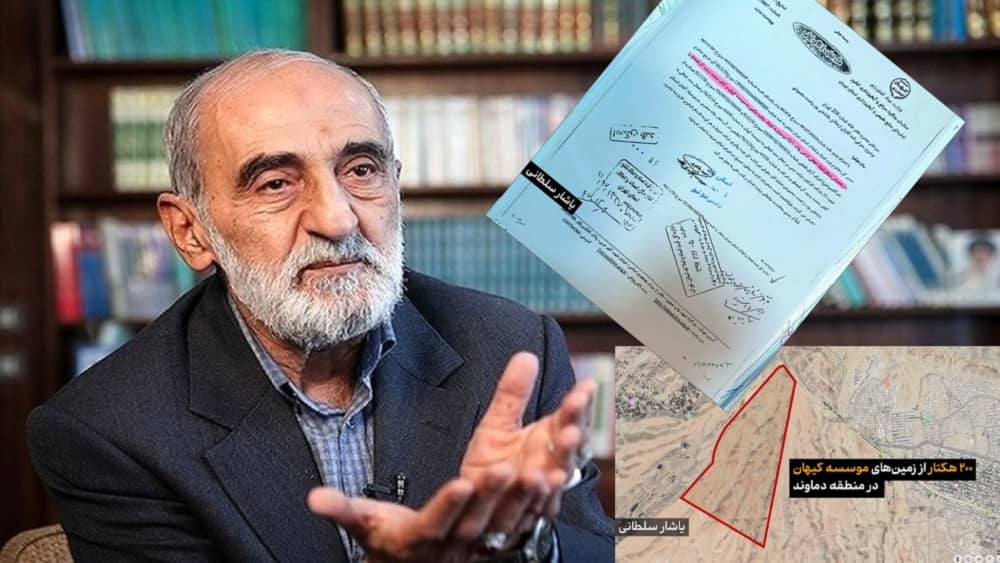
A state-affiliated reporter has recently brought attention to a major land-grabbing case involving the Kayhan Institute, an influential media organization directly overseen by Supreme Leader Ali Khamenei. The allegations, which state-controlled media have also covered, raise speculation about either an intensifying factional feud within the regime or a broader security-driven agenda at play.
The Kayhan Institute is at the center of a land dispute over 200 hectares (2 million square meters) of national land in Damavand. Despite a 2006 court ruling that deemed its ownership illegal, the institute has ignored legal mandates for nearly two decades, raising serious questions about judicial accountability and institutional corruption within the Iranian regime.
The land dispute dates back to 1996 when the final year of Ali-Akbar Hashemi Rafsanjani’s presidency saw the approval of a massive land transfer to Kayhan Institute under the pretext of “afforestation and animal husbandry.” However, internal records show that no substantial agricultural or environmental projects were ever carried out. Instead, the land was gradually turned into a restricted private estate, shielded from oversight.
In 2003, amid growing concerns over land misallocations, the regime’s Parliament passed an amendment to the Forest and Rangeland Protection Law, stating that all unauthorized land transfers since 1986 should be revoked if they failed to meet developmental goals. This triggered a legal review of multiple land deals, including Kayhan’s. The Ministry of Agriculture formally challenged the institute’s ownership and took the case to court.
Kazem Sedighi, A Khamenei Ally, Exposed to Have Grabbed Billions Worth of Land in #Iran's Capitalhttps://t.co/CmbzjfHMsP pic.twitter.com/cze9r5g7rI
— NCRI-FAC (@iran_policy) March 18, 2024
By 2006, a Tehran court ruled that the land transfer was illegitimate, ordering the revocation of Kayhan’s ownership and its conversion to a lease agreement under state control. The verdict was explicitly final and non-appealable, as per Iran’s legal framework for land restitution. However, the Kayhan Institute refused to comply, using bureaucratic delays, legal loopholes, and political influence to avoid implementation of the ruling.
Even after legal authorities attempted to enforce the judgment through the Tehran Natural Resources Office, Kayhan continued to resist, citing legal technicalities and administrative hurdles. Notably, a state notary office refused to process the land’s transfer back to public ownership, arguing that such an action would require an explicit judicial enforcement order—despite the ruling already being final.
The ongoing defiance highlights the institutionalized privilege enjoyed by entities closely aligned with the Supreme Leader. Kayhan, under the leadership of Hossein Shariatmadari, Khamenei’s appointed representative, has historically positioned itself as a hardline enforcer of the regime’s ideological agenda, advocating for strict censorship, press crackdowns, and aggressive foreign policies. However, its own refusal to abide by state law contradicts its claims of defending the “values of the revolution.”
#Iran News in Brief
According to local sources, the #IRGC is trying to expand in the Iranian #Kurdistan region by confiscating land and building bases. https://t.co/25WEIRNZrm pic.twitter.com/dW3x918C36
— NCRI-FAC (@iran_policy) May 30, 2022
The land-grabbing case also mirrors broader patterns of corruption and cronyism within Iran’s clerical establishment. Recent exposés have uncovered multiple high-ranking figures linked to illicit land acquisitions, including the Tehran Friday Prayer Leader Kazem Sedighi, who was found to have amassed billions of tomans worth of prime real estate under opaque legal arrangements.
While ordinary citizens face severe consequences for minor infractions, entities tied to the Supreme Leader operate above the law, enjoying unchecked control over public assets. The refusal of Kayhan Institute to relinquish national land, despite an unchallengeable court order, raises serious concerns over the rule of law in Iran. Whether the state will finally enforce the legal ruling or continue to allow powerful regime loyalists to evade accountability remains an open question.
Despite the revelations implicating a Khamenei-linked organization in the scandal, the information remains accessible online at the time of this reporting, an unusual occurrence given the regime’s tight control over sensitive disclosures.