

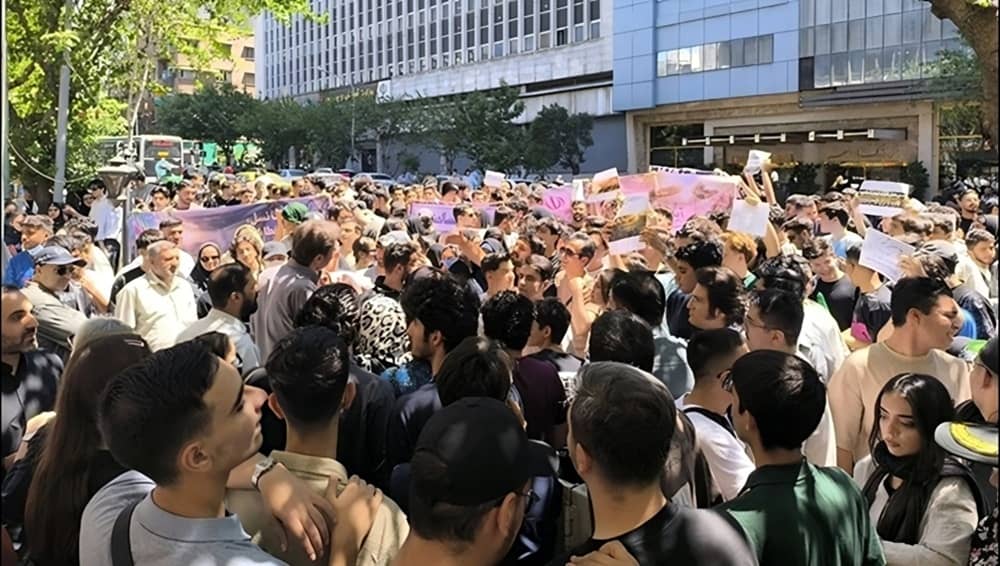
On Tuesday, June 2, 2026, widespread student protests erupted across major Iranian cities, including Tehran, Mashhad, and Hamadan, in response to sudden changes in university entrance exams and grading policies. In the capital, throngs of students gathered outside the Ministry of Education before marching toward the Supreme Council of Cultural Revolution. Staging sit-ins, the demonstrators chanted, “The student is awake, hates discrimination,” and “A student dies, but does not accept humiliation.”
“We are waiting for a result, we are not going anywhere and we are staying right here,” declared one of the protesting students in Tehran. “This generation is not a generation that will retreat with promises and repeated words; it pursues its rights.” The unrest followed a similar demonstration on Monday, June 1, 2026, when students and parents in Khorramabad rallied outside the Lorestan governor’s office, chanting, “The impact of the GPA must be positive,” and asserting that “our voices are not heard through letters.”
Despite the growing outrage, Education Minister Kazemi dismissed the students’ grievances regarding internet disruptions and severe economic pressures, explicitly stating that final exams must be held in person. This uncompromising stance mirrors a broader crackdown on the academic community. On Monday, June 1, 2026, the state-run Shargh newspaper reported an escalating wave of disciplinary actions at major universities. At Sharif University of Technology alone, between five and seven students face expulsion, while over 20 others have received suspension sentences ranging from one to three semesters.
🚨 BREAKING NEWS – #Tehran, June 2, 2026
Students are currently protesting in several areas across Tehran.
Among the slogans being chanted:
• “Students are vigilant and reject all forms of discrimination.”
• “A student may die, but will never accept humiliation.”
• “We have… pic.twitter.com/vlyjNFw6zk— Iran Freedom (@4FreedominIran) June 2, 2026
Labor Strikes and Academic Purges
The systemic crackdown extends beyond students to the faculty and labor sectors. The state-run ILNA news agency reported a nationwide gathering of dismissed university professors outside the Ministry of Education. The educators, who maintain they were illegally terminated, demanded reinstatement and an end to arbitrary security measures, noting that government officials had treated them with “vulgar and inappropriate language” rather than legal accountability.
Simultaneously, a labor crisis continues to unfold in the southwest. On Monday, June 1, 2026, municipal workers in the city of Shush entered the second consecutive day of a strike over unpaid April wages, neglected insurance contributions, and empty welfare cards. Despite facing explicit threats of termination from government institutions, the striking workers emphasized they will not end their walkout until their delayed wages and benefits are fully resolved.
These social and labor unrests are deeply intertwined with a catastrophic economic collapse. The state-run website KhabarOnline recently published a report detailing a 137 percent surge in the price of milk over the past year, attributing the leap directly to the government’s elimination of subsidized currency. According to the dairy industry’s new pricing, a 400-gram package of cheese now costs 203,000 tomans, while two kilograms of yogurt has reached 228,700 tomans.
🚨 BREAKING NEWS – More footages: Tehran, June 2, 2026
Students are currently protesting in several areas across Tehran.
Among the slogans being chanted:
• “Students are vigilant and reject all forms of discrimination.”
• “A student may die, but will never accept humiliation.”… pic.twitter.com/tOajLvR80p— Iran Freedom (@4FreedominIran) June 2, 2026
Unprecedented Inflation Reaches 80-Year High
Official statistics reveal an economy spiraling out of control. Data from the Statistical Center of Iran shows that the annual inflation rate for the period ending in May 2026 climbed to 57.7 percent—the highest officially recorded rate since the World War II occupation in 1943. Furthermore, the point-to-point inflation rate has shattered previous records, hitting a staggering 83.9 percent, while the monthly inflation rate alone spiked by 8.8 percent.
Driven by the loss of oil revenues due to international sanctions, a massive budget deficit, and the unchecked printing of fiat money, the administration is struggling to mask the severe economic reality. In an attempt to artificially suppress prices, Justice Minister Amin Hossein Rahimi announced the formation of a “unified command for market inspection” to target commercial units under the guise of combating hoarding and price gouging.
To enforce this, Rahimi explicitly called for the mobilization of “popular capacities”—a well-known state euphemism for the Basij paramilitary forces—alongside retired military and security personnel. Members of the parliament are demanding even harsher measures to militarize the economy, with MP Morteza Mahmoudi calling on the government to form a “war economy headquarters” and utilize mosques and Basij bases to inspect commercial units and root out what he called “anti-revolutionary elements.”
"The regime is weaker than at any point in recent decades, its authority eroded by successive uprisings and mounting internal and external pressures. At the same time, organized resistance inside the country has grown more resilient and more visible," write @DavidAltonHL,… pic.twitter.com/ojRk9ydkJ9
— NCRI-FAC (@iran_policy) May 28, 2026
Threats of Execution for Market Violations
The rhetoric from hardline officials has escalated to threats of lethal force against merchants. Former Foreign Minister Manouchehr Mottaki described current price hikes as “treason,” an accusation that can carry the charge of “corruption on earth” and lead to the death penalty.
Echoing this extreme stance, prominent parliamentarian Hamid Rasaee stated that the current economic conditions are akin to a state of war. He demanded that sentences against market violators be carried out in “public view and city squares” to serve as a deterrent, moving far beyond mere fines or shop closures. Meanwhile, MP Mohammad Seraj blamed digital classified apps like Divar and Sheypoor for the inflation, demanding a crackdown on the platforms.
Observers note that these draconian measures reflect the state’s deep-seated fear that the economic crisis will ignite an uncontrollable socio-political uprising. Similar heavy-handed tactics have failed spectacularly in the past; in November 2018, the state executed Vahid Mazloumin, dubbed the “Sultan of Coins,” when gold coins traded at 4 million tomans. Today, without Mazloumin, the price has skyrocketed to 185 million tomans, laying bare the systemic failure of the state’s economic governance.
The storm is coming, and no amount of narrative spinning or blame-shifting can change the regime’s fate.