
Four-minute read
The Iranian regime’s parliament formally rebuked the government’s economic management on October 27, giving Economy Minister Ali Madanizadeh a “yellow card” after 120 MPs rejected his explanation for soaring prices. The minister tried to ease pressure by conducting a speech about workers, retirees and employees being under severe inflationary pressure and apologized, but MPs confronted him with a much harsher set of figures: point-to-point inflation near 90%, annual inflation around 70%, economic growth at roughly minus 5%, liquidity approaching 19 quadrillion tomans and the free-market dollar around 270,000 tomans. One MP threatened impeachment if the government imposed another currency shock.
The confrontation goes far beyond a single minister, driven not by genuine concern for the public welfare, but by a frantic factional blame game as compounding crises deepen. Parliament reports that approximately 13 impeachment initiatives involving several ministers are now registered, with the economy minister’s own request already before the parliamentary presidium. Rather than addressing public hardship, rival factions are weaponizing these parliamentary challenges to shift responsibility and deflect accountability.
Food, bread and fuel pressures widen
Household costs continue to move faster than the government’s relief measures. Iranian state media put whole chicken at about 330,000 tomans per kilogram, with fillet reaching 873,000 tomans. Other domestic reporting says chicken had risen from roughly 280,000 to 350,000 tomans within a week in some markets. Meanwhile, the price of flour used for industrial and bulk breads has more than doubled, with the flour price reportedly nearly tripling; a large baguette is now quoted around 90,000 tomans.
Pezeshkian now says Iran cannot even plan under its permanent “neither war nor peace” crisis. State media simultaneously reports wages far below living costs, €4.07bn unpaid to food importers, 297,000 people cut from subsidies, 40% telecom price hikes and weakening #oil…
— NCRI-FAC (@iran_policy) October 24, 2026
The government is simultaneously considering narrowing food assistance. Fars reported that income deciles eight through ten could be removed from the electronic food-credit program, potentially excluding around 30% of the national population and roughly half of Tehran province.
Fuel policy is also tightening. Authorities have now restricted the use of emergency station fuel cards in 11 provinces, shifting another 50 liters of monthly consumption onto personal cards at the third-tier price of 10,000 tomans per liter. Officials say selected stations will retain emergency cards for travelers.
Agricultural arrears add another pressure point. A senior parliamentary official said around 20 trillion tomans remains owed to wheat farmers, even though the new agricultural year began about a month ago and farmers need the money to finance the next planting cycle.
Financial markets reflected the same uncertainty. The Tehran Stock Exchange fell roughly 143,000 points, dropping back below the eight-million level, while around 7.4 trillion tomans of real money reportedly left equities and equity funds. Donyaye Eqtesad meanwhile calculated the rial’s real exchange rate in October at about 258,000 tomans per dollar, approaching its previous inflation-adjusted record.
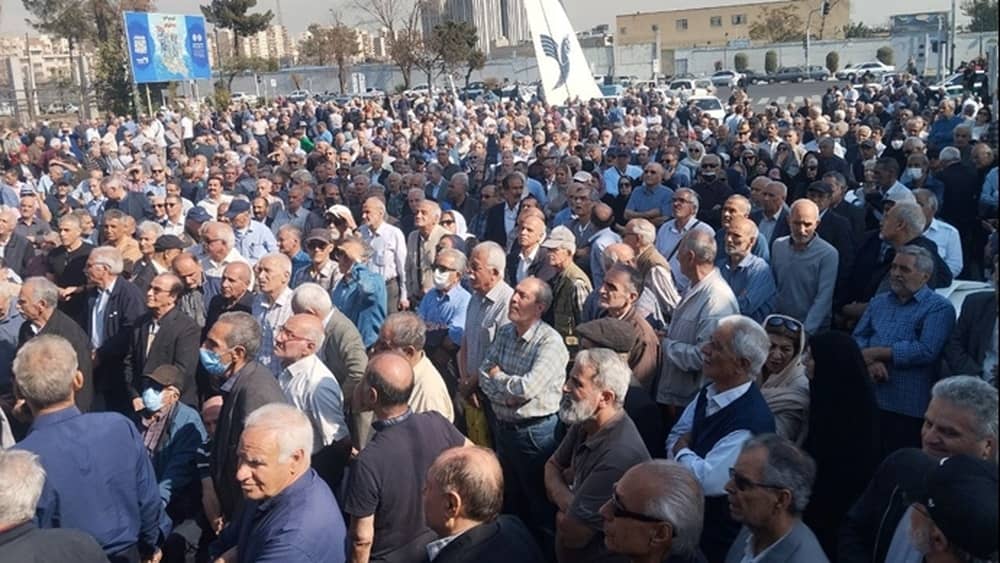
Iran is turning social pressure into a security problem: retirees protested in several cities while parliament advances “cognitive #security governance,” lawmakers insist the communications backbone remain under state control for crises, #internet shutdowns remain an option, and…
— NCRI-FAC (@iran_policy) October 25, 2026
Khash sees another major armed confrontation
Security conditions deteriorated sharply again in Khash, Sistan and Baluchestan, where armed men attacked an emergency police-unit compound and an adjoining police station on October 27. Local reporting described more than an hour of sustained gunfire, ambulances moving toward the scene and major streets being sealed. Iranian state outlets confirmed that the police facility had come under fire but did not initially provide casualty figures. Reports of security-force deaths or injuries therefore remain unverified.
The regime’s claims of firm security control are being directly undermined by incidents such as the recent takeover of the Khash–Saravan road, where an armed group operated checkpoints for several hours unhindered. This escalation, alongside persistent regional clashes, makes official assertions of restored order increasingly untenable.
The establishment argues over the crisis
Internal media warfare is sharpening alongside the economic and security pressure. The hardline newspaper Quds publicly attacked media aligned with the Paydari faction for suggesting parliament’s partial return to in-person sessions occurred only after the speaker met Mojtaba Khamenei, accusing them of dragging the regime’s leadership into their political fight with the parliamentary leadership.
Iran’s domestic pressure is widening: universities are tightening surveillance and #hijab enforcement, an armed clash erupted in Khash, state media says workers are abandoning jobs as wages collapse, officials admit persistent #poverty, and the government is rewriting its…
— NCRI-FAC (@iran_policy) October 21, 2026
Kayhan, meanwhile, has continued attacking advocates of negotiations and accommodation, portraying calls to use diplomatic opportunities as steps toward surrender. In a separate hardline commentary highlighted today, the newspaper went further in the nuclear debate by arguing that possession of nuclear weapons could have prevented the killing of the previous leader—an indication of how far parts of the establishment’s public argument over deterrence and compromise is moving.
That rhetoric contrasts sharply with Pezeshkian’s recent acknowledgment that the January unrest reflected social problems and grievances “that remain in people’s hearts and we do not hear.” Parliament’s own research arm is simultaneously warning that basic state systems remain poorly prepared for further crisis: its recent assessments say disruption of any major payment network could interrupt transactions from wholesale settlement to everyday purchases, while emergency education could exist only “on paper” if poorer, rural and displaced students lack internet access, equipment or safe routes to school.
This compounding multi-front crisis exposes the fundamental impotence of a regime whose sole remaining mechanism of survival is escalation. As economic distress fuels social hostility and security apparatuses struggle to maintain basic control, the state’s insistence on prioritizing survival over the people creates a self-reinforcing loop of instability. In doubling down on repression and factional warfare, the clerical leadership is no longer projecting strength, but rather revealing a state in terminal decay.